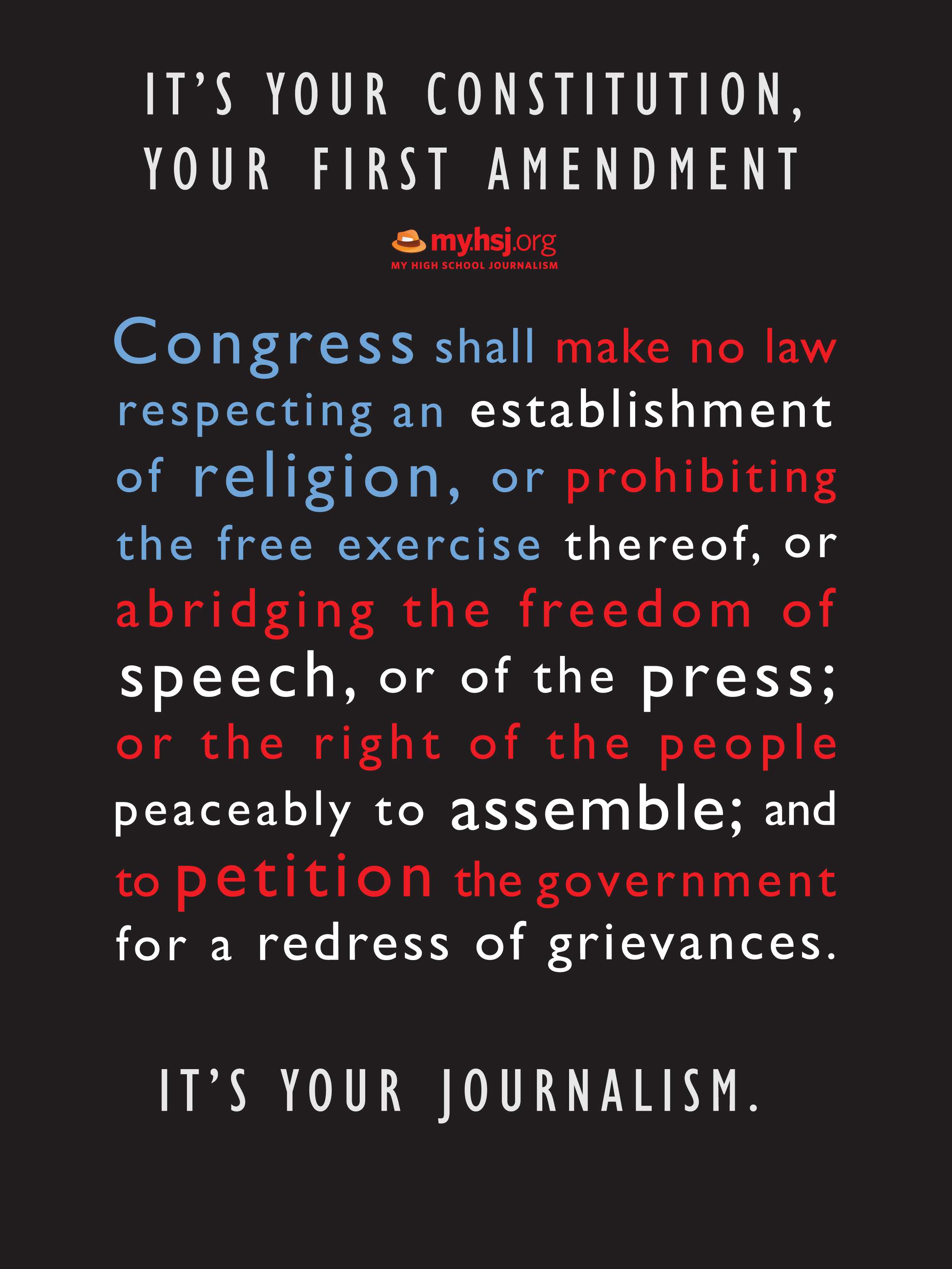
The First Amendment to the Constitution of the United States of America: we’ve reviewed it repeatedly, been versed in its implications, been made to memorize the countless examples of its violation, and have been urged to exercise our so described rights. And certainly at Newark Academy, only strict and righteous endorsement of these rights has been expected and experienced. Or so it seems.
Mlle Obydol was readily allowed to deliver a Morning Meeting presentation on identity and race; the Newark Academy community recently welcomed what some considered a controversial and at times even offensive Global Speaker, Faraj Faraj. The plethora of review committees and student-led clubs stands as a testament to the Academy’s dedication to free speech, particularly when it promotes progress. All in all, members and guests of the school community are encouraged to voice their opinions.
For this, the staff of The Minuteman should be grateful. And yet, in early November, as participants in the Columbia Scholastic Press Association’s annual journalism conference, we were once again reminded that unlike in public schools where student journalists’ rights are protected under the First Amendment, those of private school students are not. The Minuteman, unlike public school publications, cannot go to press without first being reviewed by the oft-grumble-inducing “Administration,” represented in such cases by the Dean of Students, Ms Galvin.
We understand and appreciate the administration’s desire to preemptively ensure the protection of the newspaper’s readers from insult or libel and the protection of the staff from ill-repute. As a result, we have, over the years, learned to self-regulate. Through a hierarchy of staff writers, columnists, editors, editors-in-chief, and advisors, we have learned to self-censor, and in effect have been bred to do so. But at what cost to our journalistic liberties, to the very essence of journalism, and to our community?
In this newest article set, for example, we could not publish the names of the students who compromised the Newark Academy email system, though doing so would have allowed for greater elucidation as to the problem’s causes. As we on the Minuteman‘s staff often are, we were hard put to fill our Commentary and Humor sections with “appropriate” material, especially when contending with reactions to Global Speaker Faraj Faraj’s remarks. And in a way, we have seen this self-censorship extended beyond the staff of the school newspaper to the school community at large. Through casual conversation we have heard of students and faculty members with rather strong opinions regarding various school-wide issues and incidents. Yet, when urged to express their opinions in print for The Minuteman, either in article or comment form, they quickly decline, claiming (whether sincerely or not) that their work will either be censored or, if published, damaging. Damaging, that is, in terms of the community members’ sensitivities and sensibilities.
So the question arises to be reflected upon, and can conveniently be applied to both the Newark Academy community and American society. What is more damaging to a community and a people, to the propagation of discussion-worthy opinions, and to the adventurous independence of the intellectual: an administration (or government) that explicitly denies free speech and free press to its citizens’ through conspicuous, written legislation, or a society that outwardly commends itself for upholding its members’ rights to free speech and free press and yet discreetly does otherwise? Perhaps certain written pieces in this newest article set, and perhaps this very editorial, are a step in a new direction, one in which the desire for security and conformity is replaced by the desire for frankness and truly practical and valuable dialogue.
-The Minuteman Editorial Staff


Leave a Reply
You must be logged in to post a comment.