By Louise Lamb ’11, Feature Editor
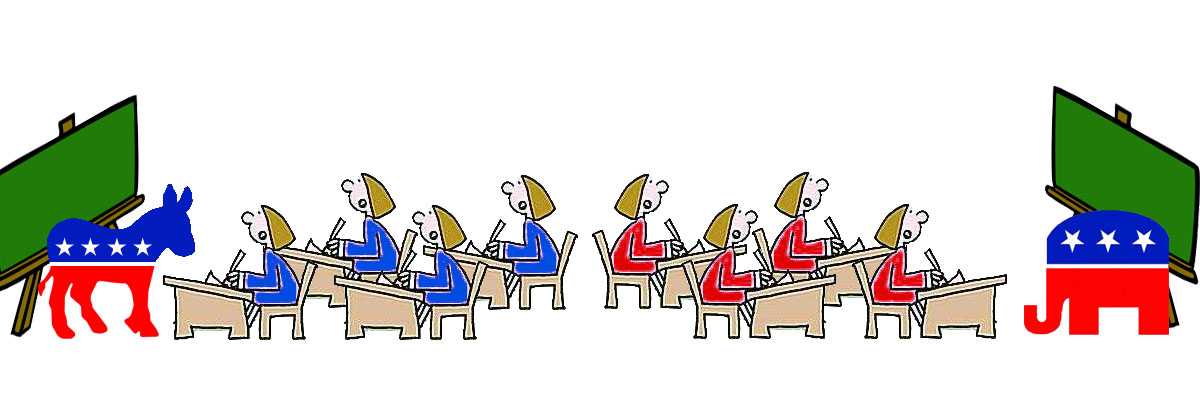
“Academic responsibility.” It is a phrase not heard very often by Newark Academy students, and yet the concept saturates our discussions and classrooms all the time much to our ignorance. Faculty members constantly work to maintain it, and students continually take it for granted. I am talking about responsibility for the education of a student. I am talking about religion. I am talking about politics. I am talking about freedom.
At Newark Academy, there is no official policy on how much, or how little, teachers should express their political opinions in the classroom, but Mr. Rollenhagen, the Dean of Faculty and an English teacher, describes an “expectation of professionalism.” He points out that faculty members “are not here to proselytize politically or religiously.”
Yet there is far more complexity to the matter than meets the eye. Mr. Rollenhagen continued by pointing out that during English class discussions, “sometimes [he does] have to say ‘this is what I believe’ about a particular issue.” Quite sincerely, he told me that “you can’t be disingenuous.” As an administrator, Mr. Rollenhagen clearly has a cut-and-dry opinion, yet as a teacher he grasps the essential dilemma at the bottom of all this. The line in the sand, or the white chalk line on the blackboard. The difference between preaching and teaching. It is acceptable to express an opinion, and it is not acceptable to force it upon students.
Upper School Principal and teacher Dr. DiBianca agrees with Mr. Rollenhagen, saying that “values emerge in relationships with students” and that sometimes, discussing politics in the classroom cannot be helped. Nonetheless, a distinction is still drawn: Dr. DiBianca notes the dangers of a teacher explicitly stating his or her political opinions. There is a possibility that knowledge of a political standing will make “kids see you through a lens.”
Other faculty members have more extreme views on the topic. Spanish teacher Dr. Schafler described the sharing of a teacher’s personal political inclinations in the classroom as “a slippery slope,” recognizing the possibility that “the student may be afraid to express an opinion” that directly opposes the teacher’s. Humanities teacher Mr. Gilbreath commented as follows: “as a history teacher, I try to play as middle of the road as possible,” noting the importance of understanding historical political opinions. He continued by declaring that explicit personal politics on the teacher’s part is “completely inappropriate.”
Evidently, teachers, to varying degrees, feel that politics in the classroom are not conducive to an open learning environment. But students feel differently. Junior Elizabeth Reisen says, “So long as [teachers] say it’s their specific opinion,” she likes to know their political inclinations. Senior Rebecca Ellis agrees. She thinks “it gives [students] more perspective,” as long as teachers are not dictating how one should feel. Doing so also helps to show students exactly what political ideologies mean.
The disparity between the opinions of teachers and students on this topic is clear. Faculty members consistently show reservation, but students believe openness makes for better understanding of a teacher’s stance on various issues. So the issue presents itself: where should the line be drawn? What is academically responsible? I cannot wave a magic wand and say I know the answer. All I can do is urge you to discuss these topics with your teachers, your students, and your peers, recalling that at Newark Academy there does exist a line, and we continually strive to know where it is and when not to cross it.
Leave a Reply
You must be logged in to post a comment.