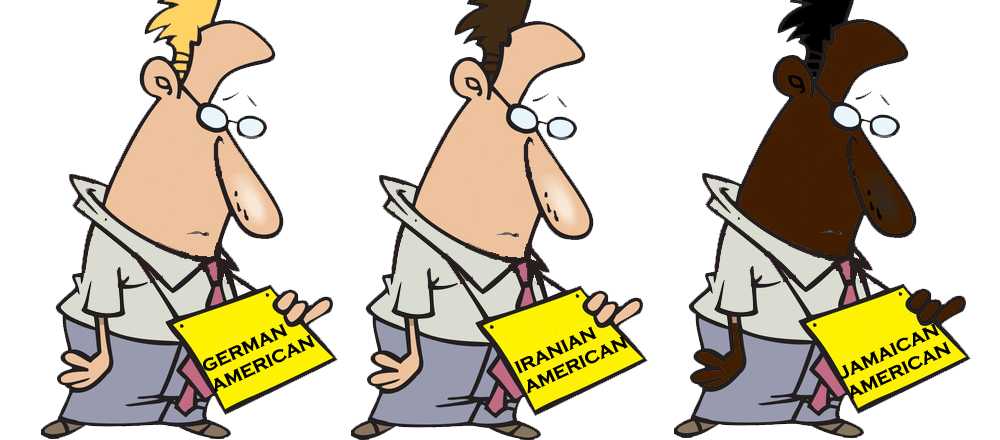
At the end of Thursday, January 13th’s Umoja Club presentation about Dr. Martin Luther King, Jr., NA faculty member Mr. Jacoby posed a thought-provoking question: Which term is better used: “African-American” or “Black”? There is no simple answer, and the question could not be answered properly in the short time available that morning. Now, however, with proper reflection, an answer to this essential question can be provided.
This question requires an examination of the following questions: Is there a difference between an African-American and a Black person, or can these terms be used interchangeably? Can one be seen as better or less offensive than the other?
At the end of the day, there is a difference between an African-American and a Black person, and the key difference arises from the word African. Not every Black person has African roots. For example, I am not African-American; my entire family is from Jamaica. While I am a Jamaican-American, I have no problem with being called an African-American because I know that some people merely use the term in an attempt to be “politically correct” when addressing people of color. Furthermore, some African-Americans are not connected to their African roots and may be uncomfortable with being labeled as “African-American.” While some see the term “Black” as harsh or rude, many people are not only fine with being called “Black,” but actually prefer it.
Even though the terms “African-American” and “Black” have distinct meanings, they are often used interchangeably in today’s society. For example, when filling out the first section of the PSATs, in the race subdivision, there is no separate bubble for “African-American” and “Black.” Instead, there is an “American-American/Black” bubble.
People who take immediate offense when others do not classify their ethnicity properly will have a rather difficult time in today’s society. People who accidentally use the term “African-American” inappropriately are almost never aiming to be offensive or insensitive. Furthermore, most people who opt for “Black” are not trying to be rude.
“Black” is the only sure way to classify a colored person whose roots you are unfamiliar with. After all, this is merely a description of a physical characteristic. For example, there are several different types of Caucasian people, often with quite distinct roots. However, there rarely exists any focus on the difference between a Caucasian person with Italian roots and one with German roots. This is because calling someone “white” is considered to be on the same level as calling that person “blonde”; it is an observation of appearance.
To properly distinguish every person of color as African-American or Black or even Jamaican-American would require you to begin every conversation with, “What race are you?” and “With what culture do you identify yourself?” In the long run this could, quite possibly, offend more people than it would please. While the technically-accurate term to use is singular to each person, “Black” and “white” are general terms of physical description that are not meant to be offensive.
When Mr. Jacoby asked his question in Morning Meeting, he had a host of Black students to answer him, considering the club is nearly 100% Black. However, Umoja is not the “Black club” it is commonly seen as being. “Umoja” means unity in Swahili, and at its base, Umoja is meant to be a diversity club. If there had been more diversity on the stage, I do not believe the question would have been asked. Umoja members inevitably face difficulties in attempting to discuss issues dealing with race relations at their meetings because the club lacks representation from other ethnic groups. Hopefully the Umoja club will build a greater forum of race representation in the future.
The intelligent Newark Academy community has the great ability to discuss issues relevant to the past, the present, and the future of our world. After the Umoja club’s Morning Meeting presentation, I sat at a lunch table with Italian, Indian, African, Iranian, and Irish-American friends who all discussed, with great enthusiasm and passion, the issues that had been raised that morning. This proved to me that whether part of the minority or the majority, individuals at Newark Academy care deeply about the issues of race relations in society. We should not pretend that the world is fully integrated, nor should we ignore the issues that arise from race divisions. At Newark Academy, we should talk about them.
Leave a Reply
You must be logged in to post a comment.