By Kevin Lin ’15, Staff Writer
Muammar al-Gaddafi’s was killed on October 20th, 2011. Gaddafi is well-known for his abusive treatment of his people, and the abusive treatment of other nations. Ever since he came to power through his military coup in 1969, he removed all U.S. and British military bases in Libya, banned Western communities in Libya, and stole all foreign-owned petroleum resources. In addition to the cruel treatment of his people, Gaddafi also directed this treatment to other countries.
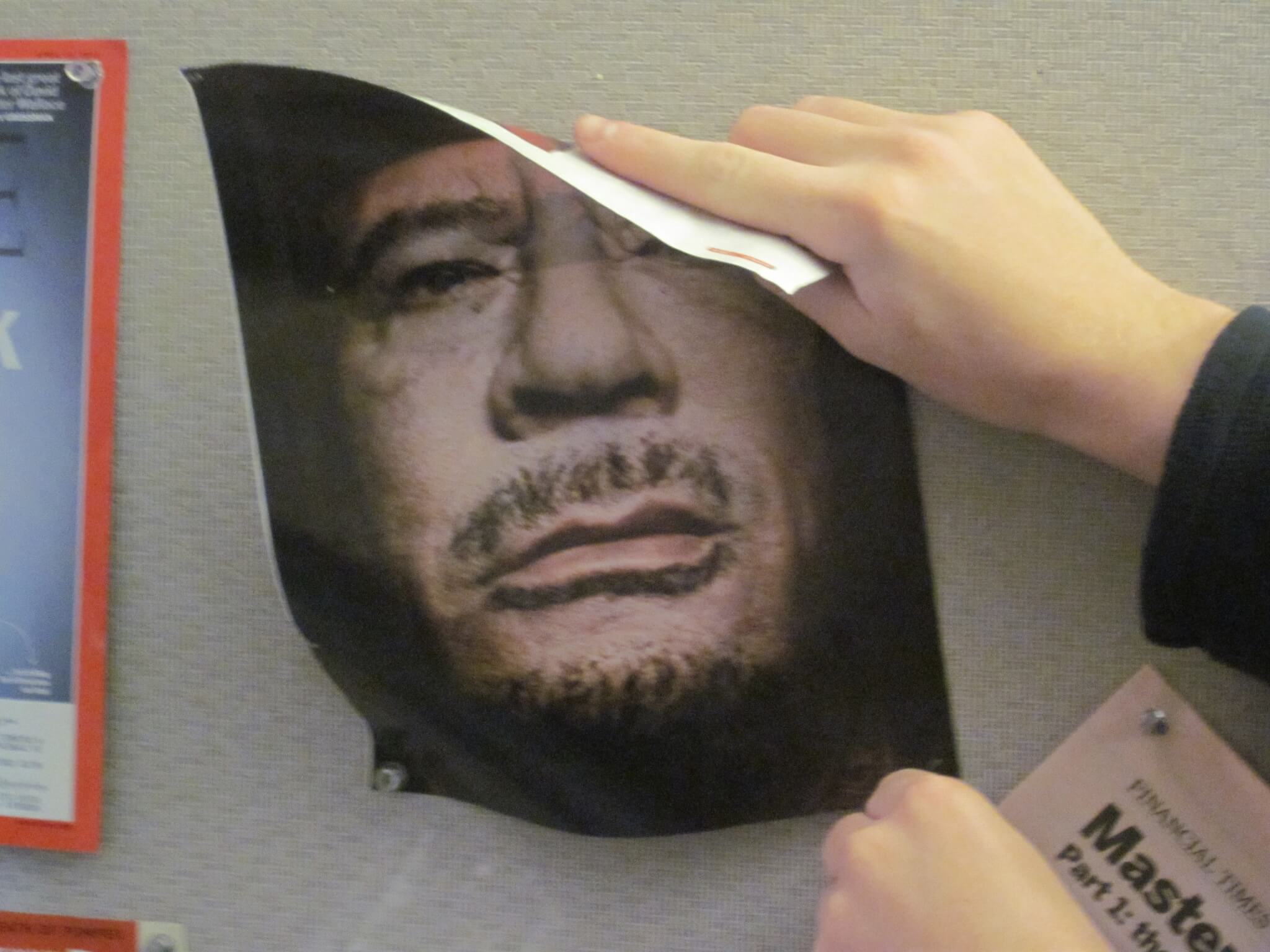
Gaddafi sent SU-22 fighter jets to the coasts of the U.S., bombed the Lockerbie airplane, and bombed an American soldier-filled nightclub in Berlin. Finally in February of 2011, the people of Libya fought with Gaddafi and slowly took control of the country. The news then suddenly came recently that the rebels had succeeded and that Gaddafi was finally dead.
When asked how N.A. as a school should respond to the Libyan War, humanities teacher, Ms. Fischer, believed that, “Hopefully at the vary least it can spark conversations about the history of colonization, the definition of freedom, the use of social media/the Internet to spread ideas and report events, the issues with oppressive forms of government, and a host of other topics.” With the belief that we as a community should respond to the War with awareness, the students of N.A. had another perspective. Perrin Clark ’15 says, “America as a country should not intervene with the whereabouts of Libya. The citizens and rebels have a right to defend themselves, and in addition with our economy not being at its best, our money should not be spent frivolously. America should stay out of their business and mind our own.”
In his time, Colonel Gaddafi was perceived by many as a “bully.” After the 1977 coup, in which Gaddafi first gain power, he ruled with an iron fist. He had little tolerence for dissent, and ensured that none of it affected his administration. After considering this style of governance, I pondered bullying on a more microcosmic scale – mainly, at Newark Academy.
Perrin Clark 15’ says, “Bullying should be stopped right away from the beginning. If it is not stopped, the circumstances and situation will only worsen. Giving advice on how to stop bullying is easy, while actually carrying out the stoppage is more difficult. To stop bullying, we must intervene as a community and carry out our actions.” Is bullying a problem at N.A.? Sam Rosenberg ’15 says, “I would say that is not, because I have not seen a lot of bullying at this school since I have been here.” If bullying does ever occur at Newark Academy or any other school, how should we deal with it? Jason Li ’15 states, “Aggression should only be responded to, on a global and local scale, depending on its extremity. If an individual or group is only joking around, time and effort should not be wasted towards them. Though, if violence becomes a factor of bullying, the authorities should be contacted immediately.”
All in all, Muammar al-Gaddafi’s death does not symbolize the end of evil in the world. We as the community of Newark Academy, should still learn how to deal with the violence and aggressors in our lives.
Leave a Reply
You must be logged in to post a comment.