By Zachary Gross ’14 and William Ulrich’14, Staff Writers
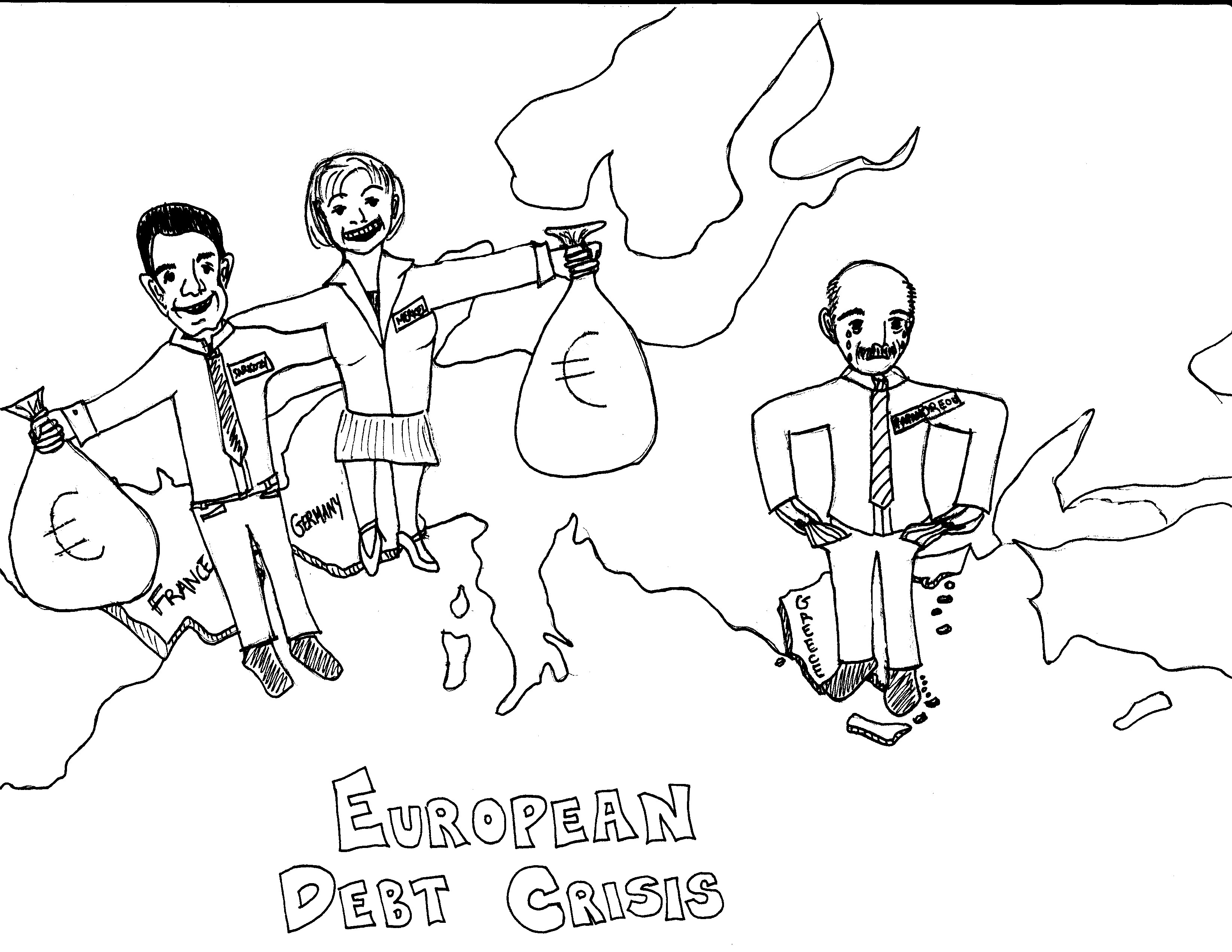
Mr. Gilbreath, a member of our own Newark Academy faculty noted for his economic acumen cautioned, “If the Eurozone fails, then everything will crumble and I may be forced to eat my students.” Although it was intended as a joke, Mr. Gilbreath is expressing a very valid concern: fear of the direction that the Eurozone is currently heading. The term Eurozone refers to the monetary and economic union between 17 of the European Union’s 27 member states. Launched in 1999 the Eurozone was born out of the 1992 Treaty of Maastricht, the goal of which was to establish a common currency, the Euro.
Fear of a potential disaster has been causing havoc in the stock market as investors fear the possible recession and its effects on their investments. The crisis itself is caused from the rising sovereign debt of specific member nations of the Eurozone, often refered to in financial media as the PIGS – Portugal, Italy, Greece & Spain. Greece the current leading concern because it has dangerous debt levels and is on its way to default on loans that were bought by private investors. Greece is not the only country in debt and the Eurozone wants to protect itself from being too affected by their members’ debt. As the Eurozone crisis remains unresolved the feeling lingers of whether the group of 17 European nations can settle upon an effective solution to the problem.
Currently, Greece’s bailout money is running thin, and it needs another aid package. Recently, another round of bailout money has been allocated to the Greeks, however with it comes a wide array of austerity measures, government layoffs, and a means of enforcing reforms that seem to infringe on Greece’s national sovereignty – three components that have outraged the Greek populace. Former Prime Minister George Papandreou faced a lot of pressure from those on both sides of the issue, leading to his resignation. On one hand, he knows that Greece needs funds to stave off an impending catastrophic default on its debt; however on the other hand, he understands the outrage from the general populace. Lucas Papademos, who formerly worked at the European Central Bank, is set to lead a new “unity” government.
Prior to stepping down, and in order to gain back the favor of his people, Papandreou called for a referendum on the bailout package, a vote that if voted against would lead Greece towards collapse. This decision shocked many European leaders, and eventually Papandreou cancelled it, once he got support from opposition leaders, notably Antonis Samaras.
Although current talks are focused primarily on Greece, countries like Italy and Spain may need massive bailouts themselves. In fact, Italian Prime Minister Silvio Berlusconi resigned after parliament passed austerity measures. In order to be able to support these two countries the Eurozone is designing a plan for a €1 trillion” firewall” in order to be prepared for the other countries that are currently building up sovereign debt. While this is a great idea it has only led to questions of where the money shall come from and who really should be entitled to it. This has left more stable countries such as Germany in a very uncomfortable place; should it help out its fellow EU member by giving them loans and risk possibly hurting their own economy, or should it resist calls for loans in order to protect its own economic interests and stability? Nations like China that are exterior of the Eurozone have even been considered possible “donors” because of a recession may have on their own market.
However, this debate has not stopped the International Monetary Fund, or IMF, an agency dedicated to helping countries out of economic crises, from creating a huge bailout package of $160 billion for Greece in 2010 and a contingency fund of $680 billion for the entire European Union.
As members of the Newark Academy community, it is imperative that we keep a cautious eye towards Europe. Although the European Union might not provide the funding for any our day-to-day lives, it is a substantial cog in the wheel of the world economy. Should it malfunction, the destabilizing effect it would have in Europe would be catastrophic. Ripples from the magnitude of the collapse of the entire European economy would surely rock us in America, too. It would open the door for the further breakdown of the world economy and digging us further into our economic downturn. It could even, potentially, cause teachers to eat their students.
Leave a Reply
You must be logged in to post a comment.