By Megha Poddar ’15, Staff Writer
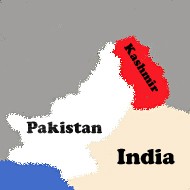
In 1947, India and Pakistan won independence from Britain. The now fabled region of Kashmir, which was predominantly Muslim, was given a choice of which country to be governed by. Supposedly, India was for the Hindus and Pakistan, the Muslims. Maharaja Hari Singh, the leader of Kashmir, preferred to form an independent state but allowed India to rule in return for military protection.
Since this partition, India and Pakistan have fought two wars over Kashmir, and there is still an abundance of tension between the two countries. Lately, it seems as though the two countries are slowly easing the tension and forming a stronger bond as the Pakistani Cabinet announced it would normalize trade relations with India. Despite these efforts, many still believe that another war is on the horizon. A student who wishes to remain unnamed said, “Pakistan and India should not have split up in the first place. They need to settle their religious differences and unite and form a stronger nation rather then fighting over Kashmir.” In other words, if the Pakistani government cannot accept the Kashmiri religious differences, then they should go to India where there is a greater religious tolerance.
Mr. Ball, an eighth grade Humanities teacher believes that it would be “wise for the people of Kashmir to be able to determine their destiny and future.” Rather than allowing others to decide the fate of Kashmir, the Kashmiris should be able to decide whether they want to belong to India, Pakistan, or even become an independent state. In a perfect world that is possible; however, in this scenario that would entail even more violence than wanted or needed.
For the U.S., this conflict could be threatening to our government and people. In fact, Senator Bob Graham warns that, “Americans should be gravely concerned; we should have and we need today to apply more diplomatic effort to resolve that [Kashmir] issue.” This would mean even more American involvement in other countries. Both Pakistan and India are allies with us on the war on terror; in this way, the government is trying to protect the relationship between our allies. However, Lila Rimalovski ’15 believes that, “America should stay out of it because there have been no positive effects of their involvement in the past.”
Leave a Reply
You must be logged in to post a comment.