By Trevor Williams ’13, Staff Writer
I have a long night ahead of me.
As I sit down to write this, I cannot goof around. I have to stay awake. I have to pay attention. I must be mindful of my responsibilities: I am a father, at least for today. Luckily I have a partner to help me through it. Today Molly Buckley ’13 is a loving mother and I am a loving father. We have to take care of a baby for twenty three and a half hours. It is a mechanical baby, of course, but it is far from inanimate. It behaves like a real baby. We have to treat it like a real baby. If it cries, we have to make it stop crying. We do this by sticking keys in its back; there are keys for attention, diaper change, feeding, and burping. We have to keep on our toes—if we do not pay attention, the baby may die. That’s parenthood for you.
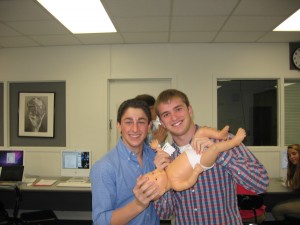
This is one of the critically important parts of the Newark Academy curriculum. It is a subset of the family project in eleventh grade health.In this project, students receive imaginary jobs and salaries. Then they have to make lives for themselves. They decide where they want to live and how they want to live. It is for many the first taste of life after high school.
I cannot praise the project highly enough. Though the premise is simple, the ramifications are not. It is a brilliant exercise, and should be required for every student at every high school across the nation.
For almost my entire life, I have gone to class. My head—like the head of any NA student—is a veritable cornucopia of material from Taylor series to Tetzel. Sometimes it is easy, however, to get bogged down in academia and lose sight of the basics. I have learned a ton of valuable intellectual information, but I have not learned a great deal of equally valuable practical information. This is where the family project comes in. It teaches how to pay bills, how to balance a budget, and how to make tough decisions about where the next paycheck is going. It is universally applicable. Few people need to be experts on lysosomes in order to be successful in life. All people need to know how to handle their personal finances.
The project is imperfect—in the end, it cannot possibly account for the complexity of modern life. All the same, it does an excellent job of getting students to think about decision making and giving students the tools with which to do it. Mr. Gertler, faculty member and health teacher, summed it up best: “Students really gain an appreciation of what their parents do.” Each day I spend money, directly or not, without even thinking about it. I use things without thinking about how much they cost and without considering how they fit into the bigger picture of a family budget. This is why the family project is so vitally important. It is critical to learn about family and finances before graduating into the world.
Leave a Reply
You must be logged in to post a comment.