By Sara Widmann ’15, Staff Writer
In early September, a crude, amateur video entitled “The Innocence of Muslims” gained fame on YouTube, causing a firestorm of demonstrations and violent protests in the Muslim world. It was written and produced in California by a man named Nakoula Basseley Nakoula, an Egyptian born U.S. resident who has a criminal history and frequently uses aliases. The video depicts the Prophet Muhammad as a womanizer and fool, and its intention is to insult and undermine the foundations of Islam. Originally released in June, the video received little American reaction given its unprofessional production and ridiculous content. However, once it was released with Arabic subtitles, right before the anniversary of the September 11th attacks, it became a focus of anger throughout the Muslim world.
The film launched a series of protests against the United States and other Western countries in the middle east, and began a series of dark days for the region. On September 11th, rioters attacked the U.S. diplomatic mission in Cairo, Egypt. On the same day, the U.S. consulate in Benghazi, Libya was attacked and the U.S. Ambassador J. Christopher Stevens along with three others were murdered. Original reports from the U.S. Government blamed the attack on over-aggressive responses to the video itself, but more informed reports since have deemed it a pre-meditated act of terrorism. Nevertheless, it was yet another act of aggression against a broad Western ideology (part of which was represented by the religious ignorance in the film) that has been demonized by many groups in the middle east. Since September 11th, protests have occurred in Yemen, Tunisia, Pakistan, and Afghanistan. In all, the riots have caused hundreds of deaths and injuries.
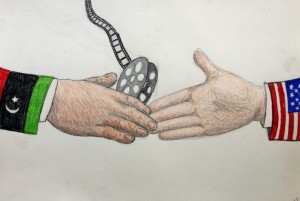
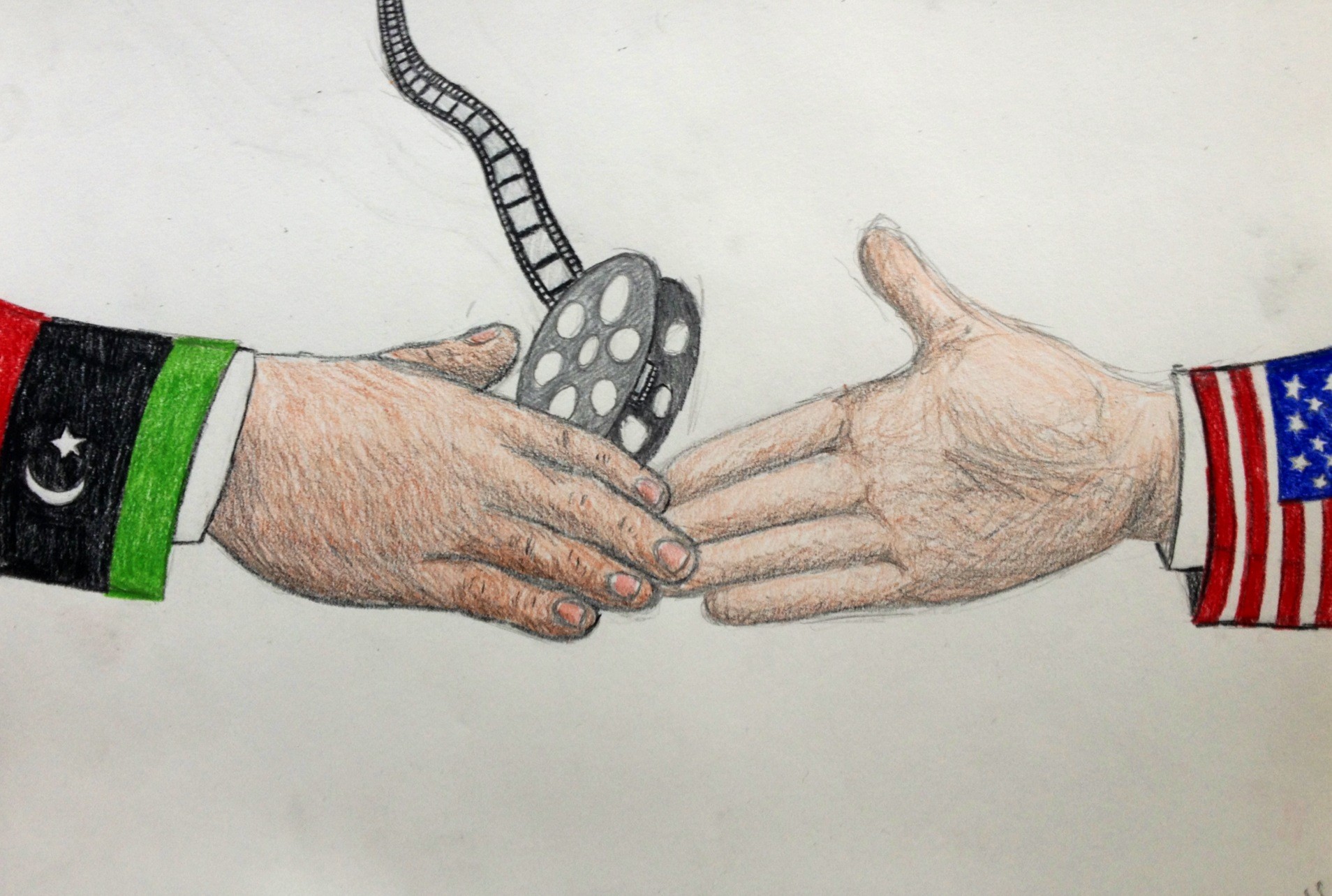
- A film so based in hatred makes diplomacy a difficult task. Drawing by Maia Yoshida ’14, Image Staff.
Although the series of protests can’t be solely attributed to the video, the fact that it is such a contentious talking point (even now, during presidential debates more than a month later) speaks to the raw power of social media. It can clearly be used with malicious intent. One angry, ignorant person can influence the opinions of millions and create havoc around the world simply by clicking the upload button.
The school community produced strong reactions to the film. Humanities teacher Mrs. Schottland, who teaches Islam in her classes, characterized the video as a “cheap, horrible production that is incredibly offensive and misconstruing to Islamic teachings of Muhammad.” Even so, Mrs. Schottland chose to show it to her Politics of Change class to use it as “a teaching tool to show an example of a vehicle of hatred and the consequences of grotesque stereotyping.”
Mrs. Powell, another Humanities teacher, was asked about the film and the power of social media. She believes that social media “changes the conversation, giving individuals a greater platform to assert their opinions, political, religious, or otherwise.” As a result, “freedom of speech becomes a more complicated matter.”
Social media today is provoking a debate surrounding the issue freedom of speech – to what extent can we continue to allow uses of the internet that create violence? After the recent events in the middle east, this question has become increasingly more complex.
Leave a Reply
You must be logged in to post a comment.