By Trevor Williams `13, Commentary Editor
The opening chapter of the 2012 fall sports season has been unlike any other in the long history of Newark Academy athletics. For the first time, the women’s and men’s soccer squads play their home games on a field of artificial turf rather than of natural grass. The benefits are certainly vast: better athlete performance, ease of scheduling, boosted fan spirit and support, and the enhanced reputation of the Academy’s athletics programs, just to name a few. There are also downsides, such as financial cost and turf-specific injuries. This piece, however, is not an exhaustive analysis of the merits and demerits of the turf. It aims only to consider Newark Academy’s turf experiment from an environmental perspective.
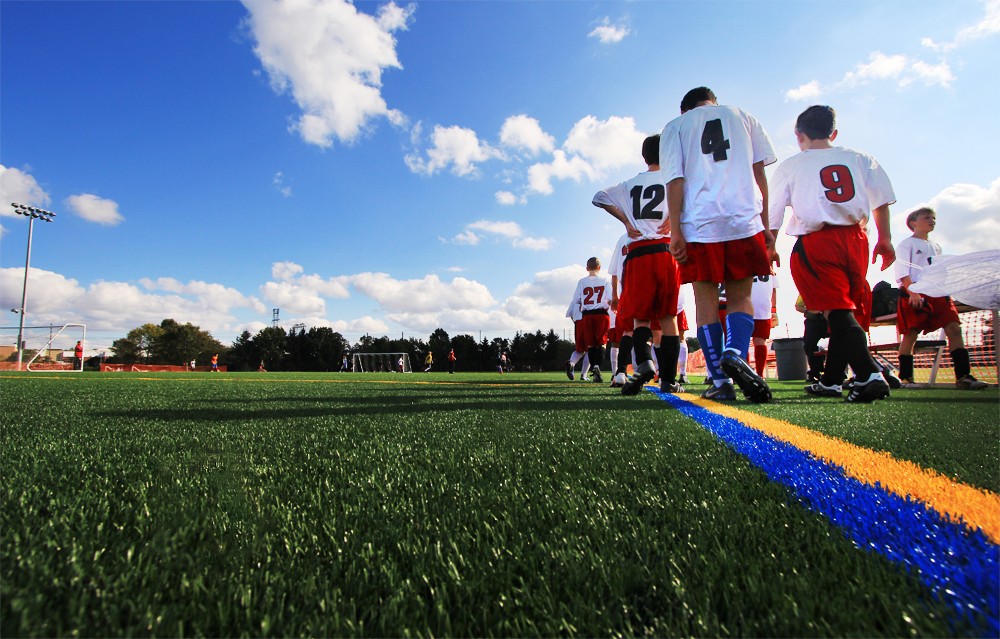
It should be obvious that the construction of a turf field is far more resource-intensive than building a grass surface. The turf requires a “huge input” to build, according to Mr. Huber, English teacher and Green Committee adviser. The components are either wholly synthetic (such as the plastic grass) or heavily processed (like the recycled rubber pellets that go into the lining). To fail to appreciate the tremendous capacity of modern industry is to fail to understand all that goes into building a turf field. By comparison, nature does the preponderance of the work when it comes to initially preparing a grass surface. Evaluating turf and grass in tandem, it seems obvious that the title of “least-intensive construction” goes to grass.
Maintenance, however, is another issue altogether. Preparing a grass surface for a game is fantastically difficult. While we find lush green velvet very appealing, we all too often ignore all the resources that go into it. Keeping grass in playable condition requires all variety of machines like “mowers, tillers, and plug aerators” as well as “fertilizers and additives,” said Mr. Huber. The fields have to be irrigated and kept free of weeds and pests. All this maintenance is petroleum-intensive. A 2005 report prepared by the San Francisco Department of Recreation and Parks cited a figure of $42,000 in annual maintenance fees for a natural grass playing field. This is money that goes toward purchasing gasoline for mowers, for example, as well as pesticides and fertilizers. Even though the Newark Academy grounds crew has a comparatively low-impact maintenance routine and uses “generally innocuous” materials, according to Mr. Huber, keeping a grass playing field does take a toll (however minimal) on the environment. The contrast to synthetic turf is stark: once a turf field is installed, maintenance is negligible. Reinstalling the turf every ten to fifteen years is the only resource-intensive task. Otherwise, turf requires none of the machine work that goes into grass.
There are other environmental considerations associated with synthetic turf. Water is certainly an issue with synthetic material. Plastic does not retain water like grass does, which leads to 1) very high field temperatures and 2) potential runoff and flooding. Because the Newark Academy campus borders the Passaic River, the latter issue is of special concern. Mr. Erlandson, the AP/IB Environmental Studies teacher, said it seems likely that “the turf will accelerate the rate of runoff into the Passaic River.”
Another issue, though a less alarming one, is the supposed emission or leaching of hazardous chemicals from the plastic and rubber materials that compose a turf field. No naïveté intended, but it seems likely that turf is no more or less harmful than anything else around school. There are, in the modern age, plenty of other toxins to worry about. A 2010 environmental review of the impacts of synthetic turf prepared by the Connecticut Academy of Science and Engineering found no evidence that turf presents a toxic risk to either human health or to the environment.
Clearly there are both environmental advantages and disadvantages to the turf, and on balance no final or unequivocal determination may be yet made as to its impact. There are convincing arguments for both sides. The analysis will have to wait for several years, or at least until the consequences are more readily apparent.
Leave a Reply
You must be logged in to post a comment.