By Courtney Cooperman `16, Staff Writer
Technology and politics are indisputably connected. The evolution of media in particular has revolutionized the ways in which voters formulate their opinions on one candidate or another. For example, the televised presidential debates, which were a technological and political innovation at their commencement fifty years ago, give voters a chance to see the candidates’ viewpoints closely and (at least in theory) to make informed decisions.
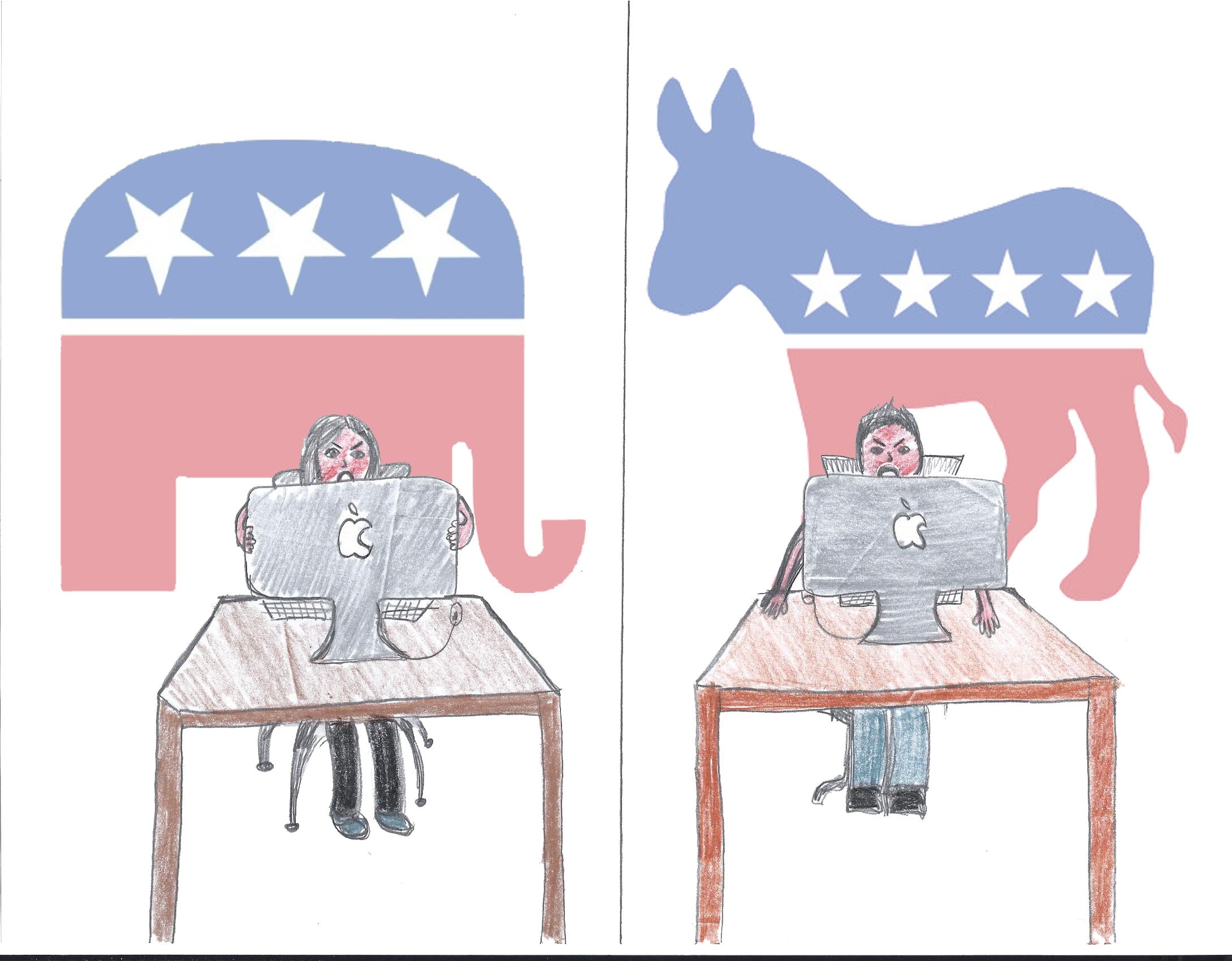
The TV screen is not the only technological medium on which political discussions and debates have unfolded during this election season. Social media has become another common platform to state, share, and dispute political views. Social media is a simple and accessible outlet for political discourse, but the common tendency of users to post without careful consideration beforehand is always an issue.
Students at Newark Academy are encouraged to be aware of this country’s current events and to express opinions. Social media takes these objectives outside of the classroom. It engages students who might otherwise be disinterested in politics, and it allows political conversation to continue long after the school day ends.
As summarized by Mr. Vinikoor, the Humanities Department Chair who delivered a Morning Meeting presentation on politics and political bias, “Unlike traditional one-way communications media…social media has the potential to enrich political conversation by engaging more people.” It can also “encourage political action by creating channels that allow people to communicate who might otherwise have had difficulty connecting.” Social media’s involvement in the political world is “undeniable and irreversible.” Its role in political discourse can bring diverse outlooks, allow for increased participation and expression, and be a powerful and beneficial tool that permits students to partake in political discourse.
Clearly, social media has revolutionary potential, but it can be easily misused. As described by Mrs. Schottland of the Humanities Department, social media is “an interesting way of further expressing ideas and exchanging ideas if the forum is true and honest, if we’re not co-opting someone’s identity or using it for a message of hate.” Keeping the discussions honest and respectful poses a challenge in any debate, whether online or offline, and the seemingly impersonal and removed nature of social media magnifies this issue. When we speak face-to-face, we generally filter insolent comments because we are so obviously accountable for our spoken words. However, online it is much easier to forget or ignore the consequences of offensive remarks. As stated by Young Democrats Club president Eric Schwed `14, “the discussion almost invariably turns offensive or divisive” when heated or personal issues are involved, as is often the case in a political debate. Students must exercise caution and civility online.
Social media is a novel method of connection and expression. But using social media as a platform for debate should not entail disrespect. Social media can have a positive influence on citizens’ involvement in the processes of democracy. However, its benefits are outweighed by the detriments if the platform is used for thoughtless, offensive political commentary rather than well-mannered discussion. If social media cannot be used considerately in political debates, then perhaps we should stick to more traditional forms of communicating our perspectives.
Leave a Reply
You must be logged in to post a comment.