By Megha Poddar ’15, News Editor
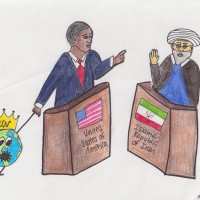
On September 27th, President Barack Obama spoke with President Hassan Rouhani of Iran over the telephone, signaling the first direct conversation between the leaders of the alienated countries since the Iran Hostage Crisis in 1979. For the past thirty years, the United States has imposed a wide range of sanctions on Iran and has broken off all official diplomatic ties with the government. However, after a generation of deep mistrust between the two countries, the leaders’ discussion served as a starting point for conducting talks on Iran’s nuclear program and renewing the relations between the estranged countries.
Elected in August, the new administration directed by the moderate President Rouhani, succeeded the one directed by the conservative Mahmoud Ahmadinejad. The new government has pledged transparency on Iran’s nuclear program, hoping to engage with the international community in an effort to lift sanctions. Though President Rouhani was elected by winning over 50% of the popular vote, Zach Persing ’15, a member of Think Tank, highlights the fact that, “Despite common belief, Iran is no democracy but rather [still] an unstable theocracy.” In fact, the elections conducted there are far from democratic as all candidates must be approved by Ayatollah Ali Khameni, the spiritual leader of Iran. Even though Iran is governed by a theocracy, Mallika Reddy ’16, another member of Think Tank, believes, “the new leader seems at least somewhat enlightened, showing there still maybe hope for a country that has been ruled by despotic mullahs.” Similarly, Mrs. Schottland, humanities teacher, who teaches Politics of Change, expressed, “there seems to be a positive shift in Iran under the new administration, at least in terms of reaching out to the west.” While it may be some time before Iran begins embracing the ideals of democracy, President Rouhani has publicly stated his hopes to reinvigorate Iran’s ties with the United States. Attempting to rectify the countries’ history of hostility, President Rouhani’s goal is now working towards future solutions in international relations.

In light of the ongoing talks, members of the Newark Academy community stand firm upon the notion that though the talks could potentially pave the way for cordial relations, the negotiations should be taken cautiously given Iran’s track record. In fact, Jake Cohen ’14, president of Think Tank, strongly asserts his view that, “Iran has repeatedly ‘committed’ to allowing inspectors to view their nuclear programs, and repeatedly revoked those commitments. I think that we will look back on this some years down the road and ask the question: why did we ever think we can trust them?” Given Iran’s history with the United States, Jake Cohen expresses a common view that questions whether the intentions of the Iranian government can ever be trusted. Zach Persing similarly stated that, “the Obama administration has shown great ineptitude and a lack of leadership regarding the crisis. Iran has made great strides towards manufacturing a nuclear weapon during the five years that Obama has been in office. If this failure by the Obama administration is not remedied then the security of the United States and our allies, especially Israel, will be in grave danger.” The United States does have a strong allegiance to Israel, and Iran’s development of nuclear weapons creates a an imbalance of power in the Middle East that is quite fragile in terms of security issues. Despite this, Mrs. Schottland cannot help but ask: “Why shouldn’t the nuclear discussions be a moment where we could maybe talk with each other and attempt to reach out to the Iranian people.”
After 30 years, the nuclear talks between the United States and Iran leave members of Newark Academy split between optimistic and pessimistic outlooks regarding the delicate situation in the Middle East. Mrs. Schottland encapsulates the situation when saying, “I believe the people of Iran, aside from the government of Iran, are ready for this new era to begin.” Only time can tell whether these two countries are really ready to move forward, leaving behind the events that have stained the past relationship in pursuit of new and peaceful international order.
Leave a Reply
You must be logged in to post a comment.