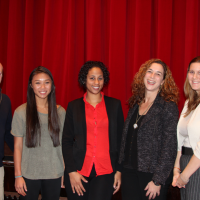
By Anna Hope Emerson ’16, News Staff Writer

As the clock nears 11:30, you struggle to concentrate in class as your stomach grumbles. Fifteen minutes seems like an eternity as you wait outside the cafeteria, until the clock finally reaches 11:45. Once inside, you are served a filling and healthy meal. The only thing you had to do was wait for it.
Unfortunately, access to healthy food is something that we take for granted. Approximately 49,000,000 Americans live in food insecure households, meaning that they lack consistent access to adequate food. In light of Hunger and Poverty Awareness Month, the Community Service Council collaborated with the Global Speaker Series to bring filmmaker Kristi Jacobson to Newark Academy on November 14, in order to discuss the topic of hunger and food insecurity in America. “We wanted to educate the Newark Academy community about global, national, and local issues relating to hunger and poverty that are often overlooked,” said Paige Willian ’16, a member of the Community Service Council.
Jacobsen is an acclaimed director and producer of many nonfiction films. One of her most famous works is a documentary titled A Place at the Table, which she co-directed with Lori Silverbush. The excerpt shown to the Newark Academy community features the stories of three different people struggling with food insecurity—Rosie, a fifth grader from Colorado; Barbie, a single mother from Philadelphia; and Tremonica, a second grader from Mississippi. They all shared their stories through film, poignantly showing us the impact that food insecurity has on a family on a very personal level. “A lot of the techniques she used in the film, such as using the firsthand stories of the children, really helped to evoke emotions of shock,” said Matt Theckkethala ’15. In addition to Jacobson, Newark Academy also had the pleasure of hosting Barbie Izquierdo, whose story is one of the main components of the film.
The main goal of this presentation, and of Hunger and Poverty Awareness Month in general, is a simple one: to start a conversation. Ms. Fischer, head of the Community Service Council, said “I hoped this presentation would raise the issue, raise awareness of the fact that this is a problem and the extent to which it is a problem.” Evidently, the presentation met this goal. “Before the presentation, I knew of this issue but I did not know that it was this widespread. The statistics were very startling,” said Mauranda Men ’16.
But how is this dire issue tangible in our day-to-day lives? Thankfully, the majority of the Newark Academy community lives in food secure households. Thus, the importance of studying food insecurity is not to teach us how to deal with it in our own lives, but to remind us that we have a responsibility to give back. Ms. Fischer continued, “I wanted to have students think about why they serve, and to think about the social justice issues that are behind all of the things that we do in service.” Zoe Rollenhagen ’14 made a similar point. “Community service is extremely important,” she said. “You need to see problems that are happening in the world, even if you aren’t experiencing them yourself.”
Jacobson’s film, presentation, and subsequent breakout sessions enlightened us on this severe problem in our country and reminded us of the importance of community service.
Leave a Reply
You must be logged in to post a comment.