Note: This is the second part in a five part series on Feminism and Gender Roles
By Matt Thekkethala ’15, Feature Staff Writer

“I posted something on Facebook” is a common introductory sentence for an explanation of an intense, emotional online debate nowadays at Newark Academy. Liberals, conservatives, feminists, and students who merely comment the occasional “Fight! Fight! Fight!” all come together to partake in the controversy. In the past week, I’ve witnessed several of these impersonal yet strangely impassioned debates ranging from topics like possible racism at the Grammy Awards to salary-related discrepancies at GM.
I rarely partake in such conversations, for a variety of reasons. It’s not that I don’t have an opinion. I do and I’ll start by asking this: Have you ever been called a sexist? Well, I have. Here’s what happened. In my Theory of Knowledge class, we had to post in a Canvas discussion board our opinions on emoticons.
I don’t use emoticons. In my post, however, I made the mistake of saying that I didn’t use emoticons in my texts because I thought they were “effeminate” and using them would be “self-emasculating.” I will always regret saying that.
Immediately afterwards, a fellow student commented on the post and called me out for being sexist. I was astonished. I honestly thought I was a feminist. I truly believe that women and men should have equal rights in the home, in the workplace, and in society. However, a culture based on machismo – male dominance – that has prevailed over humanity until relatively recently, is still somewhat entrenched in our blood. As a result, we may say things that we don’t mean. I accidentally made a sexist comment. I didn’t think it was, but claiming that a gender-neutral thing like emoticons would “emasculate me” is quite offensive.
But at the time, I didn’t understand. For one thing, I felt terrible. To be accused of something that you are not is a horrific feeling. The next day at school, things got worse. Many people confronted me about it, accusing me of this and that. I was baffled! Two hours later, I edited the post, apologized both on the discussion page and in class, and begged for it all to just go away. But then I took a step back. A thought entered my mind. Maybe my accusers were being overzealous. Maybe they were victimizing me not for just making a sexist comment, but for being a MAN that made a sexist comment.
Recently, Fox News interviewed author Nick Adams on his latest book, “War on Men.” Adams adamantly believes that the feminist movement that has gained traction over the past few decades has begun to “wussify” men, essentially preventing men from being men. He then goes on to further state that feminism in the United States poses a serious threat to national security.
He suggests that a lack of masculinity will result in weaker diplomatic relations. “It is a very hard time to be a man in today’s society,” he remarked, referring to how feminists supposedly victimize men who engage in activities considered masculine including drinking beer, watching football, and shooting guns at a range.
I, personally, don’t believe supporting feminists in their struggle for societal equality is victimizing.
Adams claims that the feminist movement is comprised of “angry women and feminine men” who blame men for all their problems. I was shocked when I heard him say this. Maybe I am an exception? Is that how men truly feel? I decided to get input from the men of the Newark Academy community to see what they thought.
Yet, none of the people I interviewed wanted to be mentioned in my article, asking to make their quotes anonymous. That in and of itself is telling. Discussing gender issues is quite uncomfortable for many people – including me – and it may be driven by a fear of accusations of sexism or a lack of understanding.
One of my interviewees started by establishing that “feminism isn’t about women being better than men or women having more rights than men. Feminism is about men and women being equal. Only when it gets radical is feminism ever trying to do more than make women equal [or] give them more rights than men.” Obviously, anyone who wants any kind of “radical” disparity between the genders is not a feminist.
Perhaps some men feel threatened by the rising feminism movement. I think it can be attributed to a common fear of change that is shared by many. “Men have screwed up in the past. But women are just getting angry about it. And by getting angry, they’re making men angry. And vice-versa.” Some men don’t feel like women are taking enough action and that the movement is simply fueled by anger. If that is the case then the movement cannot be respected. However, mere anger is not what feminism is about and some people have yet to understand that.

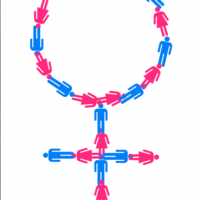
Graphic courtesy of Sivi Satchi ’15
Feminism is about men and women being equal.
The aforementioned Facebook fights resulted in a symposium led by Hannah Zack ’14 in the Eberstadt Room to address feminism. Ms. Galvin said, “Students were encouraged to gather and discuss these issues in person.” I sat in to get a sense of what the community thought. I didn’t speak. Seeing me in my helpless state of silence, Ms. Galvin kindly asked me if I would write down the names of everyone present at the meeting for her. I did so, and later, asked her to reciprocate the favor by commenting on the day’s events.
“There’s still more work to be done. It (feminism) should not just strive for equality, but it should also allow men and women to be their full selves. The idea of feminism emasculating men is a misunderstanding of what it actually is. Life is not a zero-sum game. I think men can live richer and fuller lives because of the feminism movement whether they subscribe to it or not.”
But how? I don’t want to sound uneducated and I mean this with all due respect, but Ms. Galvin is a woman. I want to hear a man say something like that. Not for confirmation. Not because I need it. Not because I don’t believe it because a woman said that. (Shame on you for thinking that.) But I want to know if men – at all – feel the same way. Thankfully, some do.
“I don’t think feminism really limits a man’s ability or freedom. If anything, it increases it or relieves pressure from men with women’s independence. Men may have had to feel that they had to be the protector and the one who looks out for the family. However with feminism and all its advantages, both men and women can feel like they have equal roles in every aspect of life. Feminism relieves pressure; it doesn’t create it.”
I was convinced after hearing that. Feminism doesn’t emasculate men. It lets people be themselves. That’s what Newark Academy strives for. At the end of interviewing all these people, I received a pleasant surprise from an anonymous interviewee. “Matt Thekkethala, I am sorry I called you a sexist on the TOK discussion board two months ago.” I’m sorry too. But the apologies have to end. We don’t need to feel sorry anymore. Feminism doesn’t weaken anyone. It makes us stronger.
The Feature Section Explores Feminism and Gender Roles
Part 2: Feminism and Men
Part 3: The “Pretty Hurts” Video

Leave a Reply
You must be logged in to post a comment.