By Ben Goodman ’16, Staff Writer
The saying goes, “quality over quantity,” yet, quantity does have its merits when it comes to high school sports. In almost all sports, having more depth on the roster yields a more energized, durable, and successful team. At Newark Academy, a school of under 500 Upper School students, the large majority of teams possess bright spots of quality, but many of them lack sufficient quantity.

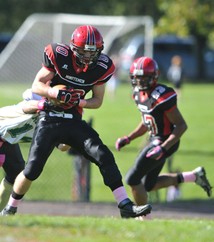
Photograph by Alex Cena and courtesy of Ms. Dixler.
Each fall, American high school culture revolves around Friday-night football games. However, spectators at the newly renovated Coursen Field might look at the Minuteman bench and ask, “Where are the rest of the players?” This past season, Newark Academy fielded only 18 players, remarkable considering there are 22 positions on the offensive and defensive unit. Larger schools, like West Essex Regional High School in North Caldwell, boast upwards of 50 players on Varsity; there, the underclassmen know they will not get on the field until junior year at the earliest. On the contrary, the Minutemen’s only senior, Jai Ghose, missed the year with an injury, and all ten freshmen (more than half the roster!) were thrust into starting roles. This posed many challenges, according to sophomore quarterback Elias Neibart. “People played positions they didn’t know how to play or weren’t big enough to play,” he said. Also, players were fatigued after playing every single snap on both sides of the ball – something most teams don’t have to do.
No one is suggesting that Newark Academy increase its enrollment, but football players have voiced other top-down, administrative solutions that would turn out more football players, while understanding the reputation their sport possesses. “With the new information about concussions, people are being more careful,” says Neibart, “But we are trying to change the culture of football at NA.” In that regard, perhaps sophomore Joe Sokolowski says it best: “If we start winning, kids will have more of a reason to play.” But to win, Newark Academy simply needs more players. “The admissions department needs to actively look for football players with top academic credentials to infuse into the student body,” suggests Neibart. Though it would help to accept more football players, more athletes can be gleaned from our current student body. Neibart and Sokolowski agree that students who do not yet play a fall sport should consider joining the football team.
If anyone knows of the struggles of Newark Academy teams to fill rosters, it is junior Rachel Neiman. During her freshman year, in the winter of 2011-2012, she was one of only eight girls varsity basketball players. Then, during the following year, field hockey captains approached both her and Sam Kent ’15 the fall with a desperate request. The field hockey team was short a player. Thankfully, Kent and Neiman were both coaxed to join the team right before the season started, preventing catastrophe. Newark Academy was that close to forfeiting its entire Field Hockey season; the record books would have skipped from 2012 to 2014. No team likes being on the verge of extinction, and Neiman has an interesting take on the problem. “NA selects very specific students, and often the basis is solely academics,” she thinks, “The high school is only made up of 400 kids, which doesn’t necessarily provide an adequate number of athletes as opposed to kids who ‘just want something to do.’” Neiman suggests that the school sometimes prioritize athletics over academics when evaluating a student application. This idea would clash with Newark Academy’s past dealings, but it might help avoid frustrating situations like those experienced by Neiman.
Armed with a long list of questions raised by these athletes, I opened the discussion to faculty member Lydia Masterson of the Admissions Department. Ms. Masterson is one of the few who actually has influence on which students are accepted into Newark Academy, and she had plenty to say about the process. “We first look at things like testing, transcript, and teacher recommendations,” she began, “We also evaluate what each individual can bring to the community.” Clearly, the admissions department values all aspects of an applicant, but Ms. Masterson took a firmer stance in response to Neiman’s question about prioritization. “Academics have to come first. We can’t accept any student that would not be able to grow and thrive in our extremely rigorous academic environment,” she said. Even while holding academics as the number one criteria, Masterson expressed her desire to see our athletic programs flourish. “Recruiting is illegal, and so are athletic scholarships,” she admits, “but what we do is have athletic captains at all open-houses.”
The administration attempts to broadcast the Academy’s sports teams to potential suitors, which is necessary because the art program and academic prestige far exceed our athletic reputation. Finally, Masterson understood complaints of students who could participate for needy sports teams and neglect to, but she reasoned there was no way around this unfortunate practice. Newark Academy does impose a policy in the Middle School requiring every student to play a sport each season, but Upper Schoolers are nearly adults and already, in many cases, in control of their life schedules. “I wouldn’t feel comfortable with that kind of policy in the Upper School,” Masterson said.
It seems evident that all Newark Academy students and faculty take pride in the success of their athletic teams and hope each squad finds success. Yet, there are some insolvable challenges that come along with being an undeniably small school. However, do not let that get you down: Newark Academy athletes master adversity. The field hockey team had a very strong campaign one year after the near-disaster of 2012, and the football team, having finally attained key depth this year with their large freshmen implant, is looking forward to a breakout season next fall on the turf of the new Coursen Field. Without a doubt, the games will go on.
Leave a Reply
You must be logged in to post a comment.