By Courtney Cooperman ’16, Feature Editor
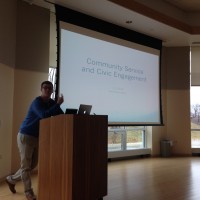
As part of Generosity of Spirit Week, which ran from January 5th through 16th, the Community Service Council brought in an alumnus whose commitment to service has already played a prominent role in his life beyond Newark Academy. Jake Wieseneck ’14 – a former feature, commentary, and magazine editor for The Minuteman, as well as Community Service Council member – spoke in the Kaltenbacher Hall on January 12th to over a dozen students and faculty members. Jake has already chosen to pursue a unique learning track at the University of Pennsylvania, where he is a current freshman, through the Civic Scholars Program. The Civic Scholars Program integrates academic learning and real-world experiences through a combination of courses and outside activities. Its focus is important social issues, especially those prevalent in Philadelphia. The Community Service Council invited Jake to speak because his college experiences embody the generosity of spirit ideal, and may provide interesting inspiration for future initiatives on our own campus.

Jake stated that through theoretical discussions and volunteer opportunities at Newark Academy, he began college with an impressive amount of exposure to societal issues, and felt very prepared to keep up these conversations and actions at the university level. To continue giving Newark Academy students this advantage, Jake cited the benefits of after-school discussions and open forums. He emphasized the importance of “making them as open as possible,” and ensuring that people’s opinions are valued regardless of their backgrounds. Jake observed, Newark Academy is a “very similar landscape to Penn in that you definitely have a mix of different backgrounds in a similar setting, with discussions of similar issues.” Based on his experiences in a diverse group, it seems that our conversations will have the most value if people of various affinity groups and perspectives can be heard.
The hallmark of the Civic Scholars Program is the intertwining of academic coursework, tangible situations, and involvement in the community. While Newark Academy offers many chances to look deeper into certain issues, doing volunteer work does not always entail delving into causes and solutions regarding the population or situation being addressed. For example, Jake explained that in the Civic Scholars Program, students understand the causes of hunger in the United States, the role of government in the situation, and how they can make a change. As Jake described, these investigations “go in tandem” with the service. Direct volunteer work is always preceded and followed by discussion.
To achieve a more holistic approach to community service, Jake suggested “incorporating more into the curriculum in humanities classes to really bring up discussions of these types of issues.” These conversations are highly present, but mostly limited to students who already have strong passions and take the initiative to attend, along with the occasional student who curiously strolls into the Kaltenbacher Hall during a free period. The investigative view of social outreach that the Penn Civic Scholars program adopts is known as service learning, which is something that Ms. Fischer and the Community Service Council hope to advocate and gradually implement. The Sociology of Poverty June Term course is one example of a good first step towards a service learning system. A handful of members will be attending the National Service Learning Conference in April, and will certainly return with innovative suggestions to promote this aspect of service.
Another element of the Civic Scholars program that Newark Academy aims to emulate is the connection to local issues. Many of the Civic Scholars’ activities revolve around the West Philadelphia community, a completely different world immediately beyond the Penn campus. Jonathan Holtzman ’16, who attended Jake’s presentation, was impressed by the program’s direct involvement in Philadelphia, especially the difference they could make through their work with the Philadelphia public schools. Likewise, Newark Academy strives to build and strengthen connections with the city of Newark through social outreach and programs such as tutoring and mentoring at Philips Academy Charter School.
After listening to Jake, Olimpia Kane ’16 commented, “I wasn’t aware that programs like the Penn Scholars even existed. It shed light on what community service looks like after high school.” Jake Wieseneck’s presentation proved that the focus on generosity of spirit at Newark Academy can play an important role even beyond graduation, and showed that there will always be opportunities to serve in meaningful ways. Jake also provided inspiration for future developments in Newark Academy community service. While our conversations about social issues are sufficient, we can always do more to include a larger audience. By adopting a more integrated approach to community service and academics, we can ensure that graduation with a completed community service requirement entails more than a number of hours served, and perhaps even encourages students to incorporate generosity of spirit into their post-Newark Academy lives.
Leave a Reply
You must be logged in to post a comment.