By Courtney Cooperman ’16, Feature Editor
As a junior with both an inbox and a mailbox overflowing with college brochures, I am constantly surrounded and disillusioned by buzzwords. Highlights from the first six emails I received today include “changing global landscape,” “connections through different lenses,” “passive recipients of knowledge,” and “intimate and nurturing.” Of course, such phrases have immense value behind them, but the words without the justification often come across as empty and pretentious. Prospective students, whether touring Newark Academy or touring colleges, often find themselves in institutions trying to package their depth into elegant, concise vocabulary. The nature of a mission statement is to do just that.
The rest of the section evaluates the Newark Academy mission statement’s success in capturing the essence of our school in twenty-four words. Yet there are many more words frequently overheard in the Newark Academy halls, used in classrooms, and projected through the microphone on the auditorium lectern. Such words work as informal mission statements: overused, cringe-worthy, and sometimes hollow. Some are filler words, used as a crutch when we cannot find precise and meaningful vocabulary, while others are blanket statements that encapsulate important aspects of our school without specific explanation. Prompting honesty through cynicism, I asked students and faculty to list “cliché and overused words, customs, phrases, statements, etc., specific to Newark Academy.” Ranging from unnecessary academic jargon to staples of the Newark Academy vernacular, I’ve picked a few of my favorites.
Recurring responses often drew from words and phrases popularized by TED talks or renowned studies on education, including “resiliency,” “risk-taking,” “grit,” “elasticity,” “innovation,” “thinking outside the box,” and “growth mindset.” Poking fun at the newspeak, English teacher Mrs. Acquadro commented, “Risk-taking – what is that?” While we all have a general idea of what these words mean, share a common understanding that they are positive traits, and strive to exhibit them in our daily lives, their ubiquity means that they seem to transcend the need for definition or specific examples. Hardly anyone would deny that these traits are important, or that their significance goes beyond the flowery babble, yet would we be able to define and concretely explain them as quickly as we are to use them without a second thought? Perhaps we take unconditional pride in upholding these abstract ideas, using showy jargon as a way to express confidence that we fulfill the pillars of education in the twenty-first century, without even needing to explain them.
More palpable terms that made the list include “the Academy,” “global academy,” “dining hall,” and “Google doc.” The first three are fairly predictable, earning eye rolls for the stigma of pretentiousness attached to them. Yet Google doc requires a little more interpretation. Creating a Google doc is the first task in any group assignment, whether a spontaneous in-class debate or a major project. They are overused but undeniably helpful tools, whose pervasiveness perhaps captures more about our collaborative nature than any mission statement could.
Other phrases that make students and faculty cringe are frequently thrown around in English and humanities classrooms, aiming to

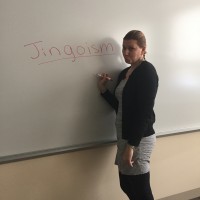
impress. Such words include “lifestyle,” “mindset,” “impactful,” “highbrow,” “lowbrow,” and “jingoism,” which makes history teacher Ms. Fischer “want to rip out [her] eyeballs.” Used in attempts to convey deep insight or show off knowledge, this vocabulary is only effective in small doses, but often takes over class discussions and essays.
Interestingly, the questions that prompt such pompous words leave their marks on Newark Academy students, even beyond the classroom. Used both sarcastically and sincerely, “to what extent” and “eternal truth” are comfortable parts of our daily conversations. Many students expressed irritation at these question stems, frustrated that they seem to surround us in essays and beyond. It is undeniable that we have colloquially embraced “to what extent,” for better or for worse. Following in the same pattern, “that’s so TOK” has become a substitute descriptor for anything philosophical, insightful, or mind-blowing.
Our classroom terminology and ways of thinking blend into our vernacular, often to the point of annoying those around us. The omnipresence of these words is perhaps more telling than a mission statement. Newark Academy is a place with students that draw from their classroom experiences in their non-academic lives so extensively that these terms make the list of overused clichés.
In my investigation, many of the words were laughable, with no redeeming qualities. Yet in many cases, sarcastic remarks uncovered truth about the nature of Newark Academy. Unmasked by our cynicism, the quirks of our commonly used vocabulary may reveal more about our character than a carefully constructed statement of our guiding principles.
Leave a Reply
You must be logged in to post a comment.