By Emma Hoffman ’16, Staff Writer

Photo: Ken Howard/Metropolitan Opera

Photo: New York Times
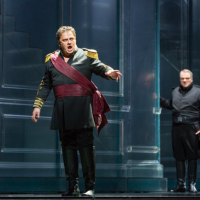
Back in September, the Metropolitan Opera’s general manger Peter Gelb announced that the company would be abandoning its use of blackface in its new production of Verdi’s Otello, prompting both praise from the theatrical community at large and condemnation from some opera fans. The new production, directed by Tony Award-winner Bartlett Sher, stars the acclaimed Latvian tenor Aleksandrs Antonenko as the title character. Sher’s productions will be the first in the Met’s history to not feature blackface, a decision made on the heels of the church shooting in Charleston, South Carolina and a series of racially motivated episodes of police brutality. The director has contended that Verdi’s adaptation of Shakespeare’s play is less concerned with the theme of race and more with the psychological aspects of the story. Gelb commented in an interview with NPR: “I realize it’s a sensitive issue. We feel that it’s the appropriate direction for this production and we’re happy with that decision.”
Many critics and operagoers applauded the Met’s decision, pointing to blackfaces’ ugly history in American theatre. Starting in the 1840s, white actors in minstrel shows blackened their faces in order to portray black characters, singing African-American folk songs and spirituals and popularizing black stereotypes. Blackface soon found its way into film, most notably in 1903’s The Birth of a Nation, and television. By removing the makeup, the Met would be purging itself of such a potent symbol of racism. Opera purists disagreed with the Met’s decision entirely. They argued that whitewashing the Moor went directly against the libretto and that the company sacrificed artistic integrity for political correctness. Other commentators, including Afro-American scholar and author Naomi André, have advocated for the continued use of darkening makeup, albeit with some kind of a program note explaining and discussing its presence.
English teacher and opera enthusiast David Beckman has added his voice to the chatter, saying, “Definitely there’s a problematic history of that particular stage tradition and I think that blackface has been used in opera productions as an easy way of signaling that the character is different from everyone else. Directors have pretended that opera should not have to be relevant to the rest of the political world and so they have been able to get away with it. What I’ve heard about this production of Otello is that they have not really found another way of achieving what blackface was lazily used to achieve and that it’s been a problem for them.”
The debate has also shed light on the complicated history of race in opera and on colorblind-casting. Both blackface and yellowface are still commonly used in productions around the world today and operatic depictions of minorities are often mired in Romantic-era orientalist ideals. The Met has reaffirmed its commitment to colorblind casting on several occasions. Yet some opera fans and critics have questioned its effectiveness in diversifying the opera stage, wondering whether ethnic roles should be open only to singers of the same ethnicity in order to avoid awkward racial blunders.
Alto Marian Anderson became the first black singer to perform on the Metropolitan Opera stage in a 1955 production of Verdi’s Un ballo in maschera. A few months later, baritone Robert McFerrin became the first black man to sing on the same stage. In the past, producers more readily cast black women over black men due to fears of having a black man onstage with a white woman. Unfortunately, that attitude has lingered into today.
People of color have also had limited access to training. This has not stopped black singers from achieving fame; Leontyne Price is largely considered to be one of the finest sopranos of last decade and Lawrence Brownlee is perhaps one of the most in-demand bel canto tenors today. The role of Otello, however, is notoriously difficult and very few tenors can sing it; even fewer can perform it in a hall as massive as the Metropolitan Opera. Until training becomes more open to communities of color, it is unlikely that we will see a black Otello at the Met any time soon.
Leave a Reply
You must be logged in to post a comment.