By Meghna Padmanabhan ’17, Staff Writer
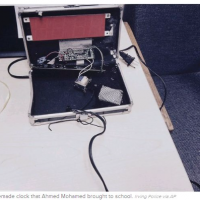
On Monday, September 14th, 2015, a 14-year old boy was handcuffed and arrested for bringing a “hoax bomb” to school. In reality, this “bomb” was a makeshift clock that this teen had created with his own hands, eager to impress his teachers with his brilliant manipulation of “a circuit board and a power supply wired to a digital display,” according to a news website called “RT (Russia Today) USA.” Most of you feel outraged and astonished that the police would unrightfully arrest a 9th grader on the grounds that he created a device that “appeared” like a bomb. There was absolutely no reason for police involvement…why did the teachers feel the need to contact the authorities?
Ahmed Mohamed is a Muslim boy living in Irving, Texas. Herein lies the answer to the question posed above. The fact that this boy was of a Muslim faith provided teachers with enough reason to accuse him of threatening the school’s safety. He had showed the clock to his engineering teacher who commended his work, but then advised him not to flaunt it. For a young, proud boy who had just created something far exceeding his expectations for himself, this was disappointing news, but he agreed. Later that day, an alarm went off and a teacher, irritated at the beeping, told him that his clock resembled a bomb and, despite his protests that it was not, confiscated it. While in a student council meeting, Ahmed was pulled out by a teacher and police officer and brought to a room where other officers sat waiting to identify the perpetrator. Many accounts of this story include direct quotes from Ahmed himself reveal that, once he walked into the room, one officer stated, “Yup, that’s who I thought it was.”
There are many people who would argue that this was not an arrest based on racial or religious factors, but simply a precautionary measure sparked by the increased paranoia over school attacks, especially in light of recent tragedies. This may hold to be true, but this infuriating statement made by an ignorant officer nullifies every single one of those arguments. Without even knowing Ahmed, or checking whether or not the “bomb” was really a bomb, this officer’s prior prejudices clouded his judgment and allowed for the irrational suspicion that followed. To say that this was a situation completely void of religious or racial preconceptions would be inaccurate.
Furthermore, Ahmed had been put into handcuffs in his very own high school and interrogated for over an hour without an opportunity to even call his parents. Some sources say that police determined that it was not a bomb on-site, yet Ahmed was still called in for questioning and suspended for three days.
According to a CNN news report, Ahmed confessed, “I felt like I was a criminal. I felt like I was a terrorist. I felt like all the names I was called.” He had been bullied in middle school due to his ethnicity and his religion by students who did not realize the implications of their words. When educated adults and authority figures were the one to hold these prejudices, they were no longer an insult to Ahmed, but a reshaping of his identity.
His parents were fearful of the harmful effects this could have on Ahmed’s view of the world, as well as his curiosity, now that he is aware of the fact that his every action is scrutinized. Out of my own curiosity, I asked my mom how she would feel if I were in a situation where my color or ethnicity led others to make unjust assumptions about me and led to a situation like this that spiraled out of hand. She stated that as a parent, she would be “concerned about the fact that I would always be wary of my actions, and that, like Ahmed, my childhood innocence would be destroyed.” A scene of a crime requires decisive measures, yet such a serious lack of discretion when dealing with a youth could impact the rest of his or her life.
On a larger scale, the issue represents a very current and very real societal mistreatment of people based on their ethnicity, race, or religious preferences.
The perception of M uslims as more threatening than an average white American is an issue that pervades even the strictest parts of society, in this case the police force. This image from aljazeera.com portrays the irony behind the fact that a young white male can parade around a gun in a “patriotic” manner without any concerns raised, yet a 14-year old male with a suspicious looking invention is placed under handcuffs after being deemed a threat to his school.
There is something seriously wrong with this picture, and widespread popular support of the movement “#IStandWithAhmed” shows how many people disagree with the way the situation was handled. Unfortunately, it is an inevitable flaw of society to hold prejudices and biases while making decisions that affect the lives of many. In the wise words of Mark Zuckerberg, “Having the skill and ambition to build something cool should lead to applause not arrest. The future belongs to people like Ahmed.”
I couldn’t agree more.
This article reflects the opinion of one staff writer, not The Minuteman as a whole. To share your opinion, comment below!

Leave a Reply
You must be logged in to post a comment.