By Kiran Damodaran ’17, Sports Editor

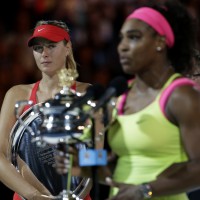
Serena Williams is the best female tennis player today, and likely ever. Her dominance is unquestionable; the top rated singles player in the WTA (Women’s Tennis Association) rankings, Serena has 21 Grand Slam singles titles (second most all-time and the same amount as all other active players combined), 69 career singles titles (fourth most all-time), an overall record of 737-123. She has won 23 of her last 24 matches against top-10 ranked opponents, and is 4-1 in her past five Grand Slam tournaments. So why does Serena make just about half as much in endorsements as third-ranked Maria Sharapova ($23 million compared to $13 million)?
The simple answer many people give is that Sharapova’s appearance is more marketable – and, well, they’re not wrong. There are two major questions this idea raises, however: firstly, why does appearance dictate endorsements in women’s sports, when the same standard is not held (at least not to the same degree) in men’s sports? Secondly, why is Sharapova’s appearance and body type so marketable, and Serena’s is not?
For years, women’s sports have not received the same attention as men’s sports, and this gap partially stems from the “women first, athletes second” mentality that is instilled in our society. (“Women first, athlete second”) In media coverage of women’s sports, a substantial amount of the articles and commentary are devoted to the appearances of the athletes, while little spotlight is cast on the actual sport. While these advertisements often do draw attention to the sport itself, as Student Pulse puts it, they essentially “further distance the image of women athletes from athletic competence” by sexualizing them in a way that trivializes their athletic achievements. (Student Pulse on Female Athletes) Some may argue that appearance is a factor in men’s sports as well, but while it may bring some media attention to male athletes, it is not the main source of attention. Is Lebron James the most endorsed NBA player because of his looks? No, he’s the most endorsed because he’s the best player in the NBA. Shouldn’t the same principle apply to Serena?

Women’s sports are judged differently – it’s as simple as that. Serena, a strong, black, athletic woman, doesn’t fit the ideal thin, feminine build and appearance that female athletes are expected to maintain. As a result, she has been described as “manly” and as a “gorilla” because of her muscular build and, possibly more so, because of her race. This type of commentary occurs because, as the Harvard Law Review puts it, the American public “has not yet become comfortable with the ways in which female athletes challenge traditional notions of femininity and masculinity.” (Harvard Law Review on Appearance in Female Sports) It is difficult, therefore, for people to associate a more muscular, strong body build in women because it threatens the power roles of a patriarchal society. Beyond this reason, however, one must examine why exactly it is that this certain body type is found so attractive in our society, and that comes back to the deeply ingrained beauty standards that pervade American society. This standard, which idealizes the thin and primarily white, isolates those who look different. Therefore, as a strong, athletic black woman, people seem to be constantly searching for ways to discredit Serena’s success in the game. As Serena herself said in an interview, “[i]f they want to market someone who is white and blonde (Sharapova), that’s their choice.” (Serena on the Endorsement Gap) As Rakhi Kundra ’17, a lifelong tennis player, added, “since tennis is traditionally a rich, white man’s sport, Serena stands out, being that she is a female of color who came from nothing.” Endorsement is a choice based on marketability, yes; but we can’t ignore the implications of what’s marketable and what’s not.
While race and gender appear to play a major role in endorsements, some may argue that there are more impactful factors, namely an athlete’s likability and desire to pursue endorsements. Serena has been known to have a temper, like many athletes, and detractors point to this as the reason she has not received the same endorsements as Sharapova. However, while likability and personality is an element of popularity, it certainly does not account for such a ridiculous disparity in endorsements.
Considering the large number of female student-athletes at Newark Academy, the issue of society imposing pressure on athletes to have a certain body type is extremely relevant. Meghna Padmanabhan, ’17, a runner for the cross-country and track teams, commented, “I feel like many of the female athletes I encounter are constantly worrying about their weight and body and it’s just not healthy. Society idealizes one athletic body type and that is thin – people can’t accept that someone who doesn’t fit this ‘perfect mold’ can be a good athlete.” It’s about time we break this ‘perfect mold’ so we can appreciate all athletes and body types. It’s about time we begin to look at women’s sports differently. And most of all, it’s about time we begin to look at Serena differently and appreciate her for what she is – the greatest tennis player of all time.
Leave a Reply
You must be logged in to post a comment.