By Emma Hoffman ’16, Staff Writer
Early last October, the art world raised its eyebrows at two protests conducted by the Instagram-based group Renoir Sucks at Painting (RSAP) at the Museum of Fine Arts Boston and The Metropolitan Museum of Art. As suggested by their rather blunt moniker, the group seeks to remove the work of French impressionist Pierre-Auguste Renoir (1841-1919), who they deem responsible of “aesthetic terrorism.” The group demanded that The Met take down on all 19 of their Renoirs in the name of good taste, calling the paintings “empty calorie-laden steaming piles” and, most memorably, “indefensible swathes of poorly rendered treacle.” For their parts, both museums disregarded the RSAP’s protests and kept their Renoirs where they belong: on their gallery walls.
Renoir Sucks at Painting was founded by Max Geller, a political organizer and noted Pro-Palestinian activist at Northeastern University. It is worth noting that Mr. Geller does not hold a degree in art history and has admitted that his knowledge on the subject is minimal. Despite his lack of expertise, his tirade has attracted a small following of what can only be described as college-aged hipsters. He has attracted the ire of Renoir’s great-great-granddaughter Genevieve Renoir and prominent art critics across the country. Sebastian Smee, art critic for The Boston Globe, called the protest at the MFA “funny, but sophomoric,” adding, “…The “protest” was not so much a protest as a coordinated cry for attention.” Geller responded by poking fun at Smee’s name and challenging him to a Hamilton-Burr-style duel.
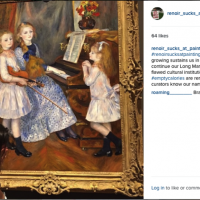
On the outside, the RSAP movement appears to be a parody of the art world; its Instagram page features pictures of Geller and his disciples gesticulating wildly (and often crudely) at Renoirs, accompanied by hyperbolic and lurid criticisms on the pieces in question. Their picket signs are modeled after those of the Westborough Baptist Church—see the memorable “God Hates Renoir” sign—and are laden with puns.

Yet, the RSAP seems to be serious about removing Renoir from public view to the storage house. Their reasons include the artist’s anti-Semitic and misogynist views as well as what they perceive to be his lack of skill and sentimental subjects. In his place, they would like to see more works by women and artists of color.
In an interview with The Daily Beast, Geller said, “In a Leninist tilt, I would say it’s the first in the Long March towards addressing cultural hegemony, which is a long-term ambition of the movement…That’s what cultural justice means to us.”
Geller and the RSAP are correct in saying that women and artists of color have been long underrepresented by major museums and galleries; it is imperative that the art community addresses these issues. In their ignorance, they fail to see Renoir’s importance and influence in the art world. One of the most notable impressionists, Pierre-Auguste Renoir painted during an era of increased industrialization and leisure. His subjects were primarily the new middle class and nudes. His works notably seek to capture moments in life rather than grand scenes and to celebrate the beauty and sensuousness of the everyday and his unfussy compositions invite the viewer to participate in his scenes. Critics have both acclaimed and questioned his rendering of light and compositional techniques, yet his work remains popular with the public.
Renoir did not seek to push the envelope or comment on his times. He sought to paint the beauty and joy of the world. He created happy art. Most people agree that paintings of suffering and despair are important on an artistic and social level. What some people fails to see is that paintings of dances and piano lessons are equally important, albeit in more subtle ways. When one looks at Renoir’s Luncheon of the Boating Party, they are drawn into the pleasant scenes, the warmth of the light and the vibrancy of the color. The viewer momentarily escapes from the drudgery of life and leaves feeling refreshed. Is it not important to take a moment to reflect on the beauty of life?
The RSAP plans to picket at the Barnes Foundation in Philadelphia, which holds one of the world’s largest collection of Renoir paintings, in the near future. They should receive a similar response to those they received at the Met and the MFA.
Leave a Reply
You must be logged in to post a comment.