By Jocelyn Tolpin ’17, Commentary Editor
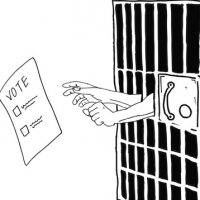
Though the issue of whether or not felons should be granted the right to vote is not at the forefront of political discussion nowadays, it is still very relevant because a large amount of the population is currently imprisoned, and an even larger percentage of minority groups (13% of African-American men) are deprived of the right to vote. Depending on the state that one lives in, a person’s voting right may or may not be reinstated after prison and probation.
I think that the most significant question regarding whether or not felons should be given the right to vote while serving their sentence is whether or not their judgment can still be trusted. An anonymous junior claimed, “Sometimes prisoners are mentally ill or challenged and their judgment will be impaired. If prisoners were given the right to vote, then there would be a large amount of [ill-intentioned] people represented in the polls.”
In addition to impaired judgment, another reason why felons should not be given the right to vote is because they breached their contract with their society, and therefore they face a punishment that includes not being able to determine what the country looks like after freedom. An anonymous junior claimed, “After prison, they should have to adapt to whatever conditions are in place when they get out.”
At the moment, I think that the most weighty deciding factor of whether or not current felons should be allowed to vote should be the magnitude of their crime. Prisoners who have completely disgraced the rules of society and committed crimes such as rape or murder should not be granted the right to vote while in prison. And if they are not able to vote and those who commit petty crimes can, where could the line be drawn? While Florida, Kentucky, Iowa, and Virginia do not allow anyone with a criminal record to vote, and Maine and Vermont never take away voting rights, 38 states reinstate the right to vote after completion of one’s sentence. I identify in the middle of this conflict, with the majority.
In addition to the issue of whether or not inmates should be able to vote, a further debate questions the voting rights of ex-cons. At the moment, the GOP and Democratic Party have reached the consensus that out of jail, felons should be able to earn back the right to vote, if not immediately, then definitely eventually. Senator Lindsey Graham (Republican) claimed, “I believe in second chances,” while his fellow Senator John McCain (Republican) said verbatim, “I think if someone is judged to have completed their debt to society, then that’s certainly something that should be seriously considered. I don’t think someone — if they paid their debt to society — why they can’t re-enter society.” Democrat Martin O’Malley agreed, “All those who served time and re-entered society should be allowed to vote.” Deputy director of the Democracy Program at the Brennan Center, Myrna Perez, insisted that states were hoping to expand voting rights, and since 1997, 23 states have expanded voter eligibility.
One of the most compelling arguments advocating for giving voting rights to current felons is that a large amount of people of lower socioeconomic status are imprisoned, and they are not being adequately represented. Though this fact is unfortunate, the government cannot frame their judicial system and amendments around the fact that a disproportionate number of minorities are imprisoned. Though there is a socioeconomic imbalance, there are still quite a few people of higher socioeconomic status that have also been stripped of their rights. Losing the right to vote is a consequence of illegal actions, not a product of race or wealth.
Voting is an important privilege given to those who demonstrate respect for the country and its constitution. Felons who have not demonstrated this respect should not be able to have a say in how it changes and what it looks like. Once they have repaid their debt to society and proved that they can be contributing members of society, their voting rights should be reinstated right away.
This article reflects one side of the debate. Check out this commentary article for an alternate perspective!
Leave a Reply
You must be logged in to post a comment.