By Oluwadamilola Oshewa ’16, Staff Writer
White feminism is a term used to describe feminism that fails to acknowledge intersectionality—the intersection between issues of gender, race, socioeconomic status, etc. White feminism ignores the experiences of women who are not white, cis-gendered, and heterosexual. Not all white people who are feminists are white feminists, but the large majority of white feminists are white. The problematic nature of white feminism has been ignored for a long time, but has finally bubbled to the surface after this year’s MTV Video Music Awards.
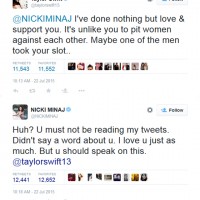
Soon after the VMA nominations were announced, Nicki Minaj used Twitter as a platform to discuss some of her anger about the role of race in the music industry, especially in awards show nominations. Nicki’s main complaint was the fact that her songs “Anaconda” and “Feeling Myself,” arguably two of the most watched videos of recent times, were both shut out of the Video of Year category. During this Twitter exchange, Swift felt that Minaj’s comments were meant to target her, despite the fact that Nicki had never even mentioned Taylor at all. Taylor’s response completely ignored the issues of race in the music industry, which Nicki was trying to bring to light. Instead of meaningfully contributing to this conversation, Taylor made herself a victim and continued to perpetuate the “Angry Black Woman” narrative.

Swift apologized to Minaj, recognizing her mistake in the situation, and everyone thought the conflict had ended. And it had — until The New York Times interviewed Miley Cyrus about being the next VMA host. When Cyrus was asked about her opinion on Minaj’s tweets, Cyrus responded: “I saw that. I didn’t really get into it. I know there was some beef.” She then criticized Minaj for not speaking to Swift “with openness and love” because “there’s a way to speak to people.” She ending by saying, “What I read sounded very Nicki Minaj, which, if you know Nicki Minaj is not too kind. It’s not very polite.” Cyrus’s statement reduces Minaj, a successful artist in the male-dominated rap industry, to just an “Angry Black Woman”. She completely dismisses Minaj’s statements about race; she tried to “tone-police” her.
What I find ironic about Miley Cyrus is that she is celebrated for speaking up publicly about sexism, yet has often been criticized by the black community for her appropriation of black culture. Miley is praised for twerking and expressing her sexuality, but black women like Nicki Minaj are ridiculed by feminists for being overtly sexual and inappropriate in their music videos. White women in the music industry are allowed to be free in expressing their sexuality, but the same is not true for black women. As a white woman, Miley Cyrus has certain privileges that she fails to acknowledge, making her form of feminism very problematic.
While this issue has just recently come to light, it is not a new one. Often in mainstream feminism, issues affecting women of color and LGBTQ+ women have been ignored. Situations like the drama surrounding this year’s VMAs serve as important sparks for conversations about feminism in the context of race.
Leave a Reply
You must be logged in to post a comment.