By Emma Hoffman ’16, Staff Writer
Some of us know Shia LaBeouf from the Disney Channel’s Even Stevens. Most of us have seen him sprint away from CGI robots in three out of four of Michael Bay’s Transformers movies. Recently, he has shed both his Disney and action hero personas for what seems like the typical child star meltdown, but is there an artistic method in LaBeouf’s madness?
LaBeouf has waded into the rather intangible world of performance art with two projects: #IAMSORRY, executed in 2014, and this year’s #ALLMYMOVIES. #IAMSORRY followed his bizarre appearance at the Berlin Film Festival premier of his film Nymphomaniac and allegations of plagiarism on a short film he directed, the actor holed up in a Los Angeles art gallery wearing a tux and a bag on his

head that read “I AM NOT FAMOUS ANYMORE.” LaBeouf claimed that his plagiarizing was an elaborate hoax—part of a performance piece under the hashtag #stopcreating. Patrons entered the gallery and could select a vestige of LaBeouf’s acting career—a whip and a transformer action figure among them—along with some quirkier objects, such as a bowl of tweets pertaining to the plagiarism scandal. They could then enter into a room where LaBeouf sat silently at a table and interact with him. Allegedly, a female patron used the whip on the actor then proceeded to whip, strip, and sexually assault him. Other visitors interacted with LaBeouf in less harmful and degrading ways.
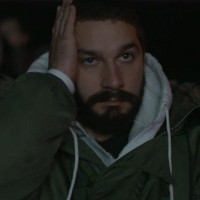
#ALLMYMOVIES saw LaBeouf sit in a movie theater and marathon watch his entire film oeuvre from his most recent efforts to his child star days. A live stream of his reactions was available for the general public; they ranged from blank to baffled. During the performance, he napped and ordered pizza. LaBeouf collaborated with artists Rönkkö and Turner for his project. In a post-performance interview with NewHive CEO Zach Verdin, the three discussed their aesthetic and their fear of “intellectualizing” performance art and their desire to create a palpable moment of connection and reflection between the artist and their audience. LaBeouf also took time to bemoan the movie industry and praise the accepting nature of the art world.
“I can’t articulate how big this was,” LaBeouf said, “…I felt extraordinary support…Once you press play on your life and you open up and there’s that vulnerability and not only are people getting the artistic side of you but they’re getting the human side of you, watching that, you’ve shared … I feel lighter today. I feel love today. It’s as simple as this: I used to order my coffee and when they’d say, “Hey what’s your name?” I’d say James, because I didn’t want them to say my name….This shit changed my coffee order name, which in turn, changed my sense of self.”
Performance art emerged in the 1960s and is defined as a performance within a fine art context that involves four elements: time, space, the performer’s body or presence in a medium, and a relationship between performer and audience. There has been a renewed interest in performance art after Marina Abramović’s The Artist Is Present, which drew a crowd of 850,000 to the MoMA and was the subject of a well-received HBO documentary. MoMA’s chief curator Stuart Comer has attributed the revival of performance art, saying, “The way we engage with images has radically changed, not least with iPhones and other devices, and images of the self have become more performative and fluid…So certainly, at the museum, we are really aspiring to represent the full thrust of that history, and really make a case for the centrality of performance in the development of Modernism.”
LaBeouf, Turner, and Rönkkö seem to be taking cues from Abramović. The general format of #IAMSORRY resembles The Artist Is Present: the visitor sits across a table from the artist and stare at each other, hoping to foster a moment of connection. LaBeouf’s props and compliance with the whims of the audience harkens back to Abramović’s Rhythm 0 (1974), where the artist stood immobile as the audience used various props, including a rose and a loaded gun, on her body. Abramović herself commented on LaBeouf in an interview with Vulture, saying, “It’s so manipulative, and it’s so complicated to answer…It’s very interesting to me that the Hollywood world wanted to go back to performance, which is something so different than what they are doing. Maybe they need our experience; maybe they need simplicity; maybe they need to be connected to [the] direct public, which, you know, being a Hollywood actor doesn’t permit you.”
Both of LaBeouf’s performances have received negative reviews from critics that called the actor’s intentions into question. Some have framed his performances as a part of a very public mental breakdown, which has included several arrests and allegations of domestic abuse towards his girlfriend Mia Goth. LaBeouf’s artistic intentions are debatable, but the results are no doubt fascinating.
Leave a Reply
You must be logged in to post a comment.