By Dalton DeStefano ’16, Arts and Entertainment Editor
Nothing drives the American movie industry more than cold hard cash. Over the past decade alone, we have seen the rise of the reboot (in which studios simply remake a previous film in order to have an already established name brand behind their product), the rise of the sequel (in which movie franchises now span 5+ movies), and the trend of splitting some films into two “parts” (splitting a film equals double the profit). The current path Hollywood is going down has inspired many a cynical reporter to lament the greed of the industry and the downfall of successful original movies. If Hollywood has a choice between greenlighting a original, bizarre new idea or another Transformers sequel, Hollywood will choose the latter every time, because the franchise has proven to bring in significant profits.
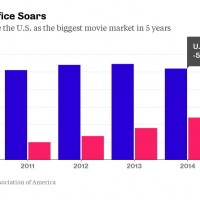
A new movement within the industry is tailoring movies to appeal to international markets, particularly that of China. China’s rapidly expanding population gets many of their big-budget blockbusters from America, and hold a massive influence in determining which American movies do well in overseas markets. Furious 7, a massively popular film that came out in America in April, grossed over

$390,000,000 in China, around $40,000,000 more than it made in America. Thus, American companies are beginning to adjust their movies to appeal to their new biggest demographic — the Chinese audience. Many critics have connected this to the increasingly simplistic plot structures present in big action movies. Production companies are supposedly “dumbing down” plot and dialogue so that the movie’s general ideas do not get muddled for foreign viewers, who are likely non-English speakers watching the films using subtitles. This explains the straightforward computer-generated explosions and unimpressive storylines that litter summer blockbuster season — movies now have to appeal to a more global audience.
This also speaks to the widening gap in movie budgets over the past few years. Gone is the constant stream of rom-coms and character dramas within Hollywood. More and more companies are skewing towards solely producing blockbusters (Inside Out, Jurassic World, Ant Man, Spectre, etc.), and leaving the smaller films with smaller budgets to indie filmmakers. It is far more lucrative for production companies to swoop in and buy indie movies to distribute than to take chances on producing their own small-budget movies. Thus, independent directors are making the smaller films that critics consider prestigious while production companies focus on blockbusters. For example, just about every Best Picture Oscar nominee from last year, including the winner, Birdman, was an independent film.
Obviously an industry as large as Hollywood will go through cycles and changes, and only retrospectively will we be able to analyze the success of the industry’s choices. For now, though, the globalization of American movies is a phenomenon that the American public is going to have to get used to. While it may compromise the quality of films we get, it certainly makes studios exponential revenues, and this new format will continue until it ceases to be profitable.
Leave a Reply
You must be logged in to post a comment.