By Dean Tan ’18, Staff Writer
On September 30th, the Russian parliament unanimously voted to grant President Vladimir Putin the permission to deploy the Russian Air Force in Syria. Hours later, Russian warplanes conducted airstrikes in 9 locations across Syria. Since then, Russian forces have carried out over 900 attacks within Syria and Iraq, targeting the several rebel groups opposed to Syrian President Bashar al-Assad. These targets have included the Islamic State (ISIS), a group internationally designated a terrorist organization; the al-Nusra front, an al-Qaeda affiliate in Syria; as well as the Free Syrian Army, a group opposed to Assad and backed by the United States. Additionally, Russian airstrikes have killed numerous civilians. However, Russian intelligence has denied that its military operations are targeting civilians.
Russian operations in Syria and Iraq come at the request of the Syrian President, Bashar al-Assad, who has been reaching out to Russia for military aid in defending his regime since July. Russia has made clear its intentions of supporting Assad’s government in Syria, even though Assad’s regime has been denounced by international human rights organizations, particularly for its use of “barrel bombs” – improvised explosives dropped from low altitudes – resulting in the deaths of hundreds of thousands of Syrians.
Russia’s airstrikes on rebel-controlled territory are one of several developments of Russian forces in Syria. Since August, Russia has sent combat troops, warplanes, tanks, and artillery to an airbase in Syria near the city of Latakia, as well as several other locations. Furthermore, Russia has sent numerous warships to patrol the waters near its base in Tartus, as a show of support for the Assad regime.
Though Russia has maintained that its mission in Syria and Iraq is to support Bashar al-Assad and the Syrian government, the more recent developments regarding the bombing of a Russian passenger jet has begun to direct Russia’s attention more directly towards ISIS. On October 31, Russian Metrojet Flight 9268, bound to St. Petersburg, Russia from Sharm el-Sheikh, Egypt, broke apart midair and crashed in the Sinai Peninsula, killing all 224 passengers and crew onboard. ISIS has since claimed responsibility for the incident, saying that the bombing of the plane was in retaliation for Russia’s intervention in Syria.
Following the attacks in France, the global community has been moved to assist in the fight against ISIS. It is evident that Russia will be expecting allies in this effort; already, the French have increased their attacks on ISIS, and are supported by the Belgians, Americans, and British. Dillan Gajarawala ‘17 shared, “Russia should extensively cooperate with the US and other countries in formulating an effective offensive against ISIS. International cooperation is very necessary to be able to defeat ISIS.” Indeed, Russia has reached out to France as an ally; French president Francois Hollande visited Moscow in November.

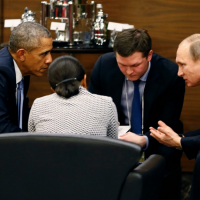
The United States has firmly rejected Russia’s proposition for coalition in the war, cooperating only to communicate air protocol in the shared airspace above Syria. Russian airstrikes have targeted several locations of the Free Syrian Army and continue to fortify Assad’s positions, a stance that the United States is fighting against. However, with the global effort mobilized by France, the United States and Russia will have to work together. Mrs. Schottland spoke with regards to the reluctant Russia/US alliance: “I think it’s really ironic that the only way that the two great superpowers can get together is over fighting a war …The United States should, at this point, support Russia in supporting Assad to stabilize the region and with time have him exit. I am no friend of Assad, but at this point, which is threatening more instability?”
On Tuesday, 11/17, Putin appeared on national television, vowing to intensify military forces and exact retribution from ISIS. It is clear now that Russia has recognized ISIS as its direct, if not already primary, enemy. Chris Pyo ‘17 shared his view on the situation, saying, “There have already been attacks on France in their own homeland and on Russia with the plane. It is unfortunately only a matter of time before ISIS reaches our homeland.” As Russia increases its aggressiveness with ISIS, Pyo believes the US should follow in its footsteps and support Russia, France, and other countries against ISIS in a similar fashion.
Leave a Reply
You must be logged in to post a comment.