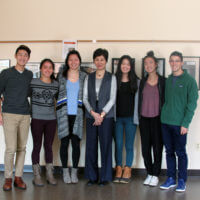
By Alena Zhang ’18, News Editor

The purpose of the Global Speaker Series is to expand the boundaries of dialogue and inspire global thinking in the NA community. On November 16, Jianying Zha, a Chinese-American journalist and non-fiction writer, visited NA as the second Global Speaker of the year. Zha’s speech, entitled “An Insider’s View of China’s Current Sociopolitical Landscape,” tackled a wide range of issues, including Chinese history, economy, and culture.
Born and raised in Beijing, Zha attended Peking University and later moved to the United States. Here, she acquired degrees from the University of South Carolina and Columbia University. In addition to writing novels, she is also a commentator on current events on Chinese television and has worked for the India China Institute at The New School in New York. Zha has been published in both The New Yorker and The New York Times.
Many appreciated Zha’s use of humor, including Samantha Ho ‘18: “She actually answered the questions, unlike some past speakers, and knew what she was talking about. She used humor to engage us — for instance, funny cartoons.” Rebecca Slater ‘18 added that “Her inclusion of personal anecdotes made the presentation more real. Instead of looking as outsiders on something many of us don’t know or deeply care about, she pulled us in.” Having published novels in both English and Chinese, Zha proved to be extremely knowledgeable about the development of Chinese nationalism. During her speech, Zha described how her brother faced nine years in prison for founding the China Democracy Party. She also covered the Chinese wealth gap, state-owned surveillance and arms, and radical movements across the younger generation.
As her presentation emphasized, China was a popular topic in the US election; Donald Trump’s accusations of climate change being a “Chinese hoax” have raised many eyebrows. Zha employed historical photographs and drawings to describe how the current Chinese society is deeply influenced by Chinese history and leaders such as Mao Zedong. She even stated that some Chinese people describe Mao as “China’s Hitler.” Moreover, she elaborated on the connection between the US Election and Chinese citizens: many love Trump and use the “messy” democratic process to emphasize the benefits of the current Chinese governance policy. While most Asian-Americans voted for Clinton, a large number of Asian-American immigrants support Trump. By drawing comparisons between the nations, Zha both captivated and raised many questions from our student body.
With this in mind, it is crucial for NA’s Global Speakers to offer thought-provoking and alternative perspectives; indeed, some guests may seem controversial to parts of our community. During the Q-and-A session, Kiran Damodaran ‘17 raised questions about the future of the Chinese economy – although it has improved in recent years, China’s GDP per capita is no match to America’s. Many Chinese citizens think they are “on top of the world,” but Zha pointed out that it would be devastating if Chinese rates of consumption suddenly matched American rates. The Chinese government recently decided to slow the growth of the economy, so future changes in the economy will be gradual.
In addition, Meghna Padmanabhan ’17 inquired about Zha’s experiences with censorship, considering that the Chinese government actively censors dissent in social media, literature, and art. Zha stated that being able to write in both Mandarin and English puts her in a privileged position, but she faces a “censoring” revision process in both America and China. In the Chinese case specifically, she chooses to accept it — otherwise, her books would not be published. Moreover, Zha revealed that she publishes complete versions of her writing in Hong Kong so that the original text can still provoke discussion and circulate within Asia.

Global Speakers are chosen each year by a committee of six students and five faculty members. Señor Romay, director of the Global Speaker Series Committee, described their process: “We look at which topics we have and haven’t covered in the past, and which topics may have gained relevance. And then we vote. This happens towards the beginning of the summer. Once we have selected general themes, we identify experts and public speakers in those fields. In the case of Ms. Zha, she was suggested by one of the speaker agencies we have worked with in the past.”
In order to maximize the impact of future Global Speakers, Señor Romay recommended that “students read articles, watch video presentations, or TED(x) Talks from upcoming guests so that they can familiarize or reacquaint themselves with the topics at hand.” By exposing ourselves to a wide variety of perspectives — both those that we agree and disagree with — we can ensure that the Global Speaker Series is informative and provocative. Jianying Zha, along with all past and future speakers, is sure to encourage insightful dialogue throughout our community.
Leave a Reply
You must be logged in to post a comment.