By Alena Zhang ’18, News Editor
The sixty-degree weather on February 8th certainly forecasted a warm and spirited welcome to this year’s third Global Speaker. Spanish teacher Mr. Romay (also known as Profé) welcomed clarinetist, saxophonist, and composer Paquito D’Rivera to the NA stage with musical performances as well as a Q-and-A session. In the past fifteen years, D’Rivera has been honored with a Guggenheim Fellowship, fourteen Grammys, an NEA Jazz Masters Award, and the National Medal for the Arts.
The presentation began with a performance by Junior Academy Voices and the Women’s Choir of the upper school’s Academy Voices. The song, entitled “Un Minuto,” is meant to last exactly one minute and convey a sense of temporal urgency; D’Rivera was inspired by Chopin’s “One Minute Waltz.” D’Rivera writes, “I accommodated a simple rhythmic melody to the Spanish and English words… with the ones [Profé] sent me… starting with the phrase ‘Un minuto, tengo solo un minuto para cantar esta canción — All I’ve got is a minute to sing this song,’ I little by little built a bilingual, sort of humoristic song that lasted exactly that. Just a minute!”
Profé and D’Rivera have worked together before: one past collaboration was a 2006 musical entitled “Cecilio Valdés, King of Havana,” which transformed the “forbidden love” premise of a famous Cuban operetta by making it take place under the Castro regime. Profé noted that it “added an element of ideology into the mix.”
When the Global Speaker Committee decided to invite Paquito D’Rivera, one of their aims was to dive into the intersection between art and politics. Profé explained, “We started the year with defining freedom of speech, but we wanted to bring in someone who had been a key player in that area. We wanted him to convey what it’s like to create art in a space where everything conspires against you.”

Many students noted that the format of the presentation was particularly unique. Profé explained his thoughts regarding D’Rivera’s musical and political background: “[I didn’t want this to] be a traditional presentation. We could have done that, but it would have taken so much away from the essence of this man.” Interestingly, D’Rivera himself suggested the Q-and-A format. Shaan Pandiri ‘17, a member of the Global Speaker Committee, said, “People might consider the series boring or monotonous since it tends to focus on really heavy global issues that… offer a pessimistic outlook on the world. But there’s nothing that connects us more than the arts, regardless of our backgrounds: it’s universal. Since I also think artists tend to be more optimistic and lighthearted, I’ve pushed to bring in more creative people during my time on the committee.”
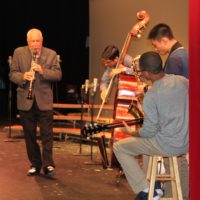
Profe also planned to contrast the rehearsed nature of the opening choral piece with the improvisational nature of jazz music. Within minutes of NA’s jazz combo giving D’Rivera the title of a song, they knew exactly what to do. D’Rivera emphasized the idea that “jazz is the best democracy.” As Allen Zhu ‘18 explains, “Jazz is collaborative music — we all have to be together and on the same page if we want it to sound good.” Onstage, as Allen, Teddy McGraw ‘19, Cosimo Fabrizio ’18, Shaan Pandiri ‘17, and Paquito D’Rivera traded off the melody of Juan Tizol’s “Perdido,” the NA community could clearly see that jazz has a spirit of unity like no other genre of music.
D’Rivera also attended the Advanced Jazz class during his visit. Michelle Lee ‘18, who plays the clarinet and tenor saxophone, said that “hearing someone play at such a professional level with an immense amount of experience was truly thrilling. It was great having Paquito listen to us and gain a different perspective on how to approach and interpret the jazz pieces that we have been working on for a while.” Allen added, “Paquito is really famous in the jazz world, so performing and eating lunch with him was like hearing a master speak.”
Like Shaan, Profé appreciated how D’Rivera balanced serious topics with lightheartedness: “It goes back to the Woody Allen quote he mentioned: ‘Comedy is tragedy plus time.’” Take D’Rivera’s story about escaping Cuba: he felt as if he was running up the down-escalator from a mob of police — but there was actually no one behind him. Although it was scary at the time, he reminisced on the experience with a smile. In a single lifetime, D’Rivera has experienced both the restraints of communist repression and the freedom of democracy, and the NA community should use his stories to continue reflecting on the complex junction between music and politics.
Leave a Reply
You must be logged in to post a comment.