By Benjy Berkowitz’18, Good friend!!!
The Oxford English Dictionary (which the library pays $295 dollars a year to subscribe to) defines the word cup as “A drinking-vessel, or something resembling it.” Now, we all know this don’t we? We drink from cups everyday to intake various liquids such as water. That’s great and all, but here at Newark Academy we happen to have a cup dilemma pretty often. It goes a little like this:
You walk into the cafeteria looking forward to a nice lunch with some friends of yours. You sit down with your food until you realize that you forgot one of the most important parts of your meal: a drink. You get up and go to the cups, reach into take one that’s at the top of the stack but wait! Two cups come up. One attached to the bottom of the first.
Cups, of course, angulate inwards at about 7 degrees. Because of this angle, they can stack nicely for compact storage, which helped create the international sport cup stacking, invented by Wayne Godinet. But, in the Newark Academy cafeteria, a strong suction is created making it very difficult to get one individual cup. Now I’m no everyday Lawrence Luellen (the inventor of the paper cup) so I do not really know what a solution to this problem would be. But I think an answer could lie in the sport that once captured the imagination of Bob Fox (the founder of speed stacker). You see speed stacking is all about cups, cups and stacking cups. William Orrell knows this first hand as he holds the top three speeds for cup stacking (his fastest being an absurd 1.902 seconds).
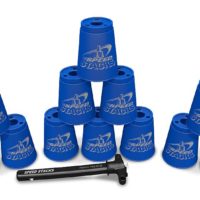
Let’s take a look at a standard speed stacking cup. If you look carefully you will notice three holes at the top. This is to prevent suction, thus maximizing stacking speed. If we look at the William Polly pro series cup (Polly has the second highest speed in the game), we will see this same premise taken to an even greater level. These cups have no bottoms; no bottoms means no suction.

Now, what can we learn from these cups? If we want our cups not to stick, we need holes. This will make them easy to pull away, saving us from the hassle that is having to separate two cups. Now can you drink from a cup with no bottom? Absolutely not, but that’s really besides the point here.
Leave a Reply
You must be logged in to post a comment.