
By Abbey Zhu ’18, Feature Editor
“Scarlett Johansson is stunning in Ghost in the Shell.” A man’s voice seeps through my earbuds and bursts my bubble of concentration. I’d been listening to a killer playlist that had been interrupted by this ad, and I was a little annoyed. The man’s voice is from a Spotify ad telling me to watch Ghost in the Shell, a live action movie based on the manga (Japanese comic books) and animated films (anime) of the same name. Ghost in the Shell is a hugely successful franchise, with the New York Times calling it “popular” and “critically acclaimed.”[1] Before the live action movie was slated to be released in 2017, Ghost in the Shell had already existed in manga and anime form since the 1990s.
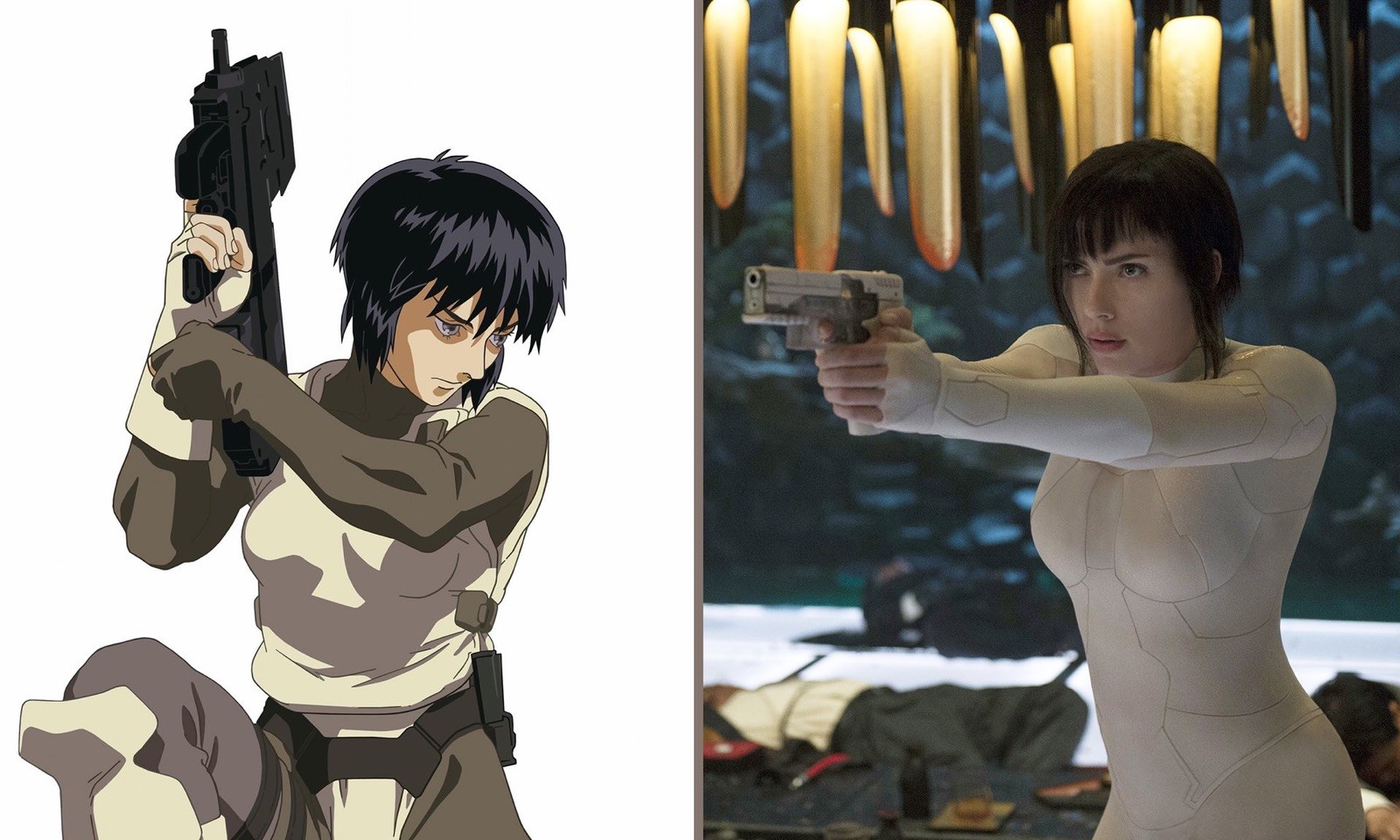
The female protagonist of Ghost in the Shell, Major, is named Motoko Kusanagi. She is drawn differently depending on which edition of the manga you read; her hair can be black or purple, and her eye color ranges from blue to orange. This is a characteristic style of anime and manga – depicting its characters with no specific ethnicity. Many argue that because of Major’s ethnic ambiguity, Scarlett Johansson playing Major is not whitewashing (the incredibly demeaning and disrespectful use of white actors and actresses instead of actors and actresses of color). However, Major’s full name is “Motoko Kusanagi,” very clearly a Japanese name. Furthermore, Scarlett Johansson’s hair and makeup in the film are a not-so-subtle attempt at making her look more Asian. This is also known as yellowface. As you can see in the picture, Johansson has a black wig on to make her look more like the black-haired version of Major – the very clearly Asian-looking version of Major. Hollywood’s decision to cast Johansson in place of a Japanese actress, or at the very least an East Asian actress, is appalling and disappointing. 100,000 fans of Ghost in the Shell signed a petition asking for Major’s character to be played by a Japanese actress instead of Johansson.[2] Nonetheless, Ghost in the Shell was released on March 31 in the United States, with Johansson as the lead actress.
I asked some of my friends if they had seen Ghost in the Shell, or if they considered watching it. Aislin Black ’17 said she planned on watching the movie with a friend and even bought tickets to watch it, but when they got to the movie theater, they decided to watch Gifted instead. When I asked why she ultimately decided against watching Ghost in the Shell, Aislin said it was mostly because, “Scarlett Johansson plays someone Asian when she clearly isn’t Asian, and I’d rather watch a movie about a cute smart kid.”
Ghost in the Shell is not the first time Hollywood has whitewashed Asian characters, and it most likely will not be the last. In Doctor Strange, Tilda Swinton, a white British actress, plays a Tibetan high priest. In Aloha, Emma Stone (who is also very white) plays Chinese-Hawaiian Allison Ng. Matt Damon is the hero of the movie The Great Wall, a movie set in Ancient China as soldiers defend China against mythical creatures. Iron Fist is Marvel’s new Netflix series. Its protagonist, Danny Rand, is a white American who learns incredible kung-fu skills. In each and every movie or TV show that I have listed, an Asian actor or actress could have been cast as the lead to increase Asian representation in film and provide Asians and Asian-Americans with role models on the big screen. These are all blatant examples of yellowface. Just as white people have the opportunity to see themselves represented on the big screen, people of color deserve to see their narratives portrayed by their people.
Ghost in the Shell appears to be yet another error in Hollywood’s casting realm and its inability to recognize that people of color want their voices to be heard. In the world of film, this means giving roles meant for minorities to minority actors, and it seems as if Hollywood still has long ways to go before it can truly address this problem.
[1] https://www.nytimes.com/2017/03/23/movies/the-live-action-birth-of-ghost-in-the-shell.html
[2] https://www.theguardian.com/film/2017/mar/31/ghost-in-the-shells-whitewashing-does-hollywood-have-an-asian-problem

Leave a Reply
You must be logged in to post a comment.