By Alena Zhang ’18, Commentary Editor
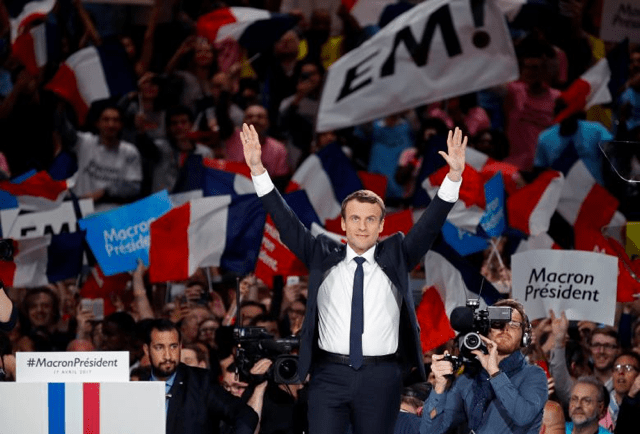
On May 7, 2017, at just thirty-nine years of age, Emmanuel Macron became the youngest President in French history. During his campaign, he ran under his own En Marche! (Forward) Party, which he defined as “neither left nor right.” On the other hand, Marine Le Pen’s populist campaign appeals to many nationalist conservatives who – fearing terrorism and foreign immigration – wish to isolate France from rest of the world. Macron takes a more reasonable and centrist stance advocating global cooperation.
Katy Kim ‘18 stated that “His focus on the environment, banking, and the economy will help strengthen and bring back the Euro. I worry about his inexperience, though – he’s under a lot of pressure because he’s essentially leading the European Union.” While Le Pen has a more extensive political background, her history in politics is quite controversial. She is a new face for The National Front – a right-wing, populist, and nationalist party – which was once led by her father. However, much of France’s younger generation is unaware that the party was once riddled with anti-Semitists and Holocaust deniers. Despite her attempts to “de-demonize” her father’s authoritarian image, the history of the party remains deeply concerning.
Le Pen’s anti-globalism is understandable, considering the importance of protecting the French domestic sphere. However, cooperation and exchange with foreign countries is vital to global security and stability. Macron will be instrumental in providing a collaborative counterpart to German leader Angela Merkel, especially when it comes to European defense. Some have stated that Macron’s predecessor – François Hollande – was too passive about security issues. In such a polarized atmosphere, Macron’s calls for unity and partnership will be more effective than isolation.
Although critics have labeled Macron as a “europhile” due to his support of the European Union, his firm beliefs are incredibly valuable in this era of global turmoil. The repercussions of Brexit were enough to shake stock markets worldwide and the UK’s economy, and a “Frexit” could pose even more dangers. Le Pen is opposed to globalization and the European Union’s “supranationalism” – a power that transcends national laws. But with the United Kingdom soon exiting the EU, France will play an increasingly important role, having a GDP only second to that of Germany.
When asked about the implications of Macron’s election, French teacher Ms. Lysinger stated, “It’s not so much about his election. What matters is what will happen in June with the assembly elections. What he is able to do [as president] is very dependent on what type of Assemblée Nationale he has. We can’t say much right now. His party is so new; he needs to build coalitions. He seems very sharp and very confident. In that way, I have high hopes, but when you get into the mud of politics, it can become a little more unpredictable.”
Macron will need to deal with a French political identity crisis, and he has attempted to remain flexible as the traditional Socialist and Republican parties scramble to create new alliances. His election is truly an atypical one: as the old generation is slowly disappearing, their juniors are learning to question the conventions of the past. One thing is certain: France has chosen to take a step into the unknown, and Macron promises to bring favorable results.
Leave a Reply
You must be logged in to post a comment.