
By Ava Sharahy ’20, Staff Writer
When Mr. Jacoby left Newark Academy last year, drama students were anxious to find out how their next teacher, Ms. Shapiro-Cooper, would fare with the fall play. Currently, she is in the process of directing her first play at Newark Academy, and many students are curious about the play’s final result. As a cast member myself, I’ll provide an inside look at the fall production for 2017, The Crucible.
The Crucible is a classic play written by Arthur Miller about the Salem Witch Trials and its victims. It’s the type of play that you would either only read in class or for a production; you would rarely read it for fun. I wondered why Ms. Shapiro-Coopr had chosen such a weighty play to direct for her first at Newark Academy. I asked Ms. Shapiro-Cooper what she thought about it, and she replied, “I chose The Crucible because I wanted to do a play that was socially and culturally relevant to the issues of our time. It’s a cornerstone of American drama, and I wanted to honor the historical implications of that while making the themes relevant and accessible for our current time.”
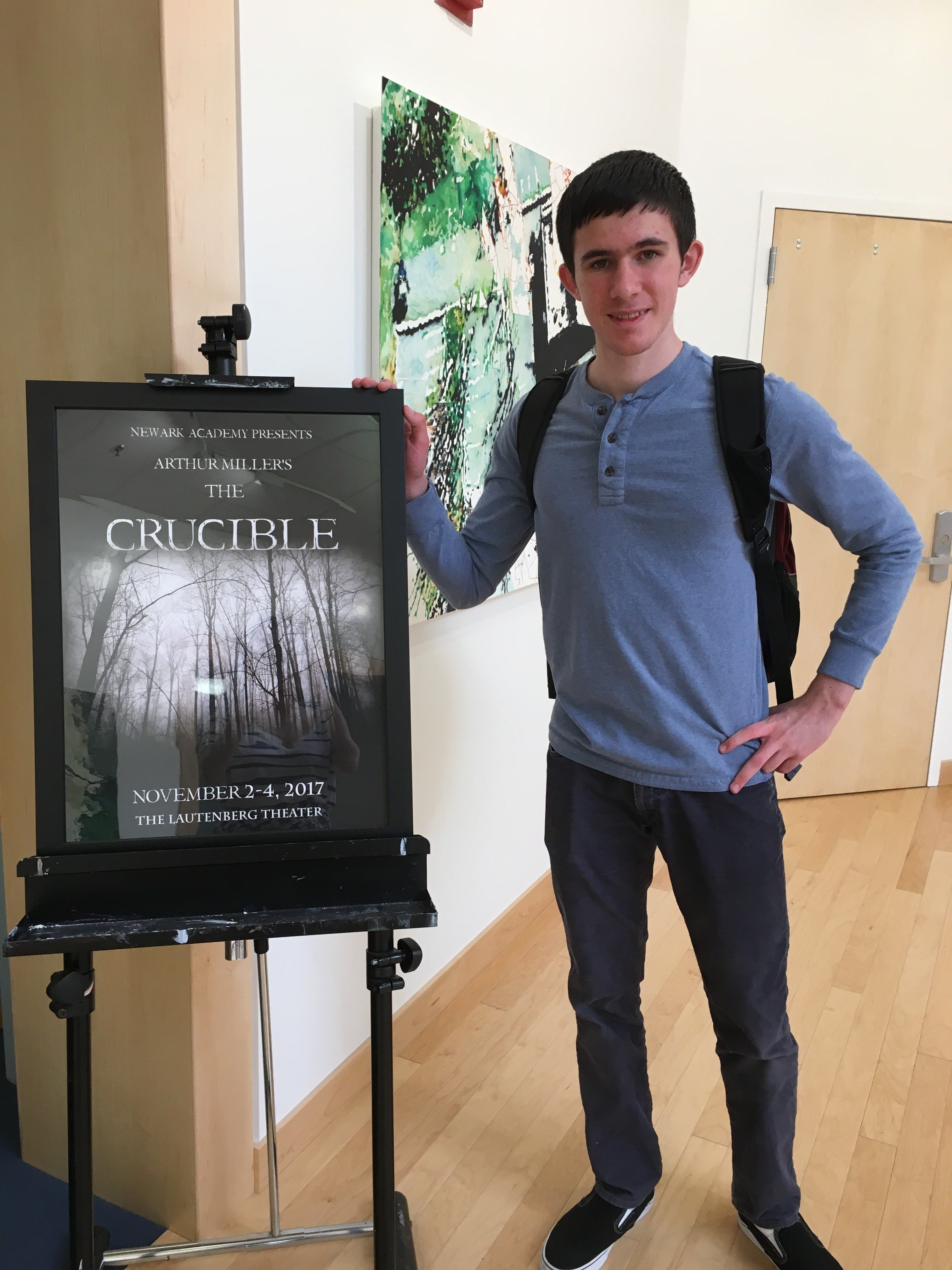
Despite being given a play with such grim subject matter, every time I walk into rehearsal, I find everyone laughing and enjoying themselves, cracking jokes that will eventually evolve into inside jokes about the play. Though there was a light-hearted and laid-back atmosphere among the actors, there seemed to be a change in attitude when the rehearsal officially started: Puritanical language flew through the actors as if they forgot they were high school students in 2017. For instance, in the trial scene, Claire Dempsey, who plays Abigail Williams, speaks of the damage that witchcraft had spread across Salem. You could hear a quiver in her voice, her fear slowly revealing itself as she spoke. The way she read the lines made me forget that Claire was there: for a moment, she was Abigail Williams, falsely accusing others of witchcraft. The only time we were ripped from the ambient hysteria of Salem was either when someone messed up or forgot a line.
“I think we’re in a fantastic spot,” said Ms. Shapiro-Cooper when asked about the progress of the play when asked two weeks before tech (lighting, scenery construction, score, etc.). “I think we’re in a really good space.”
In addition to the actors and the directions from Ms. Shapiro-Cooper and the assistant director, Gillian Cohen, the tech crew also plays an integral part in making the play come to life. Mr. Yow and students in the tech crew enhance the play’s atmosphere by constructing the sets and props, choosing the musical score, and controlling the lighting.
With blocking (the process of organizing where each character should stand in each scene) already finished and the tech crew helping out, the last component needed for the play to reach its full potential is the enthusiasm and the acting of the students. That won’t be a problem, however; despite sometimes being drained by rehearsal and memorizing lines, actors still come into the play with their best.
I asked Ms. Shapiro-Cooper how she would improve future plays based upon the experiences she gained from directing The Crucible. She responded: “I think making sure to choose material relevant to our community and student experiences shows that our students are highly capable and adaptive, and able to tackle complex theories so they can be stretched to flourish as artists. So, I will continue to pick material that both challenges and flourishes our community.”
From what I’ve witnessed so far from being in rehearsals, all I can say is that despite rocky beginnings during blocking and getting into character, The Crucible was handled to its fullest potential by tech, actors, and directors and turned out to be a great success.
Leave a Reply
You must be logged in to post a comment.