
by Simon Gorbaty ’19, Staff Writer
The horror of the Las Vegas attack on the night of October 1, 2017 left America shaken. As the deadliest mass shooting by an individual in U.S. history, Stephen Paddock’s senseless killings have naturally reignited the debate about gun control.
Strong proponents of gun ownership question the efficacy of proposals for further gun regulation, given Paddock’s legal acquirement of his semi-automatic AR-15 rifle. Indeed, as in San Bernadino in 2015 and other past shootings, increased background checks would not have stopped Paddock.
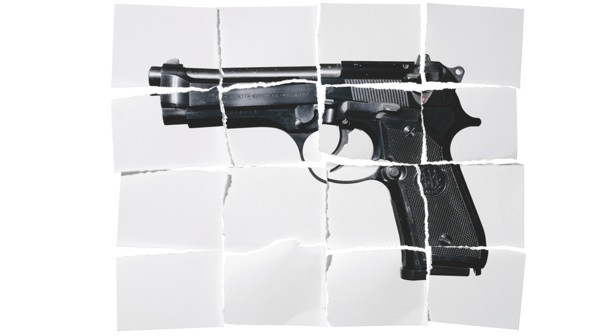
Meanwhile, gun control advocates point to the legal acquisition of the guns as justification for bans on semi-automatic weapons. Humanities teacher Ms. Lifson states: “Yes, we do have a right to bear arms. But no right is absolute…we should look both at the intent of the Framers of the Constitution and also interpret the Constitution as a living, breathing document. In the Founders’ day, we had militias defending the country, and the weapons…did not include semiautomatic or automatic weapons that would be used for mass murders in random killing sprees. Thus, these are not the kinds of weapons that I believe have protection under the Second Amendment.” Jake McEvoy ’18 agrees with Mrs. Lifson that “assault rifles and machine guns should be outlawed…you don’t need assault guns for self-defense.”
However, attempting to find this middle ground between the Second Amendment and stricter regulations is ineffective at tackling violence in general. New York Times writer Bret Stephens reveals that proposals to increase gun regulation without eliminating the Second Amendment will have little effect on the overall homicide rate in the U.S.. Banning the AR-15 rifle, for example, “would hardly improve the murder rate, since most homicides are committed by handguns.” Instead, he believes those who want change in gun laws “should want to change it fundamentally and permanently.” Stephen’s article argues that repealing the Second Amendment entirely is the only form of gun control that would actually decrease violence.
But Stephens’s argument against the amendment’s persistence relies on the apparent success of weapons bans in “the rest of the developed world.” An examination of countries with laws against weapons, past and present, reveals that weapon bans and decreases in murder rates simply do not correlate. In a 2007 study, the Harvard Journal of Law and Public Policy asserted: “the political causation is that nations which have violence problems tend to adopt severe gun controls, but these do not reduce violence, which is determined by basic sociocultural and economic factors.” For instance, after England and Wales banned handguns in 1997, the Crime Prevention Center noted “there is only one year where the homicide rate is lower than it was in 1996. The immediate effect was about a 50 percent increase in homicide rates.”
Attacks in recent years have indeed proven that guns are not the only vehicle, quite literally, for easy mass murder. As Aidan Orr ‘20 said about the Las Vegas shooting, “One thing that stuck out for me was the bump stock, but it didn’t stick out to me that guns are to blame. Look at the truck in Nice.” Aidan is referring to the 2016 Bastille Day attack in France, where a truck drove into crowds of people, killing 86 and injuring 458. As Mr. Bitler puts it, “that sort of person can do all sorts of evil without guns. There is no way you are going to prevent those people from doing great evil in the world.”
Conceding the right to bear arms will not reward us with safety. What many forget is that in repealing the Second Amendment, there is also much to lose. Extreme gun regulation is a sacrifice of a personal right to a government that, unchecked, can potentially become undemocratic. Although many contend that the United States is far from being under threat of tyrannical rule, the Second Amendment is a key element of individual liberty and checks and balances that makes the possibility of a tyrannical U.S. government so inconceivable.
Given that the only way to completely curb gun violence is through repealing the Second Amendment, and such legislation would infringe on basic liberties without minimizing violence in general, one wonders what should be done to improve security. Instead of focusing on guns, killings must be addressed from an angle of understanding mental health or socioeconomic factors that lie at the root of violence.
The Las Vegas tragedy will forever be immortalized in the nation’s history as a reminder of unprecedented savagery that man is capable of. The subsequent shock, fear, terror, and confounding lack of a clear motive leads us all to irrationally grasp for answers. We refuse to acknowledge the undecipherable complexity of evil. Our hands fall on the contentious debate of gun ownership, and we seize at it in that irrational effort to find something that makes us feel safer. Unfortunately, data and reason show that stricter regulation on gun ownership may not guarantee our safety. Why sacrifice our personal lifestyles and choices to government interference when it will not benefit our well-being? We have no reason to give up a fundamental American value if it fails to destroy the inextinguishable plague of violence.
Leave a Reply
You must be logged in to post a comment.