By Ariel Hsieh ’19, Staff Writer
On Monday, October 9, 2017, Newark Academy alumni Richard Thaler was awarded the Nobel Prize for his contributions to the field of behavioral economics. The Nobel Prize in Economics was established in memory of Alfred Nobel in 1968 by the Sweden’s Central Bank, and awarded by the Royal Swedish Academy of Sciences. According to the Nobel Prize committee, Thaler’s “empirical findings and theoretical insights have been instrumental in creating the new and rapidly expanding field of behavioral economics.” While economics is established on the assumption that people behave rationally, Thaler has shown that people are more irrational than rational, and that they do not always follow the standard models of economics. In addition to this discovery, he has also demonstrated that people become irrational in consistent ways which can be predicted and modeled.
Thaler was born in East Orange, New Jersey and graduated from Newark Academy in 1963. He graduated from Case Western University before getting his masters and doctorate degrees in economics at the University of Rochester in 1974. His career got a jump start when he met professors David Kahneman and Amos Tversky, who were also advancing the idea that economics needed to deal with actual human behavior rather than assumed rational thought. Kahneman was awarded the Nobel Prize in Economics in 2002. Thaler is the author of the best-selling book “Nudge” in which he and co-author Cass Sunstein talk about the importance of nudging people to do something beneficial to them. He has also written books such as “Quasi-rational Economics”, “The Winner’s Curse”, and “Misbehaving: The Making of Behavioral Economics”. Thaler currently teaches at the University of Chicago School of Business.
As a student in graduate school, Thaler had “deviant thoughts” about what decisions people would actually make that were contrary to the concepts his textbooks taught. He would ask people outside of class about the choices they would make. The answers Thaler received were indeed different from what textbooks said, leading Thaler to develop a curiosity about the deviations between standard economic models and actual decisions made by people in real life and why those deviations exist. After winning the prize, Thaler said in a press conference, “In order to do good economics, you have to keep in mind that people are human.”
An example of one of Thaler’s theories is that people will do what they believe is fair, even though doing so may not give them any benefits. For example, economic theory predicts that if an economy undergoes a downturn, then employers will most likely cut wages to match the demand of their goods and services, so there wouldn’t be a rise in unemployment during these periods. However, because employers are human, they believe a cut in the wage is unfair, so therefore would rather cut the number of employers than the wage, resulting in unemployment rising during economic downturns.
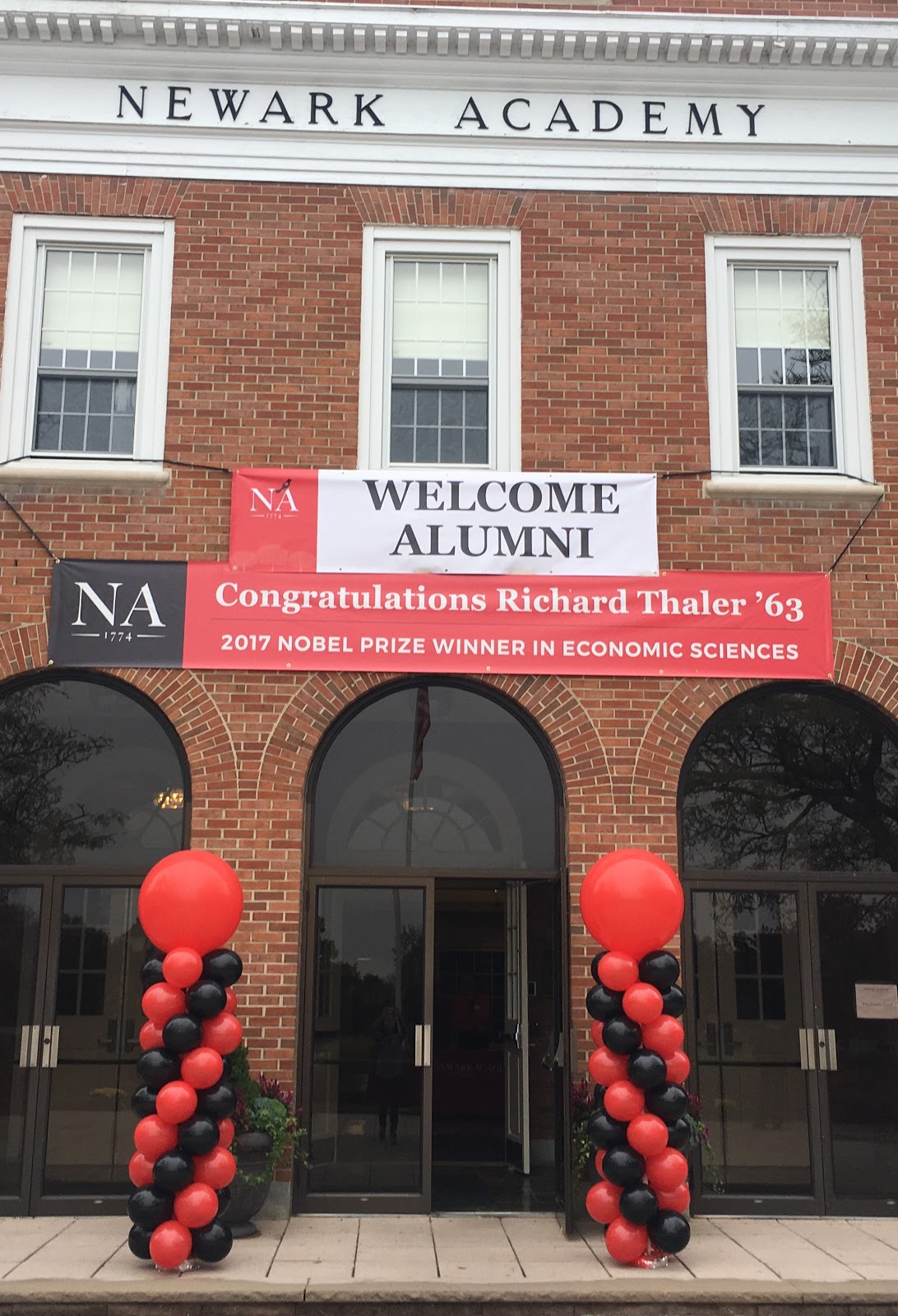
Thaler’s theory has been recognized in the NA community as Newark Academy’s pride in Thaler’s accomplishment has been on display all over the school: on the NA website, in front of the school with a huge banner, and the first announcement the next day in morning meeting. The news has gotten students, faculty, and parents alike to ask what behavioral economics really is, sparking much discussion within the community. Magnolia Wang ’19 says, “Richard Thaler is a great role model in showing us that Newark Academy prepares us for the challenges of the world.” Thaler’s success has brought the importance of economics front and center.
Thaler’s work has demonstrated that standard economic theories do not necessarily demonstrate actual human behavior. He has bridged the gap between sociology and economics. His work has “[created] an important, maturing field that is changing the way we see the world,” writes John Wasik from Forbes, adding that “we’re in a much more financially secure world because of his brave and brilliant work.” Not only has Thaler advanced the field of economics in the world, he has also inspired hundreds in the Newark Academy community.
Leave a Reply
You must be logged in to post a comment.