by Sophia Ludtke ’20, Feature Editor
This past August, a Google software engineer made national news when he released a statement attributing the underrepresentation of women in technical fields to “biological differences.” His statement was immediately met with significant backlash, with one female Google engineer threatening to leave the company if action was not taken. Ultimately, the engineer was fired, and Google released a statement claiming that the engineer had “[advanced] harmful gender stereotypes in our workplace.” Google was not alone in speaking out against the engineer’s memo. Both women and men around the globe, and even here at NA, are working hard to fight against a culture that has historically kept all too many women from pursuing certain fields in STEM.
Female underrepresentation, which is most pronounced in fields such as physics, engineering, and computer science*, has been described as a funnel in which gender imbalances become increasingly pronounced as girls grow older. At the high school level, males are more likely to take the AP Calculus BC and physics exams, and only 19% of AP Computer Science test takers are female according to a 2016 study by the National Science Foundation. By the time a girl reaches adulthood, these percentages have plummeted even further, with females comprising less than 15% of the workforce in certain fields of engineering. It is important to note that, of these small percentages, minority women make up only a small fraction of the STEM workforce (only 10% of those in STEM are currently minority women).
*It is important to note that a gender imbalance does not exist in all fields of STEM. In fact, social sciences are dominated by women (62%), and biological, agricultural, and environmental life sciences are relatively gender-balanced (48%).
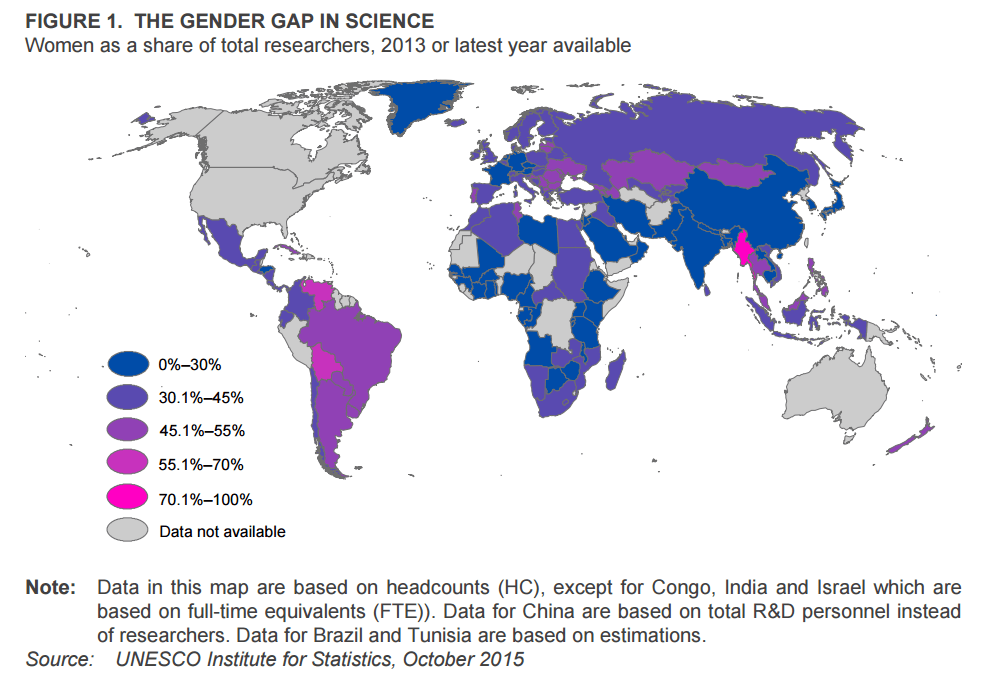
According to an article published by the Harvard Business Review along with a study released by the National Science Foundation, some attribute the imbalance to early childhood influences such as gender-biased books or TV-shows. Others claim that a lack of confidence in middle school science and math classrooms lead many girls to lose interest in STEM. Others cite a “maternal wall” come adulthood in which it becomes increasingly challenging for a woman to balance her family and career obligations. And yet others maintain that girls and women naturally gravitate towards subjects involving the study of people rather than the study of “things”. While no one factor can single-handedly explain the imbalance, addressing each of these factors individually can begin to narrow the gap between genders in the STEM workforce.
Having grown up in an era in which many are aware of the gender imbalance in STEM, I have noticed how voices encouraging girls to pursue STEM, especially those in movies, TV shows, and books, tend to operate in one of two extremes. Either, these voices overly feminize STEM (glamorizing chemistry goggles with sparkly bows or teaching girls how coding relates to shopping or make-up), or they present STEM as a field leaving little room for what is stereotypically female (perhaps a TV show features an aspiring scientist who has chosen to give up on finding a husband in order to pursue her career). Instead, these elements of pop culture should present young girls with a wide variety of female role models in STEM–rather than just one specific prototype–because, only then can girls see and identify with female scientists who truly embody a lifestyle they can foresee themselves someday living.
One initiative which has been particularly successful in doing so is the organization Girls Who Code. To date, the non-profit, which is dedicated to shrinking the gender gap in computer science, has reached 40,000 girls in all 50 states in the U.S. Similarly, Girl Scouts launched an initiative in 2016 dedicated to bringing 2.5 million girls into STEM by 2025. The program has announced new STEM-related “badges” and hopes to expose young girls to STEM education and encouragement that they might not otherwise be able to receive.

Curious to see how the global discussion about girls in STEM is relevant here at NA, I asked physics and engineering teacher Mr. Bitler for his thoughts. He emphasized that he “strongly [supports] and [encourages] ANY student interested in STEM subjects to study them and pursue careers in them – be they men or women.” While he did explain that his engineering and June Term STEMtastic classes tend to be predominantly male, he also cited the extraordinary success of women in the Robotics & Engineering club in recent years. As he explained, “there is a fair contingent of women in the club…two of our robotics club Supreme Overlords have been women..our Panasonic robotics team has had a number of distinguished women students on its core team (Jocelyn Tolpin – now at Harvard, Nina Anwar – graduating from MIT, Libby Stein – currently on the core team)”.
Yet, the gender imbalance in STEM is not completely absent at NA. For instance, out of the total of 18 students currently in an IB Chemistry class, only 3 are female according to Magnolia Wang ‘19. However, Libby Stein ‘18 was excited to share that the entire abstract algebra class this semester is made up of girls despite the fact that, “in past years the highest math classes at NA have been overwhelmingly made up of guys”. Libby, along with Elaina Kwiatkowski ‘18, have organized several STEM workshops for middle school girls this past year, with the goal of encouraging them to stay or become excited about STEM. “When Libby and I started to create the Middle School Girls in STEM program I was really excited to give back to the community that shaped me,” Elaina explained. “Giving the girls the confidence that they can go into any field at such a young age is precious and I really hope that I helped them on their journey.”
The underrepresentation of women in STEM is still a prominent issue, to a small degree here at NA and to a large degree worldwide, but with the emergence of organizations from Girls Who Code to middle school “girls in STEM” workshops at our very own school, the future of women in STEM looks bright.
Leave a Reply
You must be logged in to post a comment.