by Sophia Ludtke ’20, Feature Editor
From the uplifting to the tragic, the exciting to the appalling, this year our planet has been shaped by significant events. We all live on the same sphere of oceans, forests, deserts and mountains, but that seems to be the extent of what unites us. With opinions about our environment spanning the entire political spectrum, it seems as if our planet makes the news on a daily basis. But 2017 was a particularly newsworthy year. Here are 10 top things that happened on, about, and for our planet this year:
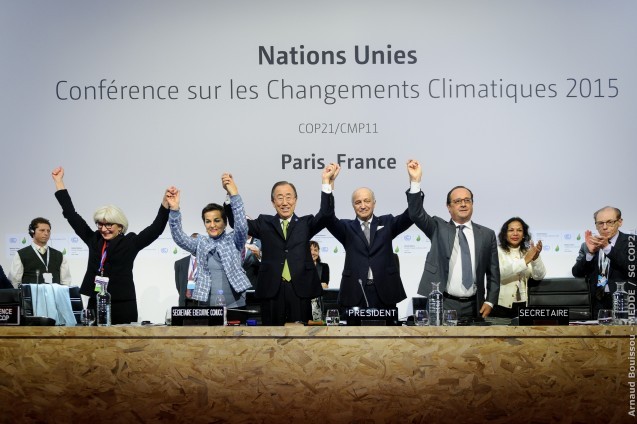
1.) Withdrawal from the Paris Climate Accord
On June 1, 2017, President Donald Trump announced that the United States would be withdrawing from the 2015 Paris Climate Accord. Announcing that “[he] was elected to represent the citizens of Pittsburgh, not Paris” the president defended his decision claiming that it was in the best interests of US citizens. Despite Trump announcing his intentions to negotiate a “better” deal, leaders from France, Germany and Italy retorted that the Paris Climate Accord was not open for further negotiation.
Under the Paris Climate Accord, the US would have been required to cut greenhouse gas emissions to 26-28% below 2005 levels by 2025. The country would also be required to give up to $3 billion in aid to developing countries by 2020.
Both domestically and internationally, several leaders on both ends of the political spectrum voiced their opinions on the decision. Senator Mitch McConnell of KY said, “I applaud Donald Trump and his administration for dealing yet another significant blow to the Obama administration’s assault on domestic energy production and jobs.” Meanwhile, the European Union’s commissioner for climate said “today’s announcement has galvanized us rather than weakened us, and this vacuum will be filled by new broad committed leadership.”
Reshma Kopparapu ‘18, president of the Green and Blue Committee, explained, “Given that we’re the one of the largest producers of carbon dioxide in the world, we have a moral obligation to not only our own citizens but to every country on the planet to do our part in limiting carbon emissions.”
2.) Record High Temperatures
According to the World Meteorological Organization, the past three years ranked in the top three on record in terms of average temperature. These measurements are based on five independently maintained records of global temperatures. Because of an El Niño, 2016 currently measures as the warmest year on record, but 2017 was a close runner-up.
Patricia Espinosa, the Executive Secretary of the United Nations Framework Convention on Climate Change, says “these findings underline the risks to people, economies, and the very fabric of life on Earth if we fail to get on track with the aims and ambitions of the Paris Agreement.”
3.) The Impossible Burger
The Impossible Burger made news headlines this year when it was introduced as a burger that looks and tastes like real meat–but at a fraction of the environmental expense. With more than $180 million from investors, including Bill Gates, the company has plans to “change the world” by satisfying our society’s voracious appetite for beef with an environmentally-sound alternative consisting solely of plant-based ingredients.
According to the Impossible Burger’s official website, the production of each burger requires 95% less land, 74% less water, and 87% fewer greenhouse gas emissions. However, the response has not been all positive as concerns have even been raised by the FDA and even by fellow environmentalists. The product uses soy leghemoglobin, which is made from genetically-modified yeast. The FDA claims that “the current arguments at hand, individually and collectively, were not enough to establish the safety of SLH for consumption.” While the Impossible Burger certainly seems to be taking steps in the right direction, it remains to be seen whether in fact, this novel “burger” is safe for human consumption.

4.) Natural Disasters & Climate Change
From the devastating forest fires that ravaged California, to the trio of tropical storms–Harvey, Irma, and Maria–that pummeled coastal areas, 2017 was a year of natural disasters.
While most scientists are reluctant to definitively attribute any one natural disaster to climate change (natural causes certainly come into play), many scientists speculate that climate change could have played at least an indirect role. The U.S. Global Change Research Program says, “Theory and numerical modeling simulations generally indicate an increase in tropical cyclone intensity in a warmer world.”
This conversation was even brought directly to NA when guest speaker Richard Larsen, a former meteorologist and current leader of a local chapter of the Citizens’ Climate Lobby, came to speak about the connection between climate change and natural disasters. He encouraged students who attended his presentation to get involved in environmental activism, as he thinks the crusade against climate change will reach new heights during our generation.
5.) Climate Data Hackathons
Fear that Trump and his administration would erase climate-related news from environmental and scientific websites prompted several groups to participate in “hackathons” before the president’s inauguration. In an effort to “save” climate data, several volunteers–both amateurs and professionals–frantically worked to preserve data from websites such as the EPA and the National Oceanic and Atmospheric Administration in safe places like the Internet Archive and DataRefuge.
When indeed Trump’s administration began to purge these websites of climate-related information, this team of committed scientists and volunteers was prepared with secure databases of preserved information.
6.) The Syria Crisis and Climate Change?
The debate over the role climate change may have played in the recent Syria crisis reached new crescendos in 2017. While many, from former President Barack Obama to Al Gore to Bernie Sanders, have claimed that a particularly devastating 6-year drought likely caused by climate change may have contributed to the crisis, others have refuted that this analysis oversimplifies a complex issue.
A scientific study published by scientists at Columbia University defended the role climate change may have played in the current crisis. The correlation has made its way into presidential campaigns and debate; this climate change attribution has even helped coin the term “climate refugees”. Yet, many fervently argue that the research into such a correlation is flawed and has been motivated primarily by political interests, rather than scientific ones.
While the debate is certainly anything but settled, 2017 has helped a topic that certainly deserves our attention reach national news.
7.) People’s Climate March
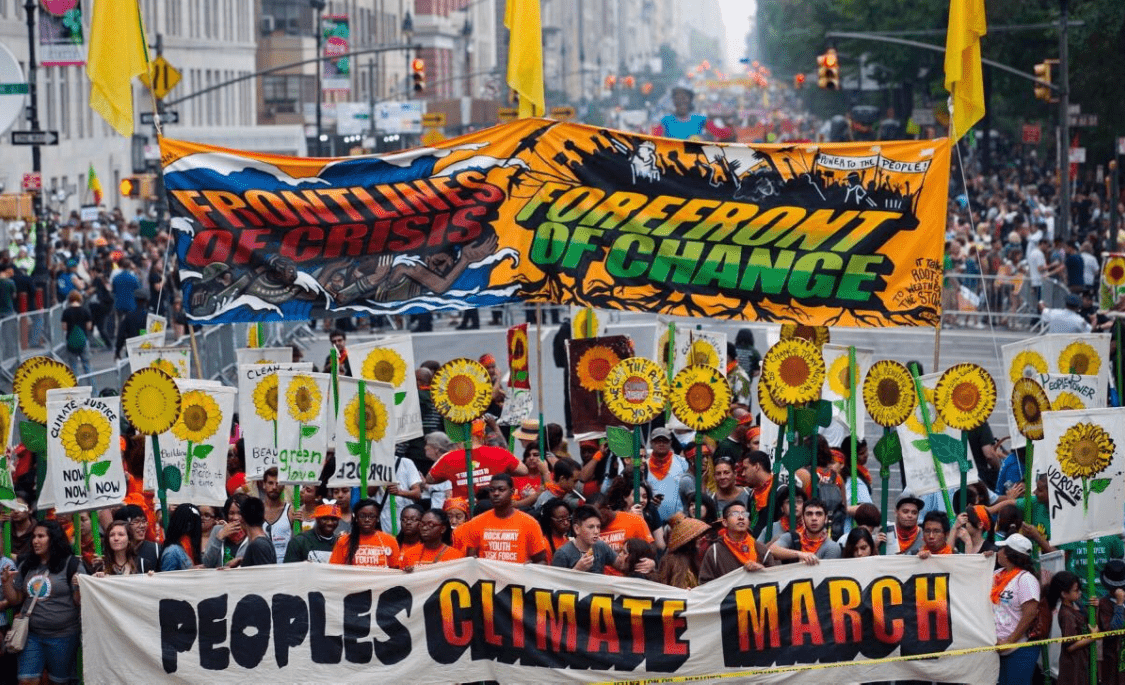
On April 29, the 100th day of Trump’s presidency, tens of thousands of protesters circled the White House, chanting, “Resistance is here to stay, welcome to your 100th day.” When protesters first gathered outside the White House, they let out a communal “roar”, symbolically drowning out the voices of climate deniers.
Several protesters said they hoped the sheer number of protesters who turned out could help translate their grievances into political action. From the appointment of Scott Pruitt as head of the EPA to the signing of executive orders overruling Obama’s Clean Power Plan to proposing EPA budget cuts, there was much that protestors had to speak out against. And they did so with gusto. Several people sporting full-body polar bear suits weaved their way through the crowd. Protesters chanted, “We’re here, we’re hot, this planet’s all we got.” Yet these moments of levity didn’t detract from the greater cause. The protesters made it clear that their grievances would not go away until they were met by executive action.
8.) An Inconvenient Sequel
10 years ago, former Vice President Al Gore produced a movie that shocked the world. Exposing the dire future of our planet should we not work to reverse climate change, the movie served as a global rallying call for action. In 2017, Al Gore released another film called An Inconvenient Sequel. Al Gore travelled around the world interviewing those tackling what has been deemed our generation’s biggest threat.
As the movie’s website says, the movie “pursues the inspirational idea that while the stakes have never been higher, the perils of climate change can be overcome with human ingenuity and passion.”
9.) Good News for the Grauer’s Gorilla
Not all the environmental news this past year was depressing. In fact, news for Grauer’s Gorillas, this year was very uplifting. The Democratic Republic of Congo has been ravaged by Civil War, and, recently, several valuable minerals have been discovered in the area. The consequences for Grauer’s Gorillas have been devastating as the population has experienced a 77% decline (the gorillas have been hunted to feed miners and militias).
But just this year, a group of scientists discovered 50 new Grauer’s gorillas that hadn’t been previously counted, and they suspect that many more may be hiding in one of DRC’s largest national parks. Before this discovery, scientists thought a mere 15 Grauer’s Gorillas still existed. While the gorillas are still teetering on the brink of extinction, this new discovery offers a glimmer of hope for the future.

10.) “Resist” Banner
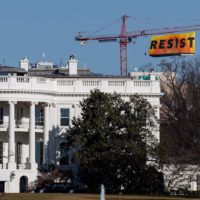
On January 25, people in Washington D.C. awoke to see a giant “Resist” banner unfurled from a crane towering behind the White House. Seven Greenpeace activists had hung the 70 by 35 foot banner, claiming that it spoke for not just environmental issues but for social, economic, and educational justice as well.
One activist said, “while Trump’s disdain and disrespect for our democratic institutions scare me, I am so inspired by the multigenerational movement of progress that is growing in every state. Greenpeace has used nonviolence to resist tyrannical bullies since 1971, and we’re not going to stop now.”
—
As Reshma Kopparapu ‘18 adds, “While 2017 seems to have been a step back for the US in terms of fighting climate change, I’m hopeful that 2018 is the year our country recognizes the urgency of the issue and takes action.”
It remains to be seen where the next year of environmental action–both support and resistance–will take us. Yet one thing remains sure: this contentious issue is not going to disappear anytime soon.
Leave a Reply
You must be logged in to post a comment.