by Carolyn Schachtel ’18, Staff Writer
Arguably the single most prevalent American news story of 2018 began as a normal day at Stoneman Douglas High School in Parkland, Florida. At 2:20 p.m., the now-infamous Nikolas Cruz entered the school with a AR-15 firearm in hand; by the end of the school day, 17 students and teachers had been killed.
It would be remiss to neglect the 17 victims in discussing the details of the tragedy. Alyssa Alhadeff (age 14), Scott Beigel (35), Martin Duque Anguiana (14), Bicholas Dworet (17), Aaron Feis (37), Jaime Guttenberg (14), Christopher Hixon (49), Luke Hoyer (15), Cara Loughran (14), Gina Montalto (14), Joaquin Oliver (17), Alaina Petty (14), Meadow Pollack (18), Helena Ramsay (17), Alexander Schachter (14), Carmen Schentrup (16), and Peter Wang (16) are being recognized, honored, and remembered countrywide in the wake of this calamity.
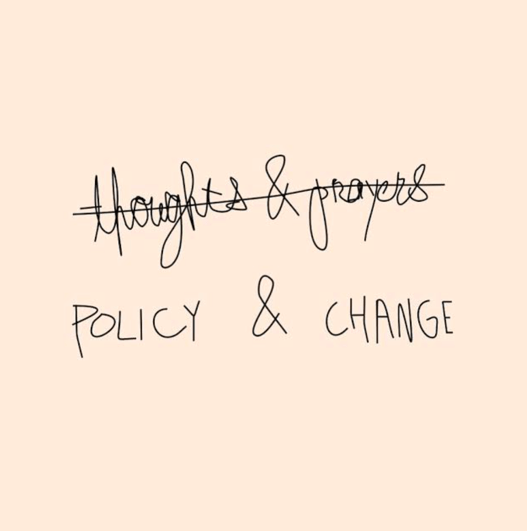
Despite multiple mass shootings throughout the past few years, the response to Parkland seems especially powerful. Parents and students alike are angered by “thoughts and prayers” sent by community members and government officials; instead, passionate victims are desperate for policy change.
Learning and writing about the recent shooting feels particularly difficult as a high school student myself. Throughout the day, I received Snapchat videos from friends revealing horrific first-hand accounts; in the weeks following, I’ve scrolled through countless Instagram stories and Facebook posts dedicated to victims and mutual friends. For this reason, the tragedy has hit especially close to home for high schoolers nationwide; evidently, students have been the driving cause of recent protests regarding gun control.
Wednesday, February 21st marked what would have been the 17th birthday of shooting victim Carmen Schentrup. On behalf of their classmate Carmen, Douglas students boarded buses and traveled to Tallahassee on Tuesday in hopes of meeting with representatives of the State Capitol regarding gun control laws. However, on Wednesday, students were turned away by officials. Despite being unable to directly talk to policy makers, students from both sides of the aisle held signs reading phrases such as “Parkland Strong,” “Arms are for hugging,” and “We stand with the kids.”
In terms of what exactly is being asked of policy makers, many people have different opinions regarding what happens next. The weapon used in the shooting was an AR-15-style-gun, which was previously banned in the US from 1994 to 2004. The 1994 ban outlawed multiple semi-automatic weapons, but was not reauthorized by Congress 10 years later. Following the Parkland shooting, many hope to see a similar ban reinstated, as well as stricter background checks. However, others argue that more extreme measures should be taken, as manufacturers still produced similar weapons through loopholes under the 1994 ban. Many argue that the only way to ensure a true decrease in mass shootings is through the complete absence of civilian guns in American society. On the other hand, opponents argue that it is the shooters, rather than the guns themselves, who are the root of the problem. From this emerges discussion of greater mental health coverage and care.
The White House revealed that Trump is “supportive of efforts to improve the federal background check system for gun purchases.” Following the shooting, Trump and Senator John Cornyn, a Texas Republican, discussed a bill that would aim to forbid unfit owners from purchasing guns. Additional measures that currently have bipartisan support include improving the National Instant Criminal Background Check System. However, it will be difficult for bills containing these measures to be passed through the Senate. Currently, many are worried about the government’s ability to successfully enact change regarding gun control.
The Newark Academy community has also had a significant response to the Parkland shooting. Following the tragedy, Think Tank, Young Democrats, and Young Republicans sparked conversation about legislative responses to mass shootings and gun laws by co-hosting a discussion in the Kaltenbacher Hall. When asked about what he would like to share with the NA community regarding his own thoughts, Young Democrats advisor Mr. Reed responded, “Our society is sick.” Mr. Reed, though deeply saddened by the 17 innocent deaths, noted that the issue was much larger than “gun control laws or better mental health coverage . . . which is not to say that there aren’t more things that can be done.” However, Mr. Reed concluded that the true problem lies in the competitive nature of our society and a lack of compassion. In the future, he hopes to see people treating each other like “brothers and sisters.” Human Rights Club president, Amanda Cohen ’18, classified the shooting as simply “not okay.” She added that having mutual friends at Stoneman Douglas High School and recognizing how similar their community is to our own makes this tragedy feel especially personal. She also hopes to see change in the future.
Leave a Reply
You must be logged in to post a comment.