Spencer Glassman ’19, Commentary Editor
Entering my sophomore year of high school, I was not an art aficionado. I recall my favorite works being Thomas Cole’s brilliant series The Course of Empire or Jacques Louis-David’s painting The Intervention of the Sabine Women. These spoke to me because they told stories and were thrilling in a similar way to an action movie such as “300”, which covers a fictionalized version of Leonidas and the Spartans’ last stand at Thermopylae. There was no great appreciation of the art underlying my fascination with these pieces. Strolling through an art museum was tedious, especially when going through a large stretch without any benches.
In the spring of 2017 I began touring colleges, and started my journey with Williams College in Williamstown, Massachusetts. It is a lovely town that is disproportionately endowed with great art. One of its museums, the Clark Art Institute, changed my perception of art towards the simple appreciate of beauty. As it is made of different parts, the museum’s architecture combines modernist minimalism with classicism. The entrance to the museum is particularly striking. There is a large pool with chairs around it that looks out into the hills and hiking paths of the surrounding area. It provides a serene and contemplative setting, which combines extremely human elements with the most natural ones.
As one enters the front of the museum, the first collection on display is of 19th century American landscapes. This section included the likes of Winslow Homer, George Inness, and others who painted the beauty of the American wild. I never objected to such pieces. Nature is beautiful, and I find environments such as Acadia or Glacier to be particularly sublime. But why should I look at a painting when a photograph or a trip would give me an even better image of the scenery? If art did not provide something in addition to reality, then its only use would be to provide symbolism and insight.
The idea of art as useful is justifiable under the supposition that it has some deep imbued meaning. However, this explanation of art was not convincing. People should be able to walk into a museum and like a painting regardless of having knowledge of its meaning. I was unwillingly to do the analytical work necessary to discover this hidden significance in every piece. It would be extremely time consuming and the purpose was not always intrinsic to the piece. If there is going to be symbolism to a painting, then it should be apparent in the work itself. Too often, I found that meaning was derived by the personal context of the author, or some spurious connection made by an art critic. While the inherent meaning of paintings is enigmatic, individual interpretation of paintings seemed contrived and artificial.
As I peered into another art room, I was instantly struck by the colors. Each painting popped with pinks, blues, and greens. They exhibited a mood of tranquility, pleasantness, and joy across the room. These paintings did not have drastically new subjects, such as those portrayed in surrealist pieces; they depicted landscapes and people. However, unlike the romantics and their predecessors, they centered on everyday life and were not entirely realistic. The painters seemed to take a scene and put it out of focus, taking just the essential elements that defined the atmosphere, instead of the minute details that carry little significance. Instead of painting what was there, the Impressionists painted the emotion. Simply put, it was beautiful.
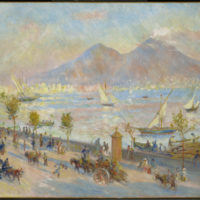
The concept of art as simply beautiful had never before occurred to me as a justification for art. I assumed that no beauty could be portrayed that was not able to be captured in a photograph, but the decision to slide away from realism freed the Impressionists to portray abstract beauty. In Auguste Renoir’s impressionist painting The Bay of Naples, the landscape that he painted may not have contained pink and orange hues in reality. However, when reflecting on the experience of being at that location, one may feel those colors as representations of the spirit of the bay. Art has the unique ability to not only transport the viewer to the scene, but also place them in the time and perspective of the painter.
Contemporary art confronts us with reexamining the question of what constitutes art, and more important, what constitutes good art. One might ask how Kandinsky’s Composition pieces can be considered good. After all, they appear to be an random collection characters and symbols with no possible connection to the real world. An art critic may justify his work with the claims that it represents Utopianism or a response to World War I. However, these rationalizations do not offer any reason for a viewer to see the piece as worthy in and of itself. Kandinsky himself, an early twentieth century abstract Russian painter, understood that it must be the art that supports itself, not an essay. As an admirer of Claude Monet’s Haystacks, Kandinsky saw the beauty in playing with light, color, and shape. Instead of picking a subject, Kandinsky isolated these elements of artistic style. Once bare, he could play with geometric forms, which he believed could evoke spiritual and psychological reactions. Kandinsky’s works were as much a study of art as art itself.
The subject of art may have significance for specific people. For example, devout Catholics may find solace in the works of the Italian renaissance and their images of Jesus, Mary, and other biblical figures. However, someone who does not have knowledge of the Christian tradition will not appreciate the same meaning of the work. Nonetheless, beauty is universal. Symmetry, complementary colors, coolness and warmth, can be understood by all viewers. When an artist concentrates on the aesthetic elements and what they provoke, he or she can create something that is simply good.
I write this article not to persuade anyone of why art is good, or to convince myself of why I like art, but to offer art to all of you. The new Museum Club at Newark Academy will explore some of the greatest institutions in the world. You can come and find a personal reason to like art. You may like to consider what inspired an artist to paint something or the facial expressions depicted on a portrait. Regardless of what inspires you about art, I implore all of you to give it a try and not to force any specific reasoning of why you like something. Just acknowledge that you like it and admit that is enough.
Leave a Reply
You must be logged in to post a comment.