By Sophia Ludtke ’20, Commentary Editor
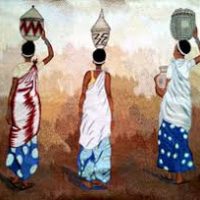
“An international exhibit that would broaden our view of the world” was Art Department Chair Mrs. Brodie’s intention when she set out to find a fall exhibit for the NA Gallery. The beautiful and powerful Pax Rwanda exhibit currently on display in the Tieger Gallery certainly achieves this aspiration.
The story of the history of the Pax Rwanda exhibit is a story about the literal and figurative art of peacemaking — a story about conflict, tragedy, rebuilding, and, ultimately, reconciliation.
The Rwandan Genocide
With 1 million Rwandans murdered in 100 days, the Rwandan Genocide in 1994 was one of the deadliest genocides in history.
Despite having been the ethnic minority at the time, the Tutsi population in Rwanda controlled the Rwandan government until 1959 when the Tutsi monarchy was overthrown by rival Hutus. A significant portion of the Tutsi population fled, forming the Rwandan Patriotic Front (RPF), which invaded the country in 1990. A peace accord was struck, temporarily ending the conflict, until a plane carrying the then-Hutu Rwandan president was shot down a year later.
A surge of violence immediately overtook the country. The Rwandan military, Hutu militias, and even radio stations called on Hutus to brutally and unforgivingly murder their Tutsi neighbors. An estimated 800,000 to 1 million lives were taken, leaving wives widowed, children orphaned, and thousands displaced as refugees. While the violence unfolded, the international community remained shamefully idle. The United Nations Security Council even voted to withdraw a peace-keeping force during the early stages of the conflict, turning their backs on the country as the death toll rose.
The History of the Pax Rwanda Exhibit
In 1994, a few months after the conclusion of the tragedy, Rwandan genocide survivor Christiane returned to her home country where she met several women trying to leave the past behind and start anew by selling embroidered textiles. Determined to help the rebuilding process in her home country move forward, Christiane opened a small workshop in which the most talented women artists she met would have the opportunity to collaborate and let their artistic ambitions grow.
A few years later, current exhibit curator Juliana Meehan was visiting Rwanda when she came across a shop run by Christiane and her fellow artists. Inspired by the beauty of the embroideries and by the workshop’s story, Juliana decided to create an exhibit that would allow the artwork, along with the story each piece tells about Rwanda’s history and culture, to reach audiences worldwide.
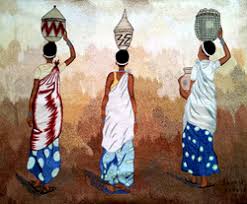
The fact that each embroidery is signed, not with the names of each individual artist, but rather with the communal name Savane Kabuye (after the town in which the workshop is now located) speaks to the unifying nature of the Pax Rwanda project. Despite coming from both sides of the conflict, the women are all able to contribute collectively to artwork that reflects aspects of their culture they all share: the natural beauty of the Rwandan landscape, the domestic role of women living in Rwanda, and various ancient Rwandan traditions.
Art & Post-Genocide Reconciliation
The Pax Rwanda exhibit is certainly a testament to the powerful role art can play in post-conflict reconciliation efforts. While the indictment and trial of those involved with the conflict or the recent turnaround of the Rwandan economy may qualify as legally-recognized, official steps in the process of rebuilding in Rwanda, art plays a more specialized but equally valuable role, aiding in the emotional rebuilding process that some of the more “official” rebuilding efforts may overlook.
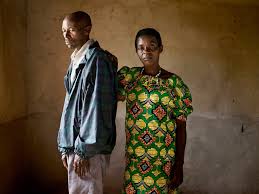
A recent NYTimes article was one such effort, employing the power of photography and storytelling in a project called “Portraits of Reconciliation.” The prospect of a genocide perpetrator, 20 years after the fact, standing next to a women whose family he had murdered during the genocide may seem nearly unthinkable. And yet, the photographs taken as a part of the project capture the incomprehensible. With the aid of counseling provided by an international non-profit, a photograph taken side by side represented the final step in a process of forgiveness between genocide perpetrators and survivors.
Likewise, a portable and inflatable movie screen travelling the country as a part of the Rwandan Film Festival has proven to be a vehicle for emotional reconciliation. By bringing movies to those in rural areas of the country who have never seen a motion picture before, Rwanda’s burgeoning film industry both reflects on the country’s somber past while urging Rwandans to optimistically look forwards. While some might question whether film is truly effective in the rebuilding process, the LA Times article “Rwanda Creating its Own Film Industry” explains how these films bring the stories of Rwandan filmmakers to some of the most marginalized people in Rwanda. In doing so, these films are carrying the message that the free voices of the film makers, along with the free voices of the everyday Rwandans in the audience, are valuable and deserve to be heard.
Rebuilding Worldwide
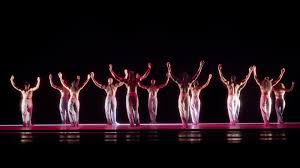
In Rwanda, an embroidery shop brought women from two sides of a conflict together. In Haiti, after the 2010 earthquake, the international “We Are the World 25 for Haiti” song drew the world’s attention to the devastating effects of a natural disaster. Just recently, the Alvin Ailey American Dance Theater’s piece “Untitled America” encouraged the country to reflect on the destructive impact of the prison system in the US.
In each of these instances, across three different continents and in response to three very distinct “disasters”, creative efforts were able to tune into the process of emotional reconciliation and recovery in a way that perhaps more formal and systematic efforts (from legislation changes to monetary aid packages to UN-backed official statements) may have been unable. While these creative efforts can only bring about substantial change when working in conjunction with these more formal efforts, by investing in grassroots artistic efforts, we are investing not just in the rebuilding of structures, or in the restoration of peace, or in the reworking of a broken system, but we are investing in an emotional rebuilding process — a process not just of external but of internal recovery as well.
This past winter, despite fears that the Trump administration may cut funding for US cultural and artistic agencies, the bill he signed actually increased funding, granting these agencies the money they need to continue to operate and expand. As surprising as his decision was, it speaks to the fact that art rises above the contention and divides of politics. From the opioid epidemic to gun violence to unemployment, countless issues in this country must be addressed with formal and systematic efforts. But by incorporating grassroots artistic efforts, these national scale, government-led actions can work to more sensitively address these issues, focusing not just on external recovery but on internal, emotional recovery as well.
*****
Thank you to the Pax Rwanda exhibit for bringing a remarkable story to NA and for sparking a discussion about the powerful role art can play in reconciliation and rebuilding efforts worldwide.
Leave a Reply
You must be logged in to post a comment.