By Sophia Chen ‘20, Staff Writer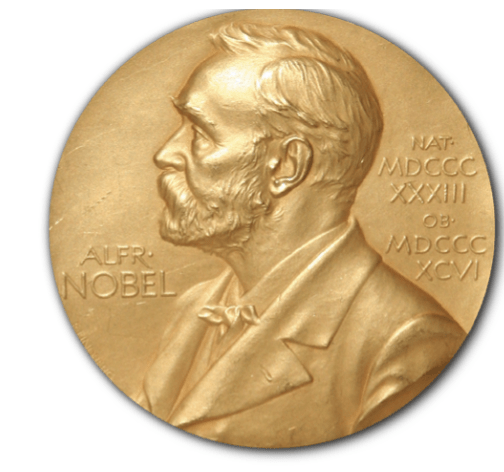
The Nobel Prize Medal depicting Alfred Nobel, Courtesy of Wikipedia
This year, 12 dedicated scientists, activists, and creative minds won the Nobel Prize for their work in advancing their respective scientific, cultural, and creative fields. The Nobel Prize is a set of annual international awards given by Swedish and Norwegian institutions to recognize achievement. The prize which was funded by Alfred Nobel who invented dynamite, is considered to be one of the most prestigious awards in the world. Since the first prize awarded in 1901, 900 individuals have won Nobel Prizes.
The first prize to be awarded this year was the Nobel Prize for Medicine. For the Nobel Prize of Medicine, James P. Allison (USA) and Tasuku Honjo (Japan) were recognized for their revolutionary work in cancer therapy. Their work involved using the immune system to fight cancer by researching a way to promote immune cells to attack cancer cells.
The 2018 Nobel Prize for Physics was awarded to Arthur Ashkin, Gerard Mourou and Donna Strickland for their work in the field of laser physics. Half of the credit goes to Arthur Ashkin and his ‘optical tweezers and his application to biological systems’ and the other half of the credit is split between Gerard Mourou and Donna Strickland for their work generating high-intensity ultra-short optical pulses. Their work allows lasers to make precise cuts which is useful for surgery and manufacturing.
For the Nobel Prize in Chemistry, Frances H. Arnold, for her creative work in directing the evolution of enzymes, as well as George P. Smith and Sir Gregory P. Winter for their work in ‘phage display of peptides and antibodies’ were awarded the prize. Dr. Arnold’s methods to engineer better enzymes are now routinely used to develop new catalysts for more efficient and environmentally friendly manufacturing of chemical substances such as drugs and the creation of renewable fuels. Smith, the other winner, won for his technique known as ‘phage display’, which involves using bacteriophage (a virus that infects bacteria) to make proteins. He genetically engineered the bacteriophage, inserting unknown genes into proteins, and then screened the proteins made. Winter used his method towards directing the evolution of antibodies with the aim of making new drugs.
The Nobel Prize for Economics was awarded to Yale Economist William D. Nordhaus and New York University for their work in alleviating the effect of climate change through economic policies. As the UN is declaring that we need to take action to battle climate change, more attention towards combating climate change is important. For the past four decades, Nordhaus has tried to persuade governments to address climate change by imposing a tax on carbon emissions. He shared the prize with Paul M. Romer, an economist at NYU for his work on how the non-rival nature of ideas can boost economic growth and innovation is necessary for solving climate change. However, since there are many people worthy of the Nobel Prize, the process for choosing the winner often sparks debate. Mr. Manfreda offers his opinion that “It can also be difficult to assess the impact of a single economist as the economy is such a complex entity. Also, the impact of economic policies is often not felt for years or even decades, making it hard to accurately assess impact.”
The Nobel Peace Prize was awarded this year to a Yazidi activist and Congolese doctor who risked their lives in order to combat sexual violence towards women. Dr. Denis Mukwege devoted his efforts to helping victims of sexual violence in the Democratic Republic of Congo, once called the rape capital of the world. In the Democratic Republic of Congo, during the civil war, soldiers used rape as a weapon to destroy women, their families and their communities. Dr. Mukwege treated thousands of women who had been victims of these tactics. In Northern Iraq, ISIS also used sexual violence towards women as a weapon. Nadia Murad, who survived sexual violence caused by the Islamic State, became inspired to become the leader of the movement against violence towards women. Ms. Murad risked her life and her identity by insisting that she be photographed to help the US state department recognize the genocide of Yazidi women and girls at the hands of ISIS.
While all Nobel laureates have done remarkable and groundbreaking work, the process involved in deciding the winners can be controversial. Recent Nobel prizes have been given to groups of individuals. Nobel-worthy work often involves individuals who may or may not be working together closely. The rules state that the Nobel Prize can only be awarded to up to three individuals, which may be an unfair rule considering that many breakthroughs in research may require numerous collaborators. In any event, it is admirable that the Nobel committee acknowledges the work of groups of individuals working in the same area or in different areas. Richard Thaler, a Newark Academy Alumni, won the Nobel Prize for his work in behavioral economics and his work was vital for expanding the behavioral economics field. Recognizing important work experts do in their respective fields is important for the creation of new and novel work. Particularly in science, the Nobel Prize is key to the process of scientific and creative discovery. Dr. Hobson explains, “The Nobel Prize is important because it brings attention to the science world and lets the public know of new discoveries. It changes the way we think about things.” New research that is awarded will motivate other researchers to make new discoveries and be inspired to do research. Dr. Hobson went on to say that, “Fundamental research needs to be done because it takes a lot of years to have any breakthroughs. It takes an accumulation of knowledge to have a new discovery.” The Nobel Prize is important because it calls attention to important research and work being done and motivates future scientists, activists, and creative minds to make new discoveries.
Leave a Reply
You must be logged in to post a comment.