By Sophia Ludtke ‘20, Commentary Editor
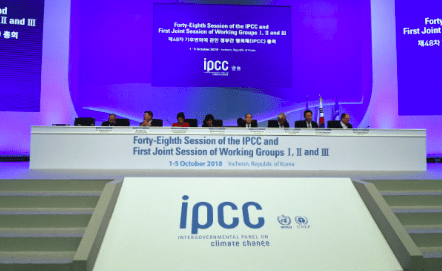
Recently, an official United Nations panel on climate change (made up of over 90 climate scientists), released a shocking and deeply-dismaying report on the current state of our planet. The report explained that 2.7 degrees of warming is all it would take for coastlines to be swept away by natural disasters, countries to be ravaged by forest fires, coral reefs to be destroyed permanently, and entire populations to be left with neither homes nor incomes. And, as the report predicts, this degree of warming could be reached by 2040 unless dramatic and “historically-unprecedented” action is taken.
As Green and Blue Committee Co-President Jamie Paradis explains, “hopefully [the UN Climate Report] will be a moment of revelation for lots of people who may not realize the weight of climate change.”
Already, the Earth has warmed 1.8 degrees above pre-industrial temperature levels, and there is one culprit largely responsible for this devastating warming: coal. To prevent any further warming, scientists and economists estimate that a substantial carbon tax of $27,000/ton would have to be implemented. Ideally, such a tax would result in less reliance on coal and, by consequence, a 45% decrease in greenhouse pollution (from 2010 levels) by 2030.
Yet, significant political opposition stands in the way of the dramatic action the report is mandating we take. President Trump has pledged to revitalize struggling coal mines (cheaper forms of electricity produced by renewable energy, along with international competition, are currently threatening to overtake the coal industry). And, most notably, President Trump pledged to withdraw the US from the Paris Climate Accords — an agreement that, while certainly a step in the right direction, does not even hold countries to the even stricter standards that must be upheld should we wish to truly prevent our planet from experiencing a devastating 2.7 degree temperature increase.
It is hard not to feel angry and helpless when confronted with these two opposing worldviews: a scientifically-backed report mandating immediate action clashing with the intentions of a president who is taking actions completely antithetical to these mandates. It is hard to accept that the fate of coral reefs, coastlines, ecosystems, and even entire vulnerable populations lies, in great part, in the palm of the president’s hand.
The threat of a historically unprecedented degree of warming will require a historically unprecedented degree of action. It is all too easy to fall into the trap of thinking that, if President Trump’s administration is failing to devote our country’s resources to the challenging but incredibly important process of reducing carbon emissions, then the environmental actions of an individual school would be a mere drop in the bucket. If a 33-39% national reduction in coal usage is what would be required to avoid the devastating of effects of 2.7 degrees of warming, then, indeed, the carbon emissions reduction of our small school would be negligible. However, I would argue that not only would this mere “drop in the bucket” be symbolic of our aspirations for the country and planet as a whole, but Newark Academy’s actions could be amplified by inspiring our neighbors to take similar action.
In other words, what the UN Climate Report and our rapidly warming planet are desperately calling for is a wide-reaching, aggressive top-down approach — an approach that would revolutionize the way we all live for the better. Rather than giving up on this goal when met with political opposition (unfortunately from our own country), we should continue to work towards the next best option: a valiant and unrelenting bottom-up approach. By focusing on grassroots initiatives, pledges at individual, school, corporate, and even state-levels to uphold the Paris Climate Accords can amount to something powerful. Not only does the accumulation of these “drop in the bucket” actions add up, but this patchwork of unfailing commitments to taking environmental action signifies to politicians that constituents care. And, when enough constituents are demanding, loudly and passionately, for environmental action to be taken on the national level, then politicians will have no choice but to listen to their constituents’ demands and fight for legislation that will reduce carbon emissions.
So where does Newark Academy fit into this global effort?
In order to contribute to this “patchwork” of actions individual institutions are taking, we must make it a school priority to make environmentally conscious choices. From our school’s compost and recycling program to various other energy usage and waste reduction efforts, Newark Academy already does an admirable job of working to reduce its environmental impact. There is, however, even more the school could be doing.
Schools nearby such as Montclair Kimberley Academy and Pingry both have official “Sustainability Mission Statements,” listing eco-consciousness as a school value and priority. Newark Academy should consider adopting a similar sustainability “pledge” which could formally reflect the school’s commitment to environmentalism.
In 2014, Pingry installed approximately 1,400 solar panels on its campus, which now produce 20% of the school’s energy needs and are forecasted to save the school money in terms of energy expenditures in the long term. The school also uses something called “Noveda Technologies,” which allows students to access real-time data about their energy usage and progress in reducing their carbon footprint. While both of these actions would certainly require significant money and planning, they have proven to be realistic options for a neighboring private school–and, perhaps Newark Academy could look into similar eco-conscious options in the near future.
The results of the recent UN Climate Report are equally alarming and disheartening, particularly in light of the fact that no national scale, politically-led action has any prospect of being taken in the near future. But, it is essential that individual institutions, no matter how small, continue to do their part in reducing carbon emissions. By doing so, a network of individuals, deeply committed to preserving the fate of our planet can signal to politicians, not just through words, but also through actions, that environmental action is essential — and it is this type of grassroots action that holds the potential to be amplified into widespread global change.
Leave a Reply
You must be logged in to post a comment.