By Jackson Powers ’20, Commentary Writer
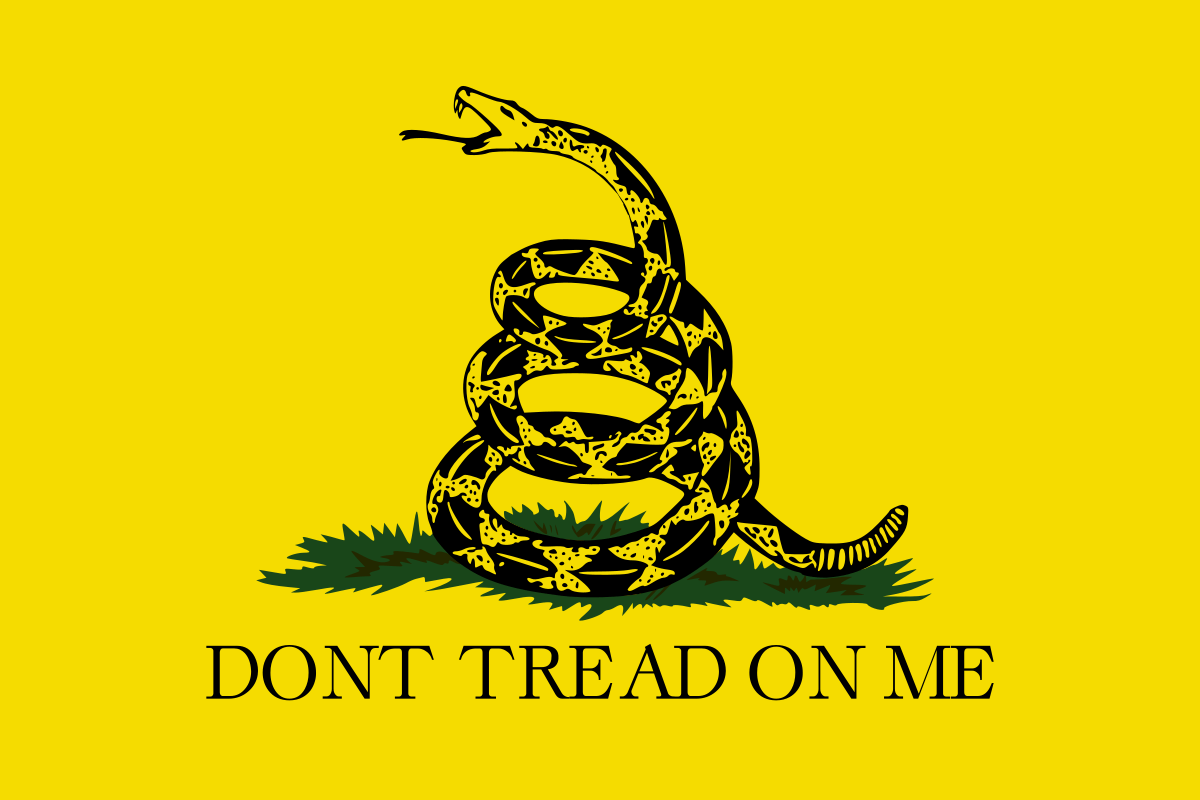
In case you managed to avoid what is most likely the biggest story of the school year thus far, a student, who will remain nameless, brought the Gadsden flag to USA Day during Spirit-Week. Unbeknownst to this student, the flag, originally designed during the era of the American Revolution as a symbol of resistance, had been adopted by the KKK as well as other hate groups as a symbol to represent their respective groups. In the Newark Academy case, there was absolutely no intent to harm or offend, but naturally, the flag drew a significant amount of backlash. This of course raised the prominent issue of how to handle a situation so complicated. The administration decided to treat this incident as an opportunity to educate the student body and spread awareness of the situation, rather than to punish or blame the owner of the flag. I believe that this was absolutely the best way the school could have responded.
I, for one, thought nothing much of the flag when I first saw it, simply noting that a revolutionary-era style was a cool feature to bring to USA Day. In fact, most of the students I talked to after the incident had no idea of the secondary meaning behind the flag. Most agree that the student had no reason to know of the unfortunate connotation. I suppose that people in my situation have the privilege of never having to live in fear of the Gadsden flag, hence our ignorance. But to quote the student in question, “I commend the administration for handling the situation very well during the meeting between me and the offended. They respected neutrality while understanding and amplifying my innocent intent.” Because there was a completely innocent intent, it was a good idea to take the neutral, non-inflammatory stance, and avoid attacking or angering either side of the issue. We do not want to accuse someone with innocent intent of purposely causing controversy, although we do not want to disregard the complaints of those who have been offended either. If anything, the school should have become more active in handling controversy years ago.
One of the students present at the meeting called by Mr. Guiteau and Ms. Hamilton told me that the main problem the meeting focused on was too much tolerance from the school, and that “I think there should have been something done to at least show students that they’re doing something. I just think that in order to show that the school really does mean it, they need to show that they really do care.” A presentation to go over certain hate symbols could not hurt, and a definitive punishment for intentionally bringing hate symbols would demonstrate an increased commitment to creating a safer environment. NA demonstrated its change in approach well, in the form of a much lower tolerance for any malicious images. The school has made it abundantly clear that if another Gadsden flag were to be displayed in any facet, the student responsible would be punished. Once a topic is addressed, nobody else can argue his or her own ignorance. Earlier, the student also mentioned, “It was brought up by a faculty member, by an administrator, that if [someone bringing in a hate symbol] happens multiple times it’s an issue, and yet, this has happened multiple times, not this one particular person, but the situation has happened multiple times and nothing’s really happened about it.” I also quoted the student who brought in the flag saying “Something else to consider is that [another student] brought a Gadsden flag on USA day for the past 2 years.” The school has an unfortunate history of ignoring situations like these. The school has seen Confederate flags, Gadsden flags, etc. brought to school, and yet only now has the administration decided to put its foot down. I think that it is of course better late than never, but the school needs to demonstrate that this is final; there will be no more tolerance for the Gadsden flag nor the Confederate flag, and once awareness has been addressed, there can be no more claims of ignorance. More than anything, the school needs to demonstrate that this ordeal is not for nothing, and that we will not revert to our old, relaxed methods of handling hate symbols.
At the same time, we need to define ourselves and draw our lines. The student who brought in the Gadsden flag was very apologetic, and absolutely agreed that the flag should not be brought back to the school in the future. However, he did bring up the excellent point that “for example, if emotional disturbance was the sole requisite then why can’t someone wearing a Make America Great Again hat or Black Lives Matter apparel be censored if that upsets someone else? There has to be a line between what makes someone feel physically unsafe or just merely uncomfortable.” A MAGA hat may draw criticism or hate by those who hate President Trump and his policies, just as a Black Lives Matter shirt may draw the same from those who believe the group is too extreme. However, these only express opinions founded in reason, rather than hate, and as such, do not demean, dehumanize or label any group as lesser humans. We pride ourselves on our open-mindedness, and on not seeking that with which we disagree. We need to make clear that we tolerate free speech, but we do not tolerate hate. The Confederate and Gadsden flags both carry a significant amount of hatred. We pride ourselves on free speech, but we also pride ourselves on our safe learning environment. No student at Newark Academy deserves to feel personally attacked and afraid. If a symbol expresses one’s superiority, or reflexively another’s inferiority, it simply has no place at our academy.
Leave a Reply
You must be logged in to post a comment.