By Magnolia Wang ‘19, Arts and Entertainment Editor
When I was five and in search for a good summer read, I wandered to an old corner of the library and stared at the endless titles and endless authors. I stopped short upon noticing a book titled “American Born Chinese.” Blowing the dust off of the cover, I opened the book to see vibrant ink illustrations inscripted with miniscule words, but being the barely literate youngster I was, I didn’t quite understand what they were talking about. Placing the book back on the shelf, I told myself, “Maybe next time.”
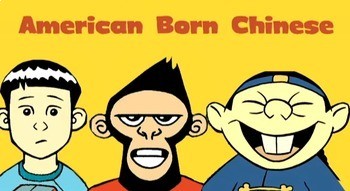
American Born Chinese, written by Gene Luen Yang, is a graphic novel depicting a Chinese-American boy named Jin Wang and his struggles through elementary and middle school because of his race. Yang parallels Jin’s narrative with the more fantastical story of Sun-Wu Kong, a legendary monkey king who struggles to find his true form, based on the Chinese fable. Finally, there is the all-American, white boy Danny dealing with the annual arrival of his mortifying cousin Chin-Kee from China. As a five year old, I knew that these three stories were tied together in some way, but I didn’t know how or why.
Back in eighth grade, my teacher announced that we were going to read American Born Chinese in class, and I was pretty excited about the fact that it was a comic book, an easy read. But as we analyzed each frame and bubble, and how the color scheme was used to portray emotion and theme, I realized that the book was more profound than I’d expected. Jin Wang, the main protagonist, moved to an all-white school district from San Francisco’s Chinatown. He styles his hair to look more “white,” fights over a girl, and reluctantly makes a new “fresh-off-the-boat’ friend, Wei-Chen Sun. Jin lets go of his Chinese identity, and wishes to become white so he won’t have such a hard time at school. Ever since he was young, Jin has attempted to fit into American culture. He has had a childhood obsession with Transformer toys, and even puts powder soap under his arms as a “deodorant”, something he’s never learned as a Chinese. However, Jin drinks bubble tea at the end of the book, reconciling with his culture and Chinese-American identity. The legend of Sun-Wu Kong told in parts throughout the novel also show the Monkey King’s quest for finding his true identity. When excluded because of his monkey form, the Monkey King trained hard to attain a humanoid form, only to be punished for breaking out of his own identity. The third narrative involves Danny, a popular white boy at his high school. He is visited by his cousin Chin-Kee from China, whose name symbolizes “chink”, a racial slur for a Chinese person. Danny despises Chin-Kee because he always has to move schools since Chin-Kee’s visits plummet Danny’s popularity. When Danny punches Chin-Kee, Chin-Kee evolves into the Monkey King, and Danny evolves into Jin. How was it possible that these characters represented each other? It certainly wasn’t logical. I didn’t do so well on my book report, but the grade didn’t bother me as much as the missing piece of the puzzle that I didn’t understand.
Fast forward three years. I was at the library, and once again, had stumbled upon this book. This time, I decided to read it through in one sitting. Through this one reading, I realized a lot of what was going on that I didn’t quite grasp the first time. I realized that Danny was the manifestation of Jin and his attempts to become white, and Chin-Kee was Jin’s perspective of the Chinese stereotypes that plagued him. But most importantly, as my understanding of the differences and divisions between ethnic groups has developed, I could now relate to Jin’s struggles as an American born Chinese. In fact, Jin Wang happens to have the same name as my dad! I’ve been asked whether I’ve eaten dog- and so has Jin. I’ve been tempted to change my look to something more “American”- dying my hair blond, changing my lingo, buying trendy clothes, just like Jin. What I especially like about American Born Chinese is that Jin is portrayed realistically, and I can relate to many of his racial struggles. We’re both experiencing a learning curve, discovering our true identities, and the book has encouraged me to embrace my culture for what it is.
I rarely read books twice. But why did I choose to read “American Born Chinese” again? Jin’s rollercoaster life is pretty similar to mine, having to juggle a social life, family expectations, and school work all at once. Just like Jin, I have downfalls and the occasional upset. In the end, however, I’ve learned to stick to my roots, and feel comfortable in the skin I’m in. I prize “American Born Chinese” highly because I feel closer to the book than I feel with any other. And though sometimes I do fall back into the temptations to conform, just like Jin has, the book has helped me to appreciate my culture and realize who I am as a Chinese American.
Leave a Reply
You must be logged in to post a comment.