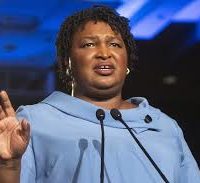
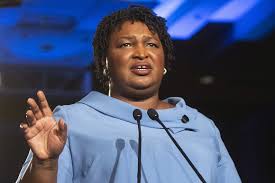
Stacy Abrams. Courtesy of Politico.
By Julia Schwed ’21, Staff Writer
Stacey Abrams faced long odds in her quest to become the 83rd governor of Georgia. Abrams would have been the first black woman to be governor in the United States, and was running a progressive campaign in a state that President Trump carried comfortably in 2016.
Her challenges, however, did not end there. Abrams was running in a state with extremely restrictive voter registration and identification laws. At the heart of the issue was Georgia’s “exact match” policy, which places voter registrations on hold if they don’t exactly match information that is stored in Georgia’s Department of Driver Services database or Social Security Administration information.
According to Abrams, anything as small as a misplaced hyphen could place an individual’s application on hold. The Associated Press reports that, as of October 14th, 70% of the 53,000 new voter registrations that were on hold were from black voters.
Making matters even worse, her opponent, Brian Kemp, was the person responsible for enforcing these laws, and was heavily involved in lobbying for the laws to be enacted. Of course, Kemp’s campaign contested this description of Georgia’s voting laws, saying that voters on hold could still cast a ballot in the election, so long as they could present a driver’s license.
While Abrams’ historic attempt to be the first black female governor and Kemp’s conflict of interest as a candidate and secretary of state focused national media attention on Georgia’s restrictive voting laws, Georgia is far from the only state with prohibitive, and targeted, voter identification and registration laws.
North Dakota, another traditionally conservative state, changed voting laws in 2012 in an attempt to influence elections through voter identification laws that target minority voters. Under a newly enacted law in North Dakota, voters in the 2018 elections were required to show identification that included their name, birth date and residential address.
Like many other voter identification laws, the North Dakota law appears to be benign on its face. However, it is no coincidence that Native American voters were twice as likely to lack acceptable identification as other voters under the new law. According to the New York Times, this was because many people living on Native American reservations don’t have residential addresses, and instead use P.O. boxes, which was not allowed under North Dakota’s new laws.
As 5% of North Dakota’s population, Native Americans are a crucial voting bloc in the state. Further, their support of Democratic candidate Heidi Heitkamp was crucial in her extremely close Senate victory in 2012. So it should not be surprising that the Republican legislature worked to pass a law that they knew would make it more difficult for Native Americans to vote.
As in Georgia, the North Dakota state leadership argues that the policy doesn’t disenfranchise any voter. In a letter that the Secretary of State’s office sent to tribal leaders, they wrote that any voter without an address could call their county’s 911 coordinator, describe where their house is, and be assigned an address that the coordinator could then confirm in a letter.
The explanations given by the Georgia and North Dakota’s Secretaries of State are technically true; the laws don’t make it impossible for anyone to vote. Unlike a century ago, when poll taxes, literacy tests, and grandfather clauses explicitly disenfranchised black voters in the south, it is more difficult now to explicitly suppress minority votes.
Instead, many conservative legislators have used concerns over voter fraud as a mechanism to make it more difficult for minority groups to vote. Unable to enact laws that explicitly prevent minority groups from voting, conservative legislators have instead focused on passing laws that make it increasingly difficult for them to vote. Instead of telling minorities that they can’t vote, the state purges them from voter records, or makes them call a 911 coordinator and get an official letter just to exercise their constitutional right to vote.
How can we be sure that Republicans aren’t legitimately concerned with voter fraud, and are instead trying to suppress minority votes? For one, voter fraud is not a real issue in the United States. According to the Brennan Center for Justice, as well as numerous other studies, voter fraud happens very rarely. A Washington Post study found only 31 credible cases of voter fraud out of 1 billion votes between 2000 and 2014. States that don’t have restrictive voter laws don’t have reports of non-citizens voting. No matter how many times Trump fabricates claims of voter fraud, the reality is that the he had to shut down the Presidential Advisory Commission on Election Integrity that he created, because they were unable to produce any evidence of voter fraud.
Of course, sometimes it is obvious that Republican lawmakers are focused on suppressing voters who aren’t likely to support them. Mississippi Senator Cindy Hyde-Smith, a Republican, recently said that “there’s a lot of liberal folks…. Who maybe we don’t want to vote. Maybe we want to make it just a little more difficult. And I think that’s a great idea.”
Cindy Hyde-Smith wasn’t talking about minority voters– instead she was focused on college voters, but her comments are consistent with the general goal of conservatives. They suppress minority votes not because they are racist, but because minorities are overwhelmingly likely to vote for Democrats. For many Republicans, it is about preventing citizens who are unlikely to support them from casting a vote against them. Voter suppression is a gross miscarriage of justice, and is fundamentally at odds with the ideals of our Constitution. Unless pressure is applied to state legislatures, history will continue to repeat itself and minority voters will continue to be disenfranchised.
As the dust settles on the contentious 2018 midterm elections and we reflect on our current political climate, voter suppression serves as a stark reminder of the issues that we must overcome in order to move towards a more productive and fair political system. If we continue to discourage people from participating in democracy because of the color of their skin or the party that they support, how can we expect them, or anyone, to believe in our democratic system? If we want a political climate that is less polarized, and more representative, we must instead encourage democratic participation.
Leave a Reply
You must be logged in to post a comment.