
By Zachary Burd ‘19, Editor-in-Chief
A spectre is haunting Newark Academy—the spectre of exams. As this set goes to print, the Newark Academy community is hunkering down for its annual academic tradition. Teachers are stapling papers and stacking Blue books. The maintenance staff are moving desks into the gyms. Students are finishing (or starting) their last-second preparations, huddled in furtive clumps in the L or the library.
To many, in-school exams are a remnant of educations past, but to others, a crucial summative assessment. The current exam system features exams in two subjects for all students each winter. One of those subjects is always Math, and the other is an annual rotation between Science, English, and Humanities.
As I’ve compiled my research for this article, interviewing and surveying teachers from every academic departments in both middle and upper school, a few students and teachers proposed to me the elimination of all in-school exams. These opponents of the current system cite the excessive burdens of stress and time that exams place on already-overworked NA students. One Math teacher agreed that exams cause an inordinate amount of stress, writing, “The single-day, timed nature of exams can lead to stress and anxiety that cause students not to perform to their capabilities.” Teachers also noted the time-intensive process of grading and creating new exams, as well as students’ tendency to avoid taking classes which have an exam that year.
With all these downsides to exams, you might wonder why we’re still herded into the dining hall and Wrightson gym every winter. The justification for the current system hinges on two main points: that exams provide an opportunity for the synthesis and review of class material, and that exams prepare students for the content and skills needed for success on other exams. Studying for a test often only promotes short-term recall of information, while an exam reinforces the entire semester’s worth of material. This is especially important for more cumulative and content-based classes, which rely heavily on earlier knowledge. I agree heartily with a Math teacher, who wrote, “A student’s grade should reflect current knowledge, not what they did or didn’t know weeks or months ago. Students who scored poorly in the past might need the exam to pull their scores up—and prove that they know now what they might not have known earlier. But students who scored high in the past should still prove that the knowledge is still theirs—and that their final A isn’t just the product of cramming—and very short-term memory.”
And besides just forcing students to organize and review class material ahead of possible AP and IB exams, having a winter exam teaches crucial test-taking and study skills like mental stamina and content, stress, and time management that can be applied to all exams. Currently, NA students face an annual endurance challenge of two exams in a day, which can seem quite cruel. But when compared to the punishing slate of AP and IB exams I (along with many other NA students this spring) will be facing, it’s a cakewalk. From May 7 to May 22, I have 11 total sittings (meaning 11 mornings or afternoons consumed with exam-taking), including 6 sittings for exams in one particularly rough week. One perspective on this is that if we already have so many exams, why would we consciously add to that stress? But another point of view is that if I don’t have adequate preparation for that stretch of exams, my performance will be severely diminished. It’s like a (very academic) form of conditioning. The more often you take an exam, the more routine the experience becomes, and the better you do.
Having winter exams is potentially even more crucial for non-AP/IB students, who don’t have those external exams at the end of year to prepare them for standardized tests like the SAT or ACT or the final exams they will soon experience in college. Although there are exceptions (most notably Harvard), final and in many cases, midterm, exams are still overwhelmingly the norm, rather than the exception, on college campuses. As a college preparatory institution, Newark Academy has a responsibility to give its students a meaningful amount of exam-testing experience, or at least some similar form of summative assessment.
Winter exams can serve as a diagnostic tool, helping guide teachers’ lesson plans and pacing in the spring as well as helping students identify areas of academic strengths and weaknesses. Moreover, I’ve heard from several teachers that students, on the whole, do much better in the spring of classes that have exams that year. As Dr. Thayer, the Math department chair, told me, “We would be doing our students a disservice if we didn’t ask them to take exams.”

At this point, I began to wonder why we don’t have spring exams for exam-testing subjects anymore. If the argument for the current system is that having to study all the fall material reinforces and ensures long-term understanding of information, then why not have a spring exam to replace or supplement the winter exam that would accomplish that goal even further? After all, we’re only testing a measly 43% of school days when we assess the fall semester.
I was feeling pretty satisfied about resurrecting this idea from previous decades until my sister, a freshman at MKA (sad, I know), read what I was typing and matter-of-factly informed me that is exactly what her school does. There are fall and spring exams (they have them in all classes), but seniors and students in AP and IB classes are exempt. After all, seniors are already checked out, both mentally and physically, by that time and there’s no need to have in-school summative assessments if the students are taking external ones on the same material. Pingry has a similar system, but there are only end-of-year exams.
I found the response to this proposal for spring exams to be mixed. Colin Murphy ’20 said, “We should have exams in both the fall and the spring, otherwise we forget everything,” and 75% of Math teachers surveyed had a positive reaction to the proposal. Spring exams can also lead to more accurate class placement for the following year, and they would help keep both students and faculty focused until the end of the academic year. But Mr. Stourton, the English department chair, rightly pointed out that in spring exams, it wouldn’t be about fixing your academic weaknesses, but rather whether you had learned what you needed to or not, which breaks with NA’s skills-based philosophy. To this criticism, I would reply that the skills gained in preparing and taking exams are valuable in and of themselves, but the point is taken. There are obvious downsides to this proposal, perhaps most clearly in terms of scheduling. Would spring exams take days away from June Term? Would they take valuable days away from class time, both in terms of taking and reviewing for the exam? These are all issues that would need to be addressed for this proposal to be implemented.
Another proposal I considered was to have permanent Math, Science, and Humanities exams. A general perception within the NA community, as one teacher put it, is that “Math is the only department really wed to [the idea of] exams.” On the surface, this seems to be the case. 75% of Math teachers surveyed like the current frequency of exams or want more, even with already having an exam every year. But 57.1% of Science teachers surveyed would like more frequent exams as well. Both Science and Math are largely cumulative and content-based subjects, and they would both be well suited to annual exams. But surprisingly, 80% of Humanities teachers surveyed also want a permanent exam every year. That’s a huge number for a department not traditionally considered a stalwart supporter of exams. But wait for it—the other 20% of Humanities teachers want an exam multiple times a year. There’s obviously a disconnect between the teachers, who are the ones actually testing the material (and who likely know best), and the administration, who tells them how often they can test. Anish Nuni ’19 supports this proposal, arguing that it “is more fair because grades can be standardized and compared over many years.” Anish makes a good point about the benefits of both teacher and student access to results from longitudinal exams. However, this proposal would require a second day of exams, which could complicate scheduling. That second day is already allotted for makeups, though, which should make the calendar issue less pressing, and I’m sure the scheduling wizards in the administrative hallway can figure something out.
Before I move onto the last (thank goodness) proposal, my personal favorite, I wanted to acknowledge that there are several other valid forms of summative assessments that accomplish many of the same goals as exams. For example, every Language teacher I’ve talked to has agreed that oral assessments are more telling of a student’s ability than any form of sit-down assessment. However, they are quick to point out that this is unique to the needs of the Language department. English is the next department many people look to when they think of opposition to exams, but I’ve found that they are ambivalent, on the whole, to exams. One teacher put it as, “We’re happy to take our turn for exams, but we’re happy to give it up as well.” English classes are less content-based, reducing the value of exams, so that is why I did not give them an annual exam in this proposal.
My last idea of how to reform the exam system is in the model of Seton Hall Prep, where final exams are the expectation for every class but individual teachers have the discretion to decide whether to replace that exam with a more unorthodox final project, like a presentation or research paper. The main problem here is of coordination when there are multiple teachers for different slots of the same class. The teachers would have to agree whether they want a final exam or not, just as teachers of different slots now have to standardize what students see on the class exam. Some students under this system would end up taking few or no exams, while others would have several. But as one Science teacher wrote, “I really like the idea that certain classes just have an exam, and others don’t. You know what you’re getting yourself into when you sign up for the class. It seems strange to me that every three years students have to take a Chem exam (which many people are intimidated by), but in other years students don’t have to worry about that.” In addition, many teachers dislike restructuring their courses every three years, as non-Math exam-testing classes are obliged to do.
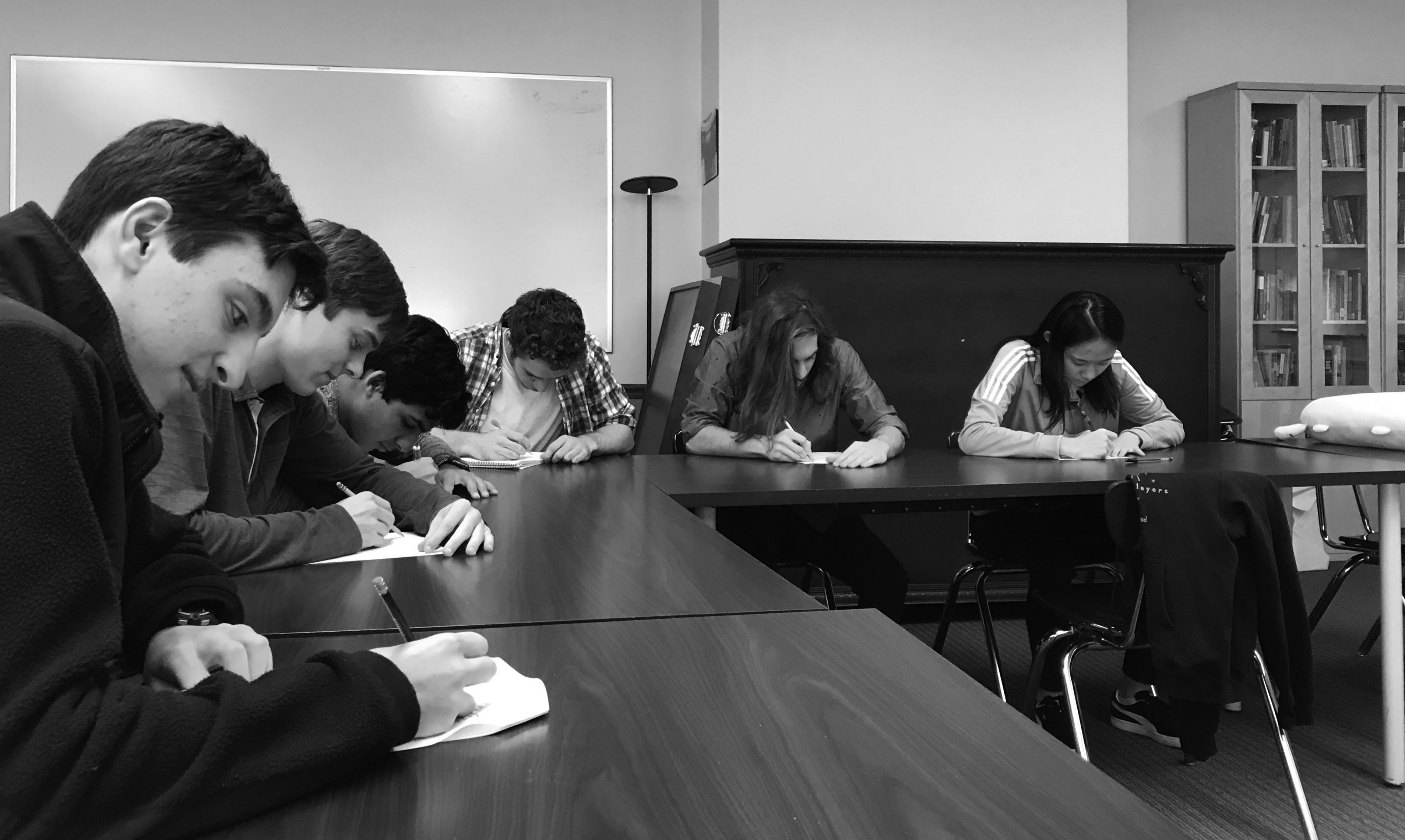
In all these proposals, the ultimate challenge is finding the line between not unduly stressing students and preparing them from the certain stresses that lurk just around the corner. As Mr. Austin, our Head of School, said, “The current system is a middle ground, providing students with important practice for formal timed exams but without overburdening them with multiple exams in a short period. Some pressure around exams is unavoidable and healthy, but too much is educationally counterproductive and unnecessarily stressful.” I support this last proposal of building exams into certain classes because some classes, not necessarily determined by academic department, are more content-based and reliant on cumulative knowledge than others. Each class can determine for itself whether or not to have an exam, and build that decision into its curriculum. That doesn’t mean all classes with associated external exams should have in-school ones, but rather that classes that are simply better suited for exams should have them. For instance, APUSH is a prime candidate for exams with its barrage of content, but so is the other sophomore history (non-AP) option, American Experience.
And exams need to have enough weight to reflect the immense amount of work students put into studying an entire semester’s worth of material. Nearly half of Math teachers surveyed said their exams are worth 1.5 tests or less in a justified attempt to make exams less stressful than a college class, where everything rides on one assessment. Yet then the studying required is not commensurate to the outcome. Currently, there is a school rule saying exams cannot be worth over 20% of a class’s semester grade, but too low of a weight can be equally detrimental to students. A bounded range of 15-25% semester weight would work better, with each teacher once again having the prerogative to decide within that range.
It’s my belief that there should be more exams than we have now, and a large majority of teachers and a significant number of students agree with me. This is especially true for the older students I talked to, whether that opinion derives from a vindictive desire for future students to suffer through more exams or a realization that students need further formal exam practice to be successful on the many important formal exams later in our academic careers. I’ve presented a wide variety of other options, though, with each proposal’s pros and cons laid out, for the school community to consider. But by no means is keeping the current system off the table; it has functioned with some success for the past few years.
I believe we should be more like Seton Hall Prep, but decide for yourself. We’ve certainly studied enough to deserve a say in the matter.

Leave a Reply
You must be logged in to post a comment.