By Joyce Wang ‘20, Arts and Entertainment Editor
This past December, hip hop artist Kendrick Lamar and R&B singer SZA finally settled the year- long Black Panther case that entailed copyright infringement claims regarding their “All the Stars” music video. Both the film and music video explore the philosophy of Afrofuturism –– combining African and African American culture, technology and science fiction to create provocative portrayals of the future. While the case’s ending remains undisclosed, the controversy surrounding the extent of copyright protection is not a first in the entertainment industry.
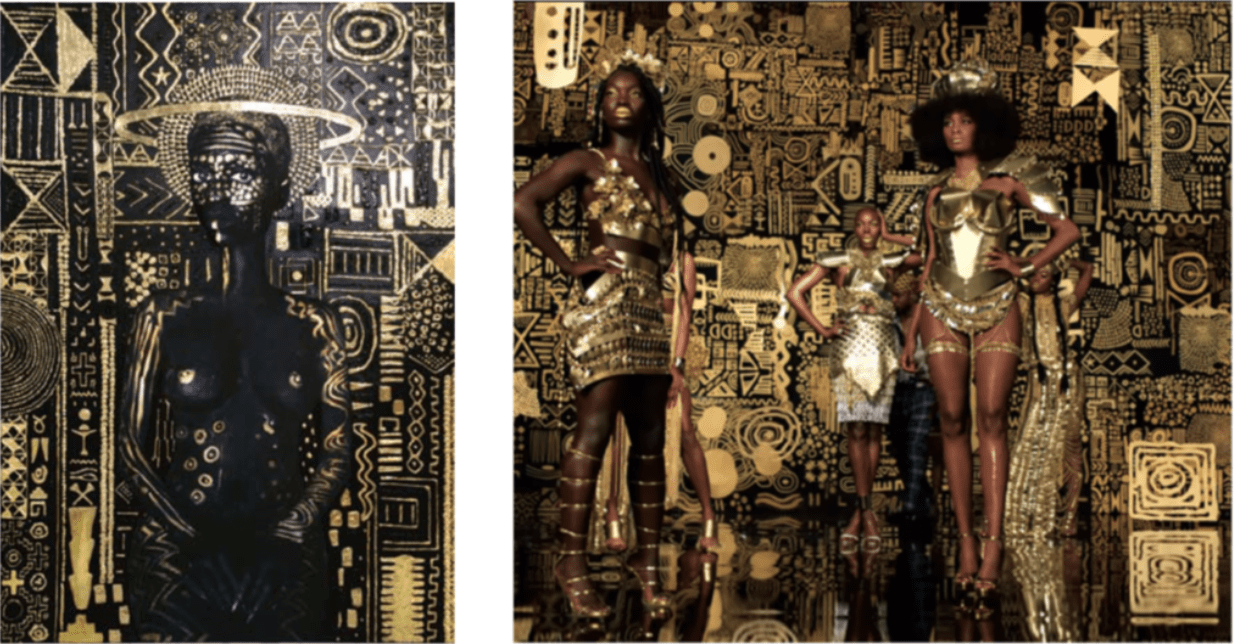
According to the British-Liberian artist Lina Iris Viktor, the music video appropriated visual elements from her painting series “Constellations” in one of its ending scenes. Viktor claims to have rejected the requests of Black Panther representatives to incorporate elements influenced from her painting into the film; however, similar gold symbols and drawings still worked their way into the promotion video All the Stars. Viktor filed a lawsuit under the Copyright Act last February, seeking compensation in the form of “cut the profit” from the song and video sales.
But is the case even eligible for copyright infringement? In order for a work to be an act of infringement, several criteria are required. First the artist needs to show ownership of the original work. Then they need to prove that there has been actual copying and improper appropriation of the work. While proving ownership is testifiable, how “substantially similar” two art works need to be to be considered an infringement offense is much more difficult. In fact, according to the American Bar, the criteria evaluating the similarity between two pieces are purposely vague in order for the test to apply to various types of works and contexts regardless of the nature of the copying. For example, there is no uniform test or rubric utilized for infringement cases. There are four tests distributed across the many circuits in court.
The first test is the ordinary observer test, which asks if a layman would recognize the accused work as being a copy from the original. The second test is called the Extrinsic/Intrinsic Test. It is a combination of the first test with a more objective portion that tries to analyze the type of materials used, the subject matter, and the setting. The third test is Total Concept and Feel. Just like its name, the test focuses on the similarity between the overall mood and conveyed message between two works. The final test is the Abstraction/Filtration/Comparison Test. Professor Kevin J. Hickey, who works at the Berkeley Center for Law and Technology specializing in copyright similarity analysis, says this test is particularly admired for its dedication to distinguish between protectable and unprotectable elements. However, it is generally used for computer software cases because of its extreme analytical process that tends to miss out on holistic elements in art or music. Which test would you use to examine the picture above?
Due to the variety of tests and case outcomes, most proof needs to be generated by the prosecutors themselves. Often, artists show a particular chain of events through which the defendant may have gained access to the work or point out common errors between the pieces that couldn’t have taken place coincidentally. But even with the best case and argument, courts may still not believe that infringement has taken place.
Mr. Worrell, NA’s own photography and digital arts teacher, shares his personal experiences confronting the complications involving copyright. A commercial still life photographer outside of school, Mr. Worrell spends a lot of time registering his images with the U.S. Copyright Office. “Over the past 25 years, I have had numerous images used without my permission. And in my experience it never makes it to court. Usually, a cease and desist letter is all that it takes, as threatening a lawsuit over copyright is your very last resort ––it is very expensive.” Furthermore, Mr. Worrell effectively points out the internet’s role in increasing the likelihood of copyright offenses: “Because anytime found on the internet is free, it makes it easy to steal images and art. The crucial communication between the artist and the “renter” is diminished and causes most violations nowadays to be people paying for an artists work for a certain amount of time and money but then using it for much more.”
Clearly, there are many complications in the copyright infringement process, often resulting in undisclosed results as in this case, but copyright protection is important because it provides incentive for artists, writers, musicians to create and publish their work. I believe that exclusive rights and benefits need to be granted to artists especially because it is more difficult to determine if an element of someone’s art was copied from as opposed to a computer software program with explicit codes as reference. Acknowledging this, while there is still improvement to be made in the legal process of infringement cases, I think artists themselves can take more responsibility and advantage of the rights granted to them as of now.
One way to do this is registering work. While any created work is automatically copyrighted, formally registering art will prove useful in cases of infringement and violation of the copyright act. Registered work gives artists eligibility status for statutory damages and attorney fees. Most importantly, registering your work will prove the owners’ legitimacy before the infringement took place and prove a higher chance of copying from the accused. Artists need to take full advantage of the protections Copyright does offer to combat the various forms of infringement existing in today’s modern age.
Leave a Reply
You must be logged in to post a comment.