By Ben Chaddha ‘21, News Editor

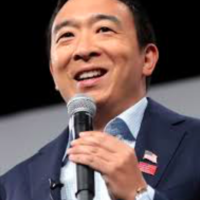
With the 2020 presidential election on the horizon, Democratic candidates’ campaigns are in full swing. While many Americans use political experience as a metric to make their decision, there is one candidate without any political experience who has gained a considerable following. This candidate is the entrepreneur, Asian American, and leader of the #YangGang, Andrew Yang. Yang has been selling posters, signs, stickers, and hats that say “math.” Yang’s “math” merchandise is catered toward his primary audience: young, educated and “nerdy” Americans. It is Yang’s plan to run a different campaign — one that focuses on why his policies are the best rather than why his rivals’ policies are bad. Yang sums up what makes him special: “The opposite of Donald Trump is an Asian man who likes math.”
Born in 1975 in Schenectady, NY, Yang is the son of Taiwanese immigrants. He graduated from Brown for his undergraduate degree and then went to Columbia for law school. In 2011, Yang began a new company called Venture for America (VFA), whose mission was to create jobs for American citizens in major cities. During that period, Yang worked closely with President Obama, using VFA to create jobs for Americans. In fact, President Obama’s administration called Yang “a champion of change” in order to highlight how Yang rose “to meet the many challenges of the 21st century.” While working on this, Yang began to realize that automation was taking jobs away from Americans. During his campaign, Yang has discussed how automation and technology are taking away jobs from millions of Americans, citing his Freedom Dividend as a response to this problem.
Yang’s Freedom Dividend, also known as Universal Basic Income (UBI), plans to give $1000 a month to all US citizens 18 years and older in the United States. Yang’s strategy is unconventional; however he is not the first to suggest it. Politicians in the 20th century, such as Huey Long and Henry George, were some of the first proponents of a UBI for all American citizens. Furthermore, in the late 20th century, Martin Luther King, President Nixon, and Senator McGovern all supported basic income to varying degrees. As stated before, Yang wants to institute the Freedom Dividend in order to mitigate jobs lost to automation. UBI achieves this through a trickle up economy; Americans can use the $1,000 per month to educate themselves and get by as more and more jobs are getting lost to automation. Furthermore, Yang is trying to boost consumption, which in turn creates more jobs in other sectors. As technology progresses in the next few decades, many blue collar jobs will be eliminated in the US. However, as Yang states on his website, “If Americans have no source of income—no ability to pay for groceries, buy homes, save for education, or start families with confidence—then the future could be very dark.” In order to pay for the UBI, Yang plans to implement a new tax on Amazon and other big corporations. Companies like Amazon and Google are chosen because they are large technology companies. Yang asserted that the money would result in large economic growth. Furthermore, lower federal costs in the prison system and in homelessness services would also allow for the US government to pay for the Freedom Dividend. Lastly, the Freedom Dividend would result in “value gains,” which allow Americans to be better educated, healthier, and more productive. Yang also plans on implementing a value added tax (VAT), which would give a miniscule amount of every Amazon sale and Google ad to American citizens, thus creating a trickle-up economy. VAT targets companies like Amazon and Google because they are companies in which automation is going to take away people’s jobs as technology progresses (i.e. automation replacing Amazon warehouse workers).
Another unique aspect about Yang and his campaign is that he is one of the few first-generation US citizens to run for president. As more people immigrate to the United States and their children become first generation US citizens, there should also be more first generation citizens in the government. This allows immigrants to be better represented in the United States.
Overall, Yang has received mixed feedback from the press. One negative headline from the Economist states, “Andrew Yang, prophet of doom.” On the other hand, the New York Times states that “[Yang] has also built one of the most ideologically eclectic coalitions in the field, drawing support from progressives, libertarians, Trump voters and disaffected voters.” Yang’s wide array of supporters will allow the US to move “not left, not right, but forward.”(CNN) One Newark Academy student states that “Andrew Yang has a lot of new and interesting proposals that should be brought into the political discourse. I think his proposal for the Universal Basic Income is very unique.” Another Newark Academy student states,“As much as I think that Andrew Yang is better than some of the alternatives, I think that Yang’s core political platform, being the universal basic income, is simply not economically or politically sound.” Overall, Yang’s young social media followers have allowed him to make it to three Democratic debates and get a large amount of news time to share his thoughts and ideas about the future of America. If the past is any indication for the future, Andrew Yang is sure to stay active in the next year of campaigning and debating.
Leave a Reply
You must be logged in to post a comment.