Julia Schwed ‘21, Commentary Editor
The 2020 presidential primary elections are around the corner, and Democrats are searching for a candidate who can beat President Trump in the general election. Although the desire to limit President Trump to one term has unified and energized the party, one important issue has divided voters and the candidates: healthcare. All major Democratic candidates support changing the current system, but they have different proposals for how to do it. Moderates, such as Vice President Joe Biden, propose modest changes, whereas liberal candidates, such as Senators Elizabeth Warren and Bernie Sanders, seek a complete overhaul of the system.
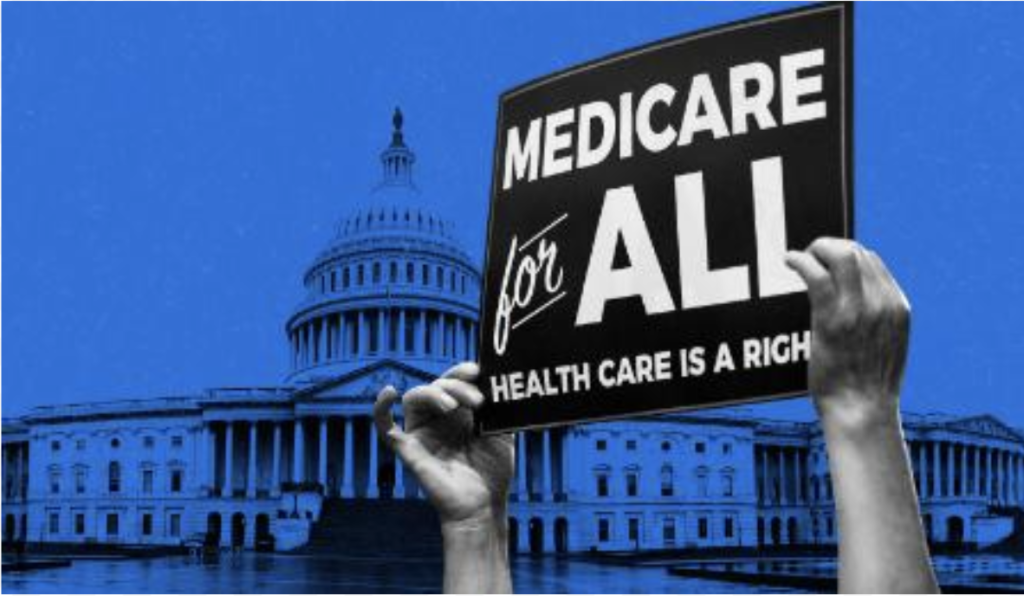
Several Democratic candidates are supporting the Medicare-For-All plan to win the nomination, but this plan may not work in 2020.
Photo courtesy of CNN.
Under the current system, the elderly get their health insurance through Medicare, and the lowest income people are covered by Medicaid. These are the only forms of government health insurance that exist today. For those who do not qualify for Medicare or Medicaid, private insurance is the only option for health insurance. All the major Democratic candidates want to increase the government’s role in health insurance and decrease reliance on private insurance, but they differ in the amount of government involvement. Vice President Biden has proposed a plan that expands Obamacare to include a public option, while Senator Warren and Senator Sanders support a single-payer “Medicare-for-all” plan that replaces private insurance with government insurance.
Warren’s and Sanders’s 30 trillion dollar single-payer plan replaces private health insurance with Medicare coverage for everyone. Under Medicare-for-all, everybody receives government health insurance, and private insurance as it exists today would be eliminated. Like Medicare, the government insurance would be free to everyone, but taxes would be increased to pay for the insurance.
Biden has proposed a middle ground between a single-payer plan and what is currently in place – the private-only plan. His plan is often referred to as the “public option” because it offers people the option of government insurance, but, unlike the single-payer plan, does not require people to use government insurance. Under Biden’s plan, everyone has the option to continue to be covered through private insurance or to buy into government health insurance.
Although the single-payer option appears to be popular among Democratic primary voters, it presents a big risk for the Democrats in the general election. Its popularity is shown by a Kaiser Family Foundation (KFF) poll, which found that 53% of voters were in favor and 45% opposed the plan. However, it appears that much of the support is based on a lack of understanding of what would happen if the plan were to be implemented. In the same poll, 67% percent of those in favor of Medicare-for-all believe they would be able to keep their private health insurance. Of course, the single-payer plans proposed by Senator Warren and Senator Sanders would eliminate private insurance. One KFF poll showed that after understanding this aspect of Medicare-for-all, only 37% were in favor and 58% percent opposed the plan. In contrast, the public option has broad support across political parties. The KFF poll showed that 75% of the electorate supports the public option plan. It has broader support as well, as 64% of Republicans in the KFF poll supported creating a public option.
It is easy to understand why so many people are nervous about losing private health insurance under Medicare-for-all. Although Warren has said she has never met anybody who likes their health insurance, the polls disagree. One Gallup poll found that 80% of people with private health insurance said that the quality of their insurance was good or excellent. Considering that 66% of the population has private health insurance, that is a significant portion of voters. There may come a day when public health insurance dominates the marketplace, but there is no reason for Democrats to try to force it on a hesitant electorate. If people find government health insurance to be better, then they will switch and force private health insurers to improve or go out of business. In addition, a gradual switch would have less of an impact on the economy than immediately shutting down an entire industry.
If the main goal of the Democratic party is truly to beat Trump, supporting a single-payer system is a risky proposition. Voters in both parties view health care as an important issue, and the fear of losing private insurance may energize the Republican base, push Independents to vote for Trump, and keep some Democratic voters at home on election day. Furthermore, since many Medicare-for-all supporters apparently do not understand what the plan entails, if it becomes the focal point of the election, it may become better understood and less popular.
Democratic candidates and voters must decide if they are willing to risk the 2020 election on their hopes of a single-payer system. It is an idealistic hope, rather than a realistic plan, because of how unlikely it is to be accomplished, even if Senator Sanders or Warren were to win the election. Congress would be extremely unlikely to pass a bill that creates a single-payer system. It seems foolish to risk the election on something that could turn out to be politically toxic and is unlikely to happen, even with a Democrat as president.
Leave a Reply
You must be logged in to post a comment.