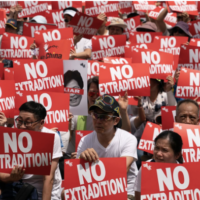
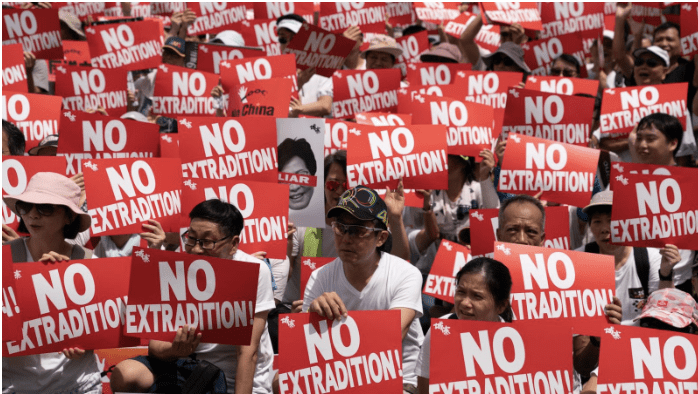
Protestors gather on June 9th to demonstrate against the extradition bill
By Katie Powers ’22, News Writer
In 2010, the people of Tunisia began government protests, rebellions, and uprisings in response to government corruption, oppressive monarchies, human rights violations, and low standards of living. This movement for democracy marked the beginning of a series of revolutions across the Middle East now known as the Arab Spring. From 2013 to 2014, Thailand entered a state of political instability as citizens began anti-government protests aimed at diminishing class-conflicts, combating external influence on politics, and removing a Prime Minister who was thought to be corrupt and challenging democracy. Now, in 2019, the autonomous territory of Hong Kong has begun another in the long list of Democratic revolutions across the globe.
The territory of Hong Kong was firstly a British Colony, before being handed back over to China in 1997 and becoming a Special Administrative Region (SAR). As an SAR, Hong Kong retains limited autonomy, meaning the territory can largely operate as an independent country, with its own currency, immigration channels, and legal system, despite being under the control of mainland China. This relationship is often referred to as “one country, two systems.”
Hong Kong’s conflict began in April, when an extradition bill was proposed. The extradition plan essentially allows the Hong Kong government to detain and transfer people in their territory who are wanted in an areas such as mainland China, where there was formerly no extradition plan. Critics in Hong Kong were concerned that this bill would diminish Hong Kong’s autonomy and challenge democracy, as it allowed for China to not only extradite criminals but to extradite political activists. The China director at Human Rights Watch, Sophie Richardson, stated, “The proposed changes to the extradition laws will put anyone in Hong Kong doing work related to the mainland at risk. No one will be safe, including activists, human rights lawyers, journalists, and social workers.”
Across the month of June, large-scale protests across Hong Kong took place to demonstrate the public dissent. They began June 9th, with a million people peacefully marching to government headquarters. After this initial march the protests only increased in violence. A second march in response to the second reading of the bill incurred tear gas, rubber bullets, and bean-bag rounds fired from the Hong Kong police force, causing at least 72 injuries. The bill was eventually suspended on June 15th, but as the month went on protests continued; now calling for the complete withdrawal of the bill, the resignation of chief executive Carrie Lam, amnesty for those arrested in previous riots, and finally international assistance. The territory’s state of instability was only heightened in July after countless violent demonstrations and clashes during protests. Police efforts against protesters became rampant and extreme, resulting in a police effort to arrest protesters that almost completely enveloped Sai Ying Pun’s downtown area in tear gas. Protests in August continued along the same pattern, with police even firing live rounds into crowds of protesters, and hundreds of arrests, including those of several high-profile activists. All of this led to September 4th, which brought the announcement that the extradition bill had been withdrawn.
Even after September 4th, protests have been continuing indefinitely and show no sign of calming down. It is clear that these protests have become much more significant than when they began, as protesters still demand an investigation into police brutality, amnesty for those who were arrested in the riots, and most importantly, universal suffrage. Universal suffrage is the right to direct elections, meaning Hong Kong elections would occur entirely uninfluenced by mainland China. Whatever the outcome of these protests may be, it will completely alter the relationship between Hong Kong and mainland China, and will likely either solidify or dissolve Hong Kong’s status as a democracy.
Leave a Reply
You must be logged in to post a comment.