By Jeffery Keys ‘21, Feature Writer
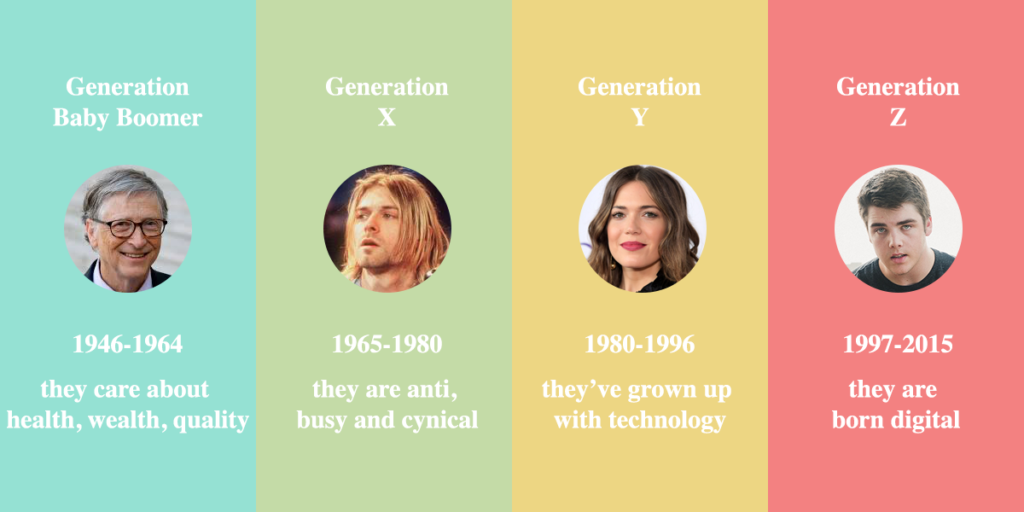
Between every generation exists cultural boundaries, where those born between specific time frames are labeled with distinct characteristics, values, and identities. The period in which a generation is raised shapes the culture and mentality of those generations, influencing how they perceive the world around them. For example, the baby boomers burst onto the scene after the end of World War II, in an era of economic prosperity. This productive age prompted them to become heavily devoted to their work, at times even prioritizing it above their family. As time went on, however, paradigms began to shift. The boomers’ work-heavy emphasis became drowned out by a desire to maintain a healthy work-life balance through social connections. As this mentality began to reign, a medium that increased connectivity and the speed at which information could spread was introduced to the world: the internet. Generation Z, the new kids on the block, has constructed their entire sense of cultural identity around the internet, with the platform completely enveloping the youth raised in a cynical post-9/11 world. Gen Z has utilized the internet and its social capabilities to construct numerous tightly knit communities. The language of the internet is one naturally inscribed within every teenager’s tongues — or rather, thumbs. And there is no better example of this shared language than Gen Z’s obsession with memes.
Look anywhere on popular social media platforms and you won’t scroll for very long without coming across a meme. As time goes on, memes become harder to define, but they are generally recognized as a visual collection often paired with creative captions, aiming to poke fun at a current event or showcase a recently emerged joke from popular culture. Memes transcend cultural boundaries, commentating on sports, referencing celebrities, praising popular songs, or even critiquing other memes. They are simply an extension of human thought and expression in digital format, and their prominence is attributed to the capabilities of their platform: the internet’s ability to rapidly spread information to whoever desires to see. For the internet-oriented Gen Z, memes course through our collective veins, acting as the lifeblood of our unity. The effectiveness of these memes depends solely on one’s knowledge of the popular culture being referenced, which those immersed in societal tech are constantly exposed to. In essence, memes are inside jokes that only the younger generations know the punchlines to. But as we venture outside of our generation, the impact of memes is distorted, shifting from a symbol of unity to one of exclusion, providing a sizable fission between our generation and those before us — those trying to understand.
When the internet was first introduced to the mainstream, baby boomers were in their 30s and 40s, devoted to their jobs in the pursuit of the classic “American Dream.” Thus, this internet was used more as a device for work time productivity than anything else. But as more and more people were born into the age of the internet, the digital plane became ever-increasingly valuable from a societal standpoint. The new generations raised in a tech-dominated world recognized the potential of the internet beyond work, utilizing its connectivity for uses primarily social. It is here where a definitive generational gap is evident — boomers utilized the internet as a device to achieve greater economic benefit, a tool in a strictly business environment. But for Gen Z, the internet is the destination in and of itself, a haven for online societal interactions, and memes are a product of this distinct forum. This discrepancy between generations in regards to how the internet is viewed serves as a wide schism between boomers and memes. This cultural chasm leads to moments such as Hillary Clinton’s infamous call for teens to “Pokémon Go to the Polls!” or boomers’ misinterpretation of “OK, Boomer” as a malicious war cry, with their subsequent retaliation feeding into the very intention of the phrase in the first place. When boomers explore the social dimension of the internet, trying to grasp hold of memes, they become foreigners struggling to decipher a native language. The older generations have had no incentive nor use in venturing into the social side of the web, so obviously they would seem out of place. Their estrangement, however, is only exemplified in their trying to understand memes.
But this is natural, as a generation is only the product of their environment, defined by the relevant topics of their day. Boomers only used the internet for business due to the work-heavy zeitgeist and the limited development and spread of technology at the time, so this ostensibly leads to boomers being knowledgeable about the internet strictly within those professional confines. With the dominance of the internet continuing to overtake society, the world will continue to become faster-paced. Meme culture reflects that topics change within a matter of days, hours even, and only those who are constantly logged on can keep up. In the case of Gen Z, we are enveloped in internet culture — we’re the ones who determine which memes are still fresh and which ones expire. Ironically, the short attention spans that the younger generations are always criticized for is exactly why older generations will never keep up with meme culture.
As our world becomes increasingly fast-paced in nature, the generational gaps grow increasingly wider. Will the time periods generations are confined to remain as lengthy as a decade or two? Perhaps as the haste of our culture remains on an upward trend, generations will gain new definitions, ones that suit the ever-changing topics relevant at that given time. In meme culture, we even divide ourselves amongst graduating years now — Gen Zers, how often do you encounter memes that pit the classes of ‘20, ‘21, and ‘22 against ‘23, ‘24, and ‘25, alluding to shorter spans of generational ties? So at the end of the day, boomers aren’t to blame for being inept in the meme world. They’re simply on the outside of an elaborate inside joke. Further down the line, we’ll be the ones surrounded by a world of comedy completely unrecognizable from our own, and perhaps that time isn’t as far down the line as we would think.
Leave a Reply
You must be logged in to post a comment.