By Vikram Bala ‘20, Editor in Chief

(Screenshots used with consent of senders)
As more and more aspects of our everyday lives have become politicized (e.g. school, sports, music), it has become harder to stay out of political discussion–to the dismay of many who like to avoid arguments and confrontation. However, political discussion can be beneficial by helping us understand the viewpoints of those from different backgrounds–whether social, economic, racial, etc. Many of us have witnessed heated political arguments at Thanksgiving dinner tables, in classroom discussions, or via social media such as Twitter. Nevertheless, productive political discussion, although seemingly rare these days, is feasible and possibly rewarding. Before delving into the topic of political discussion over text, it is important to understand a few principles of what productive political discussion looks like when conducted in person.
Entering a political discussion, it’s important to acknowledge that the other person may not want to change their mind, no matter how nuanced and persuasive your argument is. Trying to change their mind is likely to cause frustration in a discussion, as the goal of changing one’s mind is often unattainable–conversation does not need to come to a resolution or agreement.
Another mistake in political discussion is the separation of viewpoints into “good or evil.” A binary mindset, in which an entrant to a discussion has predetermined that their viewpoint is the only morally just opinion, leads one to immediately discount any opinion that opposes theirs. Listening and empathy are critical tenets of productive discussion; if one cannot understand the other person’s argument–comprehending the factors behind why such a viewpoint manifested and appears justifiable to others–how can they properly respond?
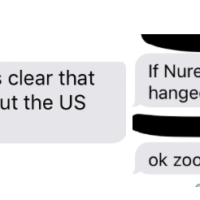
Hitherto, the tenets of productive discussion I have highlighted appear straightforward and are easy to be mindful of when having a conversation. So what is the issue with political discussion over text? Recently, I witnessed a political debate in a group chat (concerning the topic of Iranian General Qasem Solemani’s death by a U.S. drone strike). As the above conversation snippet screenshots (used with the consent of the senders) reveal, the conversation morphed into a more argumentative discussion where participants were intent on changing each other’s minds—in addition to proving that the opposing viewpoint lacked any validity. Eventually, subtle personal jabs snuck into the discussion, and with tensions high, the “debate” only seemed to get less productive. It seemed that the discussion had become a “roasting session,” where some sort of winner was supposed to emerge from the attacks and snide remarks in between political argument. Later that day, I talked to both participants individually, and they both voiced the notion that by having a debate over text, they felt they had been misinterpreted; knowing both participants personally, it was evident that they hadn’t intended for the debate to dissolve into chaos, frustration, and emotional stress. The following question arises: is it possible to have productive political conversation over text?
Social psychologist Malcolm Gladwell outlines what he calls “mismatch theory” in his book, Talking to Strangers. Gladwell discusses an experiment in which pairs of participants were left in a room, inside of which there was a sealed envelope with answers to a question. The two participants in each trial were instructed not to look at the answers in the envelope. After a few minutes in the room, one of the scientists would interview each partner individually, and ask them some questions about whether or not they or their partner looked at the answers. When people were shown videos of these interviews and asked to determine if the participant was lying or not (based on physical appearance, expression, tone of voice, etc), they were wrong much of the time. One girl, despite displaying “telltale” signs of lying, such as twirling hair nervously and acting defensive, was telling the truth; most people who saw the video guessed otherwise.
Essentially, this experiment displays that even when we can see people and have a face to face interaction, we often cannot predict their intentions and emotions correctly—we mismatch what we see/hear with the wrong intentions and emotions. Thus, it is even more likely that we will misunderstand people when conversing over text. Aidan Orr ‘20 explains: “Oftentimes, it is very easy to get emotionally involved and frustrated, as you can’t see whether or not what you are saying is actually registering with the reader; over text, it just seems like they deflect everything.” Oliver Adelson ‘21 adds, “Sometimes something intended to be sarcastic can be interpreted as literal and vice versa.” The ease of misunderstanding over text, coupled with the emotional involvement that politics entails, predisposes discussion to turn into personal attacks, with participants often “giving up” out of frustration—feeling that the other person doesn’t “hear” their argument.
Another issue is the environment of a group chat, rather than a one-on-one setting. Aidan elaborates: “The main issue with political discussions over text, particularly when done in group chats, is that you are much less concerned with maintaining serious conversation–due in part to the fact that you can’t see the faces of the people you are engaging with. Making jokes and witty one-liners at the expense of those you are talking to becomes a lot more common.” The personal connection and sensitivity of many political topics, as well as their complexity, seems to be obscured in group chats.
What does this mean for you? It depends on your intention. If you seek to carry out a nuanced and respectful political conversation over text, it’s best to do it in a one-on-one with someone you know well, to avoid misunderstandings as much as possible and promote uninterrupted “serious” conversation. If you do find yourself in a heated political argument over text in the future, make sure to step back for a moment, and keep in mind that the other participant’s intentions and emotions may be starkly different than you picture.
Leave a Reply
You must be logged in to post a comment.